SEAMO self-study edition 2027; not an official 2027 paper. Original source years are retained. 25 questions, 90 minutes; Q1–10: 3 points, Q11–20: 4 points, Q21–25: 6 points, total 100. Original response types and all subparts are preserved. Verified is an editorial convention; source defects, necessary assumptions and unresolved mathematical uncertainty are disclosed.
$\overline{abc}$ is a three-digit number with no repeated digits. Given that $$\overline{ab}+\overline{ba}+\overline{ac}+\overline{ca}+\overline{bc}+\overline{cb}=\overline{abc},$$ the sum of the digits of $\overline{abc}$ is a multiple of ____. A bar denotes a number formed by the indicated digits.
The source does not ask for the greatest divisor, so more than one answer may fit the blank. Give any positive integer that divides every possible digit sum.
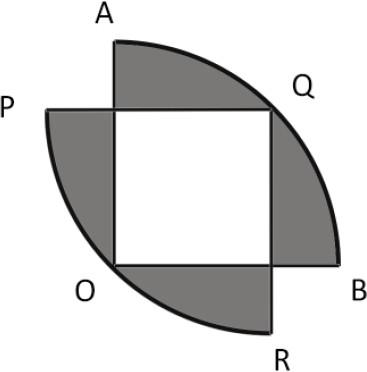
$OAB$ and $QPR$ are two identical quadrants that overlap in a square of area $10\text{ cm}^2$, as shown. Find the shaded area, in $\text{cm}^2$. Take $\pi=3.14$.
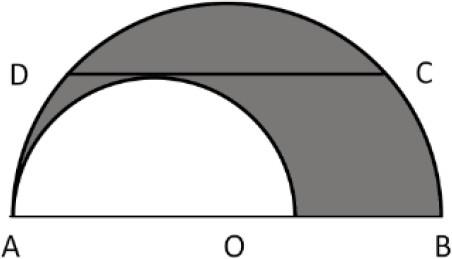
In the diagram, $OC=10$ and $CD=16$. Find the shaded area. Leave your answer in terms of $\pi$.
Use the intended geometric relations shown: O is the centre of the large semicircle; CD is parallel to AB and tangent to the small semicircle. Both diameters lie on AB. These relations are shown pictorially rather than stated in words.
Find the remainder in $$\frac{\overline{abababab}}{\overline{ab}}\times\frac19.$$ Bars denote decimal numbers formed from the indicated digits; $\overline{ab}$ is a two-digit number.
Interpret remainder as the remainder when the integer quotient of the first fraction is divided by 9.
How many ways are there to form a $5\text{ cm}\times3\text{ cm}$ rectangle from squares with side lengths 1 cm, 2 cm and 3 cm?
Counting convention: tile a fixed 5-by-3 rectangle completely, without gaps or overlaps, on its unit grid. Any nonnegative number of each square size may be used. Different tile positions count separately, including reflected arrangements. The source gives no such convention and its short key conflicts with this interpretation.
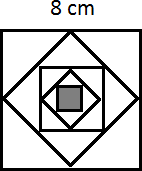
The figure consists of nested squares. The vertices of each inner square are the midpoints of the sides of the immediately surrounding square. The largest square has side 8 cm. Find the shaded area, in $\text{cm}^2$.
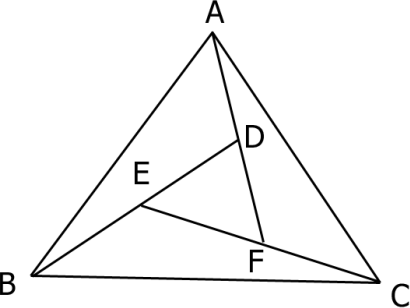
In triangle $ABC$, D, E and F are the midpoints of $AF$, $BD$ and $CE$, respectively, as shown. Given that triangle $DEF$ has area $12\text{ cm}^2$, find the area of triangle $ABC$, in $\text{cm}^2$.
After Wattana spent 35 dollars on a wallet, his money and James’s money were in the ratio 3:4. Wattana then received 220 dollars and James spent 50 dollars. In the end, Wattana had twice as much money as James. How many dollars did Wattana have at first?
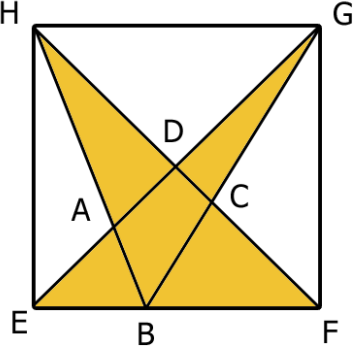
Square $EFGH$ has side 10 cm. B lies on EF. In the diagram A is the intersection of HB and EG, D the intersection of EG and HF, and C the intersection of BG and HF. The quadrilateral $ABCD$ has area $6\text{ cm}^2$. Find the shaded area, in $\text{cm}^2$.
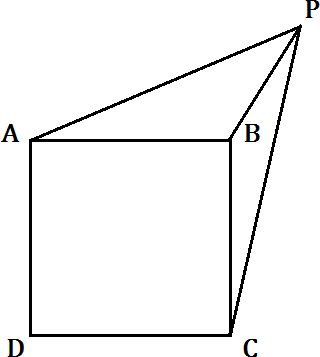
In the diagram, $ABCD$ is a square and $BP=10\text{ cm}$. Triangles $APB$ and $BPC$ have areas $60\text{ cm}^2$ and $30\text{ cm}^2$, respectively. Find the area of square $ABCD$, in $\text{cm}^2$.
In 2018, Lucas invested 1000 dollars for two years. At the end of the first year his investment had lost 18%. In the second year it gained 25% on the remaining amount. What was the percentage change over the two years?
A pasture grows at a constant rate each week. 27 oxen eat all its grass in 6 weeks, while 23 oxen eat all its grass in 9 weeks. How many weeks would 21 oxen take to eat all the grass?
Model assumptions: each ox eats at the same constant rate; each scenario begins with the same initial grass; weekly growth is the same in every scenario.
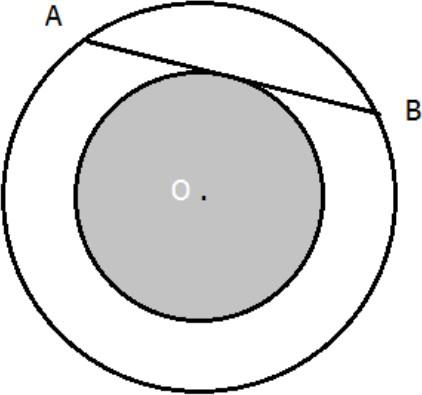
The diagram shows two circles with the same centre O. Chord AB of the outer circle is 14 cm long and tangent to the shaded inner circle. Find the non-shaded area, in $\text{cm}^2$. Take $\pi=22/7$.