SEAMO self-study edition 2027; not an official 2027 paper. Original source years are retained. 25 questions, 90 minutes; Q1–10: 3 points, Q11–20: 4 points, Q21–25: 6 points, total 100. Original response types and all subparts are preserved. Verified is an editorial convention; source defects, necessary assumptions and unresolved mathematical uncertainty are disclosed.
It is known that $x$ and $y$ are both integers. Given that $100x+y=2xy$, find the smallest possible sum of $x$ and $y$.
Domain note: the source says integers, not positive integers. Use all integers, including zero and negative integers. Its answer key uses a different implicit domain; the solution explains the discrepancy.
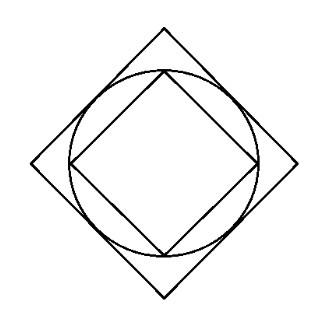
The diagram shows a circle whose circumference touches the sides of a large square and the vertices of a small square. The small square has area $9\text{ cm}^2$ and the large square has area $x\text{ cm}^2$. Find $x$.
Find the 2025th digit in the string formed by writing the positive integers in order: $1\ 2\ 3\ 4\ 5\ 6\ 7\ 8\ 9\ 10\ 11\ 12\ldots$. Spaces are separators and are not counted.
The first term of a sequence is 8. From the second term onward: if the previous term is odd, subtract 1 and then multiply by 3; if it is even, divide it by 2 and then add 2. Find the 100th term.
A car leaves Town A for Town B at the same time as a van leaves Town B for Town A. Their speeds are in the ratio $3:2$. They continue after meeting, each makes a U-turn on reaching its destination, and they meet again 30 km from their first meeting point. How far apart are the towns?
Use the usual journey model: both speeds stay constant and the U-turns take no time.
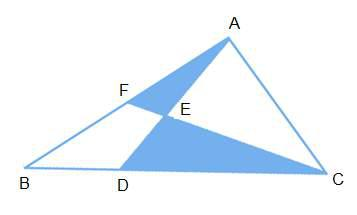
In triangle $ABC$, $D$ lies on $BC$, $CD=3BD$, and $E$ is the midpoint of $AD$. The line $CE$ meets $AB$ at $F$, as shown. Given that triangle $ABC$ has area $14\text{ cm}^2$, find the total area of the shaded regions $AFE$ and $DEC$, in $\text{cm}^2$.
The product $745\times32\times20\times n$ ends with five consecutive zeroes. Find the smallest possible value of $n$.
Domain clarification: take n to be a positive integer, as intended by this trailing-zero exercise. The source does not explicitly state that restriction.
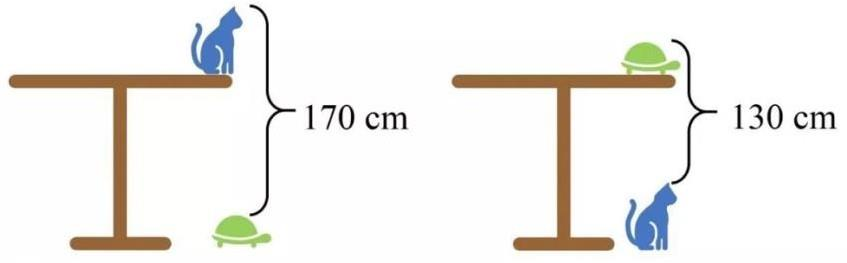
A cat and a turtle are near a table, as shown. When the cat is on the table and the turtle is on the floor, the vertical distance between their tops is 170 cm. When their positions are exchanged, that distance is 130 cm. How tall is the table, in centimetres?
What is the maximum number of distinct numbers that can be selected from $1,2,3,\ldots,49,50$ such that the sum of any two selected numbers is not divisible by 7?
Ming has 424 wooden and plastic dominoes in total. He gives his cousin 40% of the wooden dominoes and $5/6$ of the plastic dominoes. Then he buys 28 plastic dominoes. The number of plastic dominoes he now has is $16\frac23\%$ of the number of wooden dominoes left. How many plastic dominoes did he have at first?
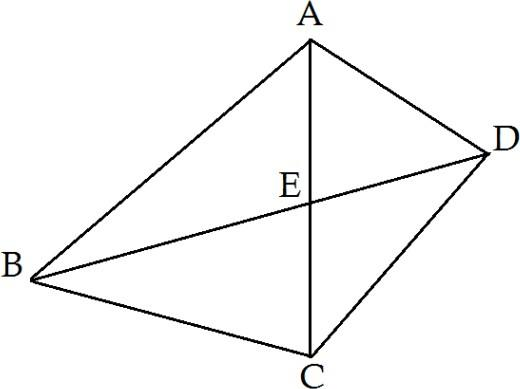
In quadrilateral $ABCD$, diagonals $AC$ and $BD$ intersect at $E$. The areas of triangles $ABE$, $AED$ and $CED$ are $64\text{ cm}^2$, $32\text{ cm}^2$ and $35\text{ cm}^2$, respectively. Find the area of quadrilateral $ABCD$, in $\text{cm}^2$.
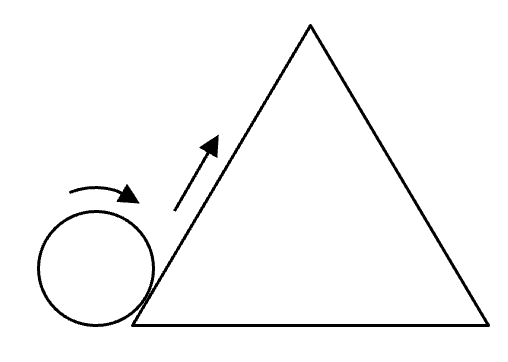
A circular roller rolls around the outside of an equilateral triangle without slipping, as shown. Its circumference equals the side length of the triangle. How many full turns does the roller make in one complete trip back to its starting position?
Four numbers $A,B,C,D$ are written in a row. The average of A and B is 70, the average of B and C is 23, and the average of C and D is 8. Find the average of A and D.
Source-key note: the printed short key conflicts with the stated averages. Solve using the averages as printed; the solution explains the discrepancy.