SEAMO self-study edition 2027; not an official 2027 paper. Original source years are retained. 25 questions, 90 minutes; Q1–10: 3 points, Q11–20: 4 points, Q21–25: 6 points, total 100. Original response types and all subparts are preserved. Verified is an editorial convention; source defects, necessary assumptions and unresolved mathematical uncertainty are disclosed.
A 2020-digit number begins $123456789101112\cdots$. Find the remainder when it is divided by 9.
Editorial clarification: concatenate the positive integers 1, 2, 3, ... in order and stop after exactly 2020 digits, even if the final integer is incomplete.
Dr Soe was driving from Yangon to Mandalay. If he drove at 90 km/h, he would arrive at 2:00 pm. If he drove at 105 km/h, he would arrive at 1:00 pm. Find the distance between the two cities, in km.
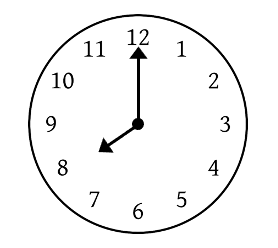
The time is now 8:00 PM. At the earliest, it will take $A\dfrac BC$ minutes for the hour and minute hands to be equidistant from the number 8. Find $A\div B+C$.
Editorial convention: “equidistant” means equal smaller angular distances from the direction of 8, not distances from the unequal hand tips. Write the time as a mixed number with a positive proper fraction B/C in lowest terms. The source does not state these conventions explicitly.
Archie, Beatrice and Carlos walked up an upward escalator in 12, 10 and 6 steps respectively. Archie then ran down the escalator twice as fast as he walked up, taking 30 steps to reach the bottom. If the ratio of the time taken by Beatrice to that of Carlos to ascend the escalator is $m:n$, find $m+n$.
Editorial assumptions: each counted step covers one escalator tread; all walking/running speeds are relative to the escalator; the escalator speed is constant. Use positive coprime integers m and n. Without a lowest-terms convention, m+n is not unique.
A car and a motorcycle travelled from Town A to Town C, passing through Town B. The motorcycle travelled at 80% of the car’s speed, left Town A 11 minutes earlier, and stopped for 7 minutes in Town B. The car did not stop and reached Town C 4 minutes before the motorcycle. The distances AB and BC are equal. How many minutes did it take for the car to catch up to the motorcycle?
Measure the catch-up time from the car’s departure from A. The source does not explicitly identify the starting instant for the requested number of minutes.
Group A consists of 16 numbers whose sum is 98. Group B consists of some numbers whose average is 11. The average of all the numbers in both groups is 8. How many numbers are in Group B?
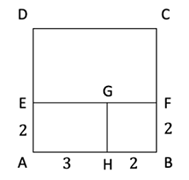
The ratio of the area of AEGH to the area of BFGH is $3:2$. How many times the area of square BFGH is the area of square ABCD? Use the labels in the figure.