Find the positive difference between the sum of all possible integers $x$ and the sum of all possible integers $y$ satisfying $x^y=81$.
**Convention used by the source solution and by this exercise:** List every integer solution pair $(x,y)$ once, and add its first and second coordinates separately. Thus a repeated coordinate is counted once for each pair in which it occurs.
How many different sums can be obtained by adding two different integers chosen from $\{-102,-101,-100,\ldots,86,87,88\}$? Count distinct sum values, not pairs.
Suppose the product $\frac{98}{100}\times\frac{97}{99}\times\frac{96}{98}\times\cdots\times\frac35\times\frac24\times\frac13$ is $\frac ab$ in simplest form, with positive integers $a,b$. Find $a+b-4000$.
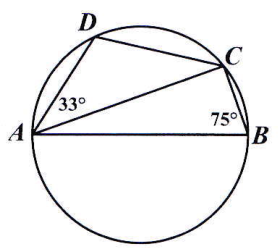
In the figure, $AB$ is a diameter of the circle, and $C,D$ lie on the same side of it, in the order shown. If $\angle ABC=75^\circ$ and $\angle DAC=33^\circ$, find $\angle DCA$ in degrees.
Define $n!=n\times(n-1)\times\cdots\times2\times1$. For example, $4!=4\times3\times2\times1=24$ and $3!=3\times2\times1=6$. Simplify
$$\frac{41!+40!}{3\times39!+2\times39!+39!}.$$
Choose one option.
How many numbers in the list $\frac11,\frac12,\frac13,\ldots,\frac1{98},\frac1{99},\frac1{100}$ have a terminating decimal expansion? Integers count as terminating decimals.
Three cubes of volumes $8\text{ cm}^3$, $27\text{ cm}^3$ and $64\text{ cm}^3$ are glued together. What is the least possible surface area of the resulting solid, in $\text{cm}^2$?
**Added editorial restriction for this self-study question:** all cube vertices must lie on one common cubic grid with spacing 1 cm, and all cube edges must be parallel to the grid axes. The cubes are not cut, their interiors do not overlap, and planar face contacts may be partial. This grid restriction is not stated in the original question. Enter the number.
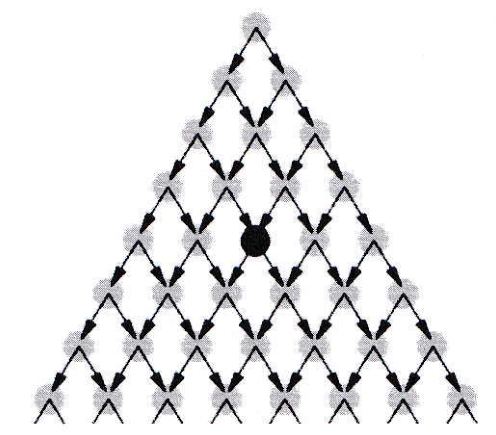
In how many ways can you reach any circle in the 10th row from the top circle if you can only move down-left or down-right and cannot pass through the black circle?
**Diagram convention:** The printed sketch shows only eight rows. Continue the same triangular pattern to row 10, counting the top circle as row 1. The forbidden circle is the middle circle of row 5. Different sequences of moves count as different paths, even if they end at the same circle. Enter the total number of paths as an integer.