Skip to content / Đến nội dung
ThichHocToan.com

SASMO 2027 · Grades 2-3 · SET 019 · Self-study

Question 1

Editorial self-study SET for 2027; not an official SASMO 2027 examination. Known source years remain in individual attributions. Time: 90 minutes. Platform scoring starts at 0: Q1–15 are worth 2 points each; Q16–25 are worth 4 points each; wrong and blank answers score 0; maximum 70. Official SASMO scoring instead starts at 15, deducts 1 for an incorrect Section A answer and has a maximum of 85. Verified means editorially checked; assumptions, source errors and mathematical uncertainty are disclosed where relevant.

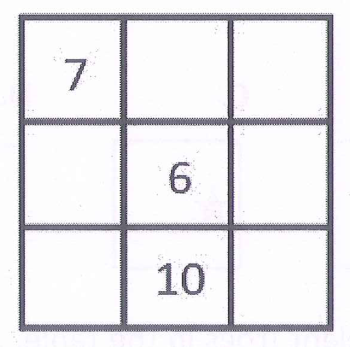
Fill each empty cell so that every row, column and diagonal totals 18. Give the six missing numbers in row order, from left to right, skipping the three printed numbers. Separate them with semicolons.

Question illustration

Question 2

Find the next three missing terms of each sequence.

(a) 1, 5, 9, 13, __, __, __

(b) 2, 3, 6, 11, 18, __, __, __

(c) 1, 3, 9, 27, __, __, __

(d) 1, 2, 3, 5, 8, 13, __, __, __

(e) 1, 1, 1, 1, 4, 7, 13, __, __, __

(f) 0, 77, 7, 71, 14, 65, 21, __, __, __

(g) 1, 2, 3, 5, 5, 8, 7, 11, __, __, __

Explain the rule for every part.

Use the simple source-intended arithmetic or interleaving rules; a finite sequence may admit other continuations. Explain your rule for each part.

Question 3

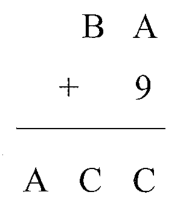
Different letters stand for different digits. In the column addition BA+9=ACC shown, what is C? BA is a two-digit number and ACC is a three-digit number.

Question illustration

Question 4

How many hours are there in two weeks? Select the equivalent expression from the original paper choices.
  1. 7×12
  2. 7×2×12
  3. 2×7×2×12
  4. (7+7)×12
  5. None of the above

Question 5

What is the next number in the sequence 29, 28, 25, 20, 13, …?

Continue the simple pattern intended by the source. A finite list may admit other rules.
  1. 4
  2. 5
  3. 6
  4. 7
  5. None of the above

Question 6

A special operation satisfies 2∗6=26−2−6=18 and 3∗7=37−3−7=27. For non-zero digits a and b, a∗b=36. What is a? Here ab means the two-digit number with tens digit a and units digit b.

Extend the demonstrated rule as a∗b=ab−a−b, with ab a two-digit numeral, not a product.

Question 7

A basket of mangoes weighs 80 grams when full and 60 grams when half full. What does the empty basket weigh, in grams?

Question 8

James and Nina have 22 buttons altogether. Nina has more than James. After Nina gives 4 buttons to James, they have equal numbers. How many buttons did Nina have originally?

Question 9

Some people line up. The source says: “There are 3 people standing in front of 3 people, 3 people standing behind 3 people and 3 people standing between 3 people.” How many people are there?

The final source phrase is ambiguous. For this question, count exactly the two disjoint consecutive groups of three described at the front and back, with no extra people; treat the final phrase as an imprecise repeated description, not an additional condition.
  1. 9
  2. 3
  3. 5
  4. 6
  5. None of the above

Question 10

Mom is 24 years older than Tom. In 5 years, Mom will be 4 times as old as Tom. How old is Mom now?
  1. 27
  2. 28
  3. 29
  4. 30
  5. None of the above

Question 11

Using the digits 1, 2 and 3, form two-digit numbers whose two digits are different. How many such numbers are there?

Use the source solution convention: the two digits within each number must be different.

Question 12

Find the secret number among the numbers in the three shapes. It is not in the square. It is even. It is greater than every number in the triangle.

Question illustration

Question 13

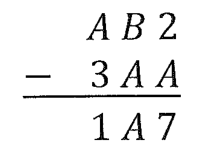
In the subtraction AB2−3AA=1A7 shown, different letters are different digits. Find A+B+B+A.

Question illustration

Question 14

Compute (2017×5+2017×3)÷4.
  1. 2017
  2. 8068
  3. 4034
  4. 6051
  5. None of the above

Question 15

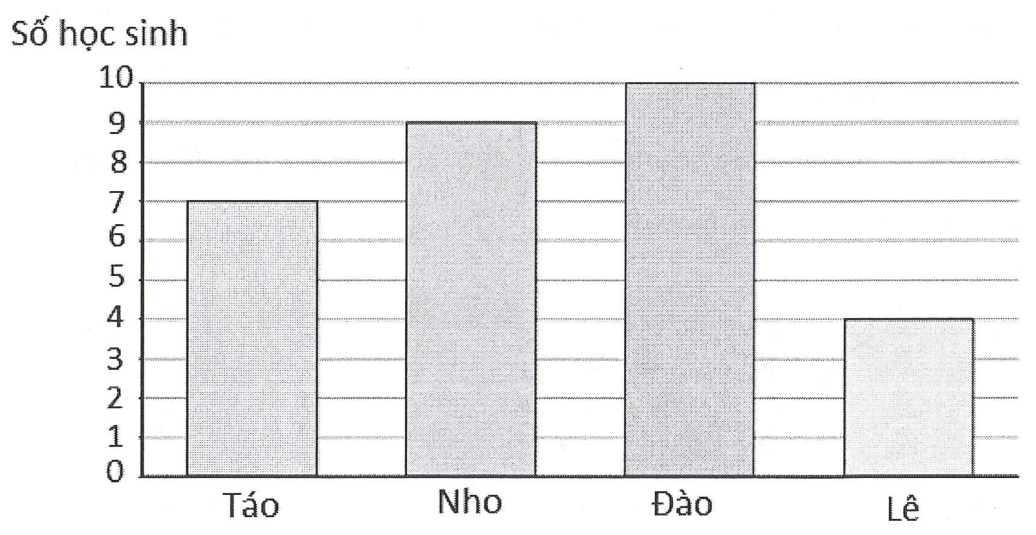
According to the bar chart, which fruit is the most popular? The vertical axis is the number of students. The original labels are Táo=Apple, Nho=Grape, Đào=Peach and Lê=Pear.

Question illustration
  1. Mango
  2. Apple
  3. Pear
  4. Peach
  5. None of the above

Question 16

The sum of a father’s and daughter’s present ages is 60. Eight years ago, the father was three times as old as his daughter. How old is the father now?

Question 17

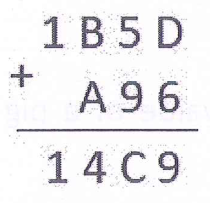
Different letters stand for different digits. In the column addition 1B5D+A96=14C9, find A+B+C+D. A96 is a three-digit number.

Question illustration

Question 18

The original languages give different age problems. Solve both.

(a) English source: Grandfather and Jane’s ages total 66 now. Three years later, Grandfather will be 8 times Jane’s age. How old is Jane now?

(b) Vietnamese source: Grandfather and Jane’s ages total 69 now. Three years ago, Grandfather was 8 times Jane’s age. How old is Jane now?

Enter (a); (b).

The source languages disagree on both the total age and the time direction. Answer the two variants separately; neither is silently corrected.

Question 19

Four gift boxes have different sizes. The red box is bigger than the white box. The yellow box is smaller than the white box. The black box is smaller than the red box but bigger than the yellow box. Which is biggest, and which is smallest? Give biggest; smallest.

Question 20

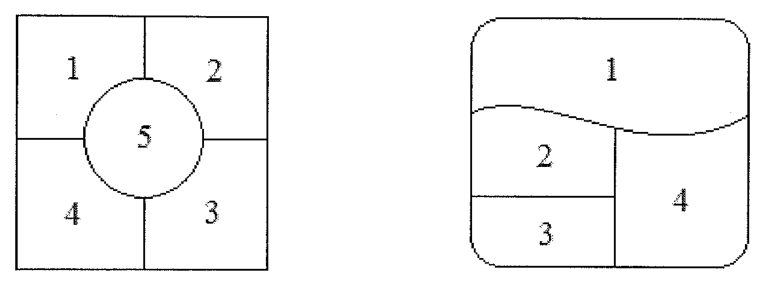
For each of the two maps shown, what is the fewest different colors needed so that no two neighboring regions have the same color? Give left map; right map.

Question illustration

Two regions are neighbors when they share a boundary segment; touching at one point alone does not count.