Editorial self-study SET for 2027; not an official SASMO 2027 examination. Known source years remain in individual attributions. Time: 90 minutes. Platform scoring starts at 0: Q1–15 are worth 2 points each; Q16–25 are worth 4 points each; wrong and blank answers score 0; maximum 70. Official SASMO scoring instead starts at 15, deducts 1 for an incorrect Section A answer and has a maximum of 85. Verified means editorially checked; assumptions, source errors and mathematical uncertainty are disclosed where relevant.
Find the sum $1+2+3+\cdots+98+99+100$. Enter the number only.
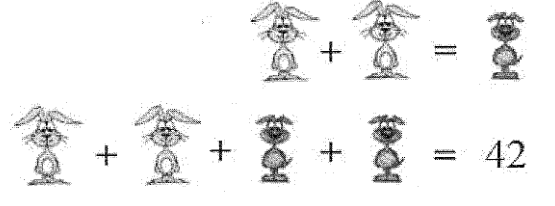
The same dog symbol always represents the same number. Use the two equations in the picture. What number does the dark dog represent? Enter the number only.
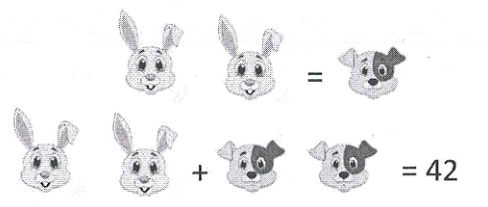
Additional source representation (study_3, PDF 132): two rabbits equal one dog, and two rabbits plus two dogs total 42. Find the dog’s value. In this equivalent picture, each rabbit takes the place of a light dog above, and the dog takes the place of a dark dog. Give the same single numerical answer for both representations.
How many times does the digit 4 occur when all integers from 1 to 100 are written? Count each occurrence, so a number may contribute more than once. Enter the number only.
A square has side length 5 cm. Its side length is doubled. Find (a) the ratio of the new area to the old area; (b) the ratio of the new perimeter to the old perimeter. Enter the two ratios as a;b.
Source wording conflict: the English text asks about area, while the Vietnamese text and worked solution ask about perimeter. This edition asks both, in the order area then perimeter.
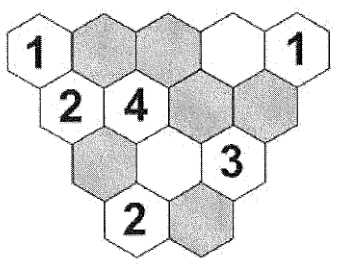
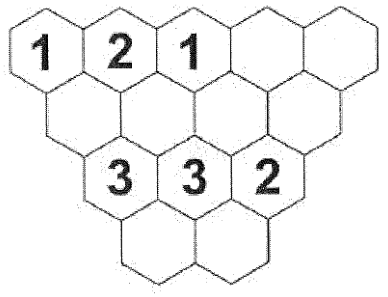
In each hexagonal grid, a number tells how many cells sharing an edge with it are shaded. The first picture is an example. Shade only unnumbered cells in the second grid. What is the minimum number of shaded cells needed? Enter the number only.
Clarification: the original asks for the number of shaded cells without saying “minimum”. Its top-right cell touches no numbered cell, so the rules alone permit an unnecessary extra shaded cell. This edition asks for the minimum, matching the source’s construction.
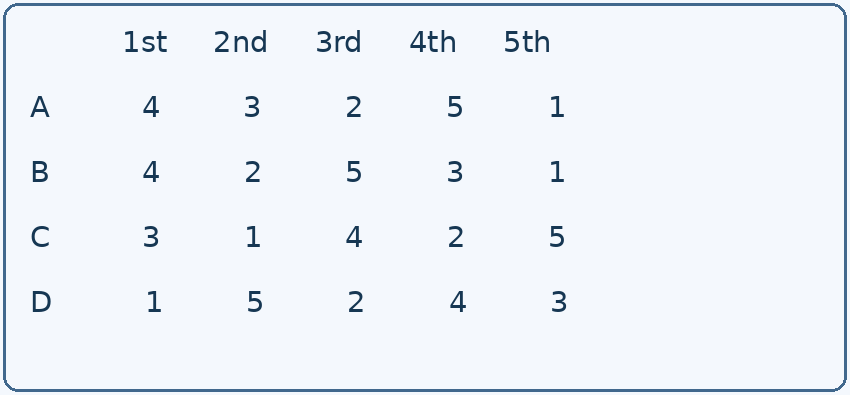
Four teachers predict the finishing order of five classes as shown. Every individual prediction in the table is wrong. There are no ties. In which place does Class 2 finish? The table entries are class numbers. Enter the number only.
An egg takes 6 minutes to boil. What is the least time, in minutes, needed to boil 3 eggs? Enter the number only.
Assume the pot holds all three eggs and each still takes six minutes when boiled together; ignore setup and heating time.
Original choices in study_1 (PDF 37), retained for reference: A. 5 minutes; B. 12 minutes; C. 18 minutes; D. 6 minutes; E. None of the above. This edition keeps a numerical response: enter minutes, not an option letter.
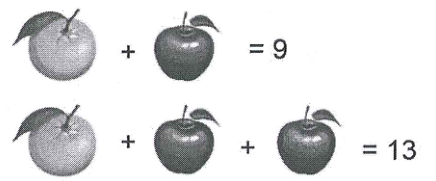
A supermarket sells 6 apples for 36 dollars and 5 pears for 20 dollars. How many dollars more does one apple cost than one pear? Enter the number only.
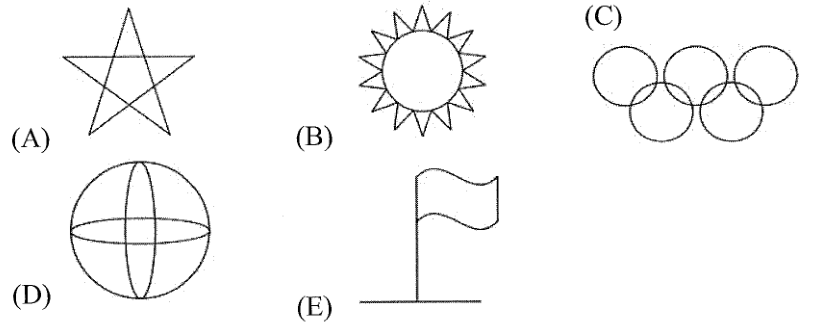
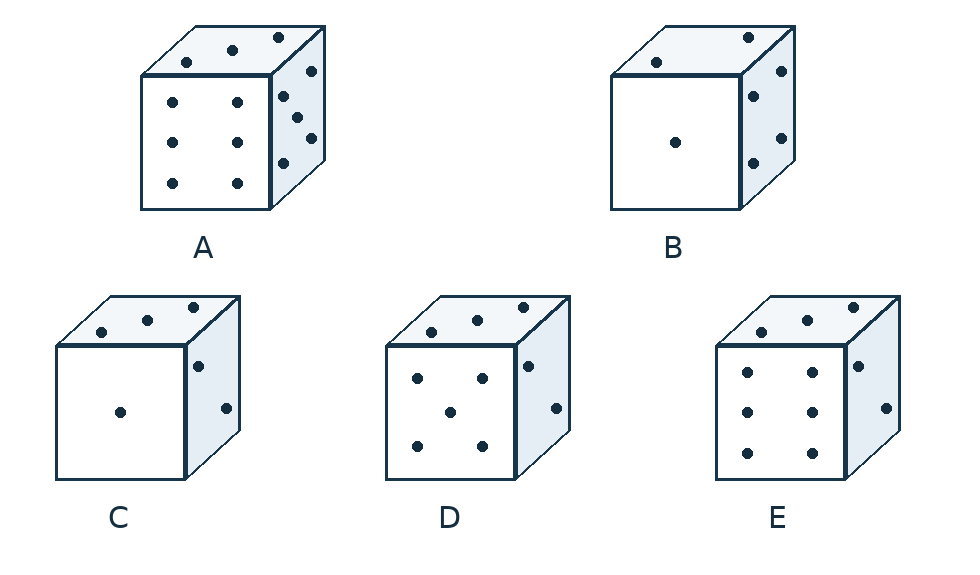
Which of the five figures cannot be traced in one continuous stroke without lifting the pencil or retracing any segment? At an intersection you may change direction. Choose the letter printed beside the figure. Choose one option.
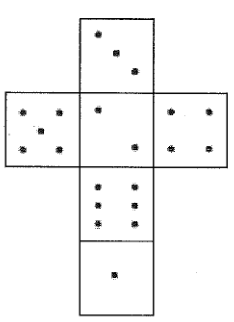
Which cube can be formed by folding the displayed die net? Choose one option.
Editorial correction: the printed source options contain an error. The choices below have been redrawn with one face corrected so that exactly one answer is valid. Fold with the printed dots on the outside; use these corrected choices.
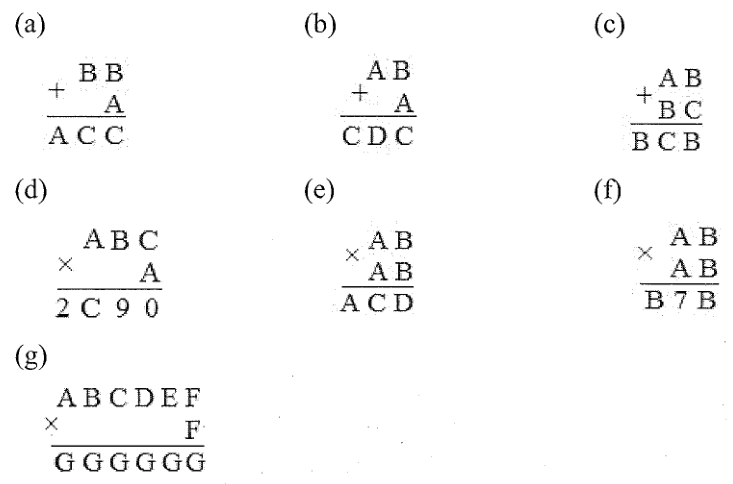
What digit does each letter represent in each of the seven calculations? Adjacent letters form a decimal number.
(a) $BB+A=ACC$
(b) $AB+A=CDC$
(c) $AB+BC=BCB$
(d) $ABC\times A=2C90$
(e) $AB\times AB=ACD$
(f) $AB\times AB=B7B$
(g) $ABCDEF\times F=GGGGGG$
Give the letter values and explain your reasoning for all parts; in (e), give both solutions. This is a written-response question.
Use the standard letter-digit convention separately in each part: equal letters mean equal digits, different letters mean different digits, and a leading digit is not zero. These conventions are implicit rather than stated in the source.
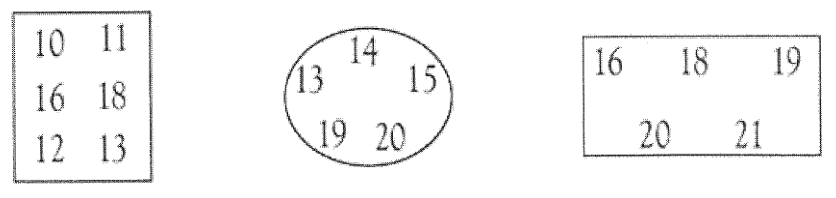
Use the picture to find the secret number. It appears in both the square and the rectangle. It is greater than 10 and less than 17. Enter the number only.
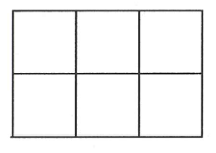
The rectangle in the picture is made of 6 equal small squares. Its perimeter is 30 cm. What is the perimeter, in centimetres, of one small square? Enter the number only.