Menkara has a $4 \times 6$ index card. If she shortens the length of one side of this card by $1$ inch, the card would have area $18$ square inches. What would the area of the card be in square inches if instead she shortens the length of the other side by $1$ inch?
Mr. Lopez has a choice of two routes to get to work. Route A is $6$ miles long, and his average speed along this route is $30$ miles per hour. Route B is $5$ miles long, and his average speed along this route is $40$ miles per hour, except for a $\tfrac{1}{2}$-mile stretch in a school zone where his average speed is $20$ miles per hour. By how many minutes is Route B quicker than Route A?
The six-digit number $\underline{2}\,\underline{0}\,\underline{2}\,\underline{1}\,\underline{0}\,\underline{A}$ is prime for only one digit $A.$ What is $A?$
Elmer the emu takes $44$ equal strides to walk between consecutive telephone poles on a rural road. Oscar the ostrich can cover the same distance in $12$ equal leaps. The telephone poles are evenly spaced, and the $41$st pole along this road is exactly one mile ($5280$ feet) from the first pole. How much longer, in feet, is Oscar’s leap than Elmer’s stride?
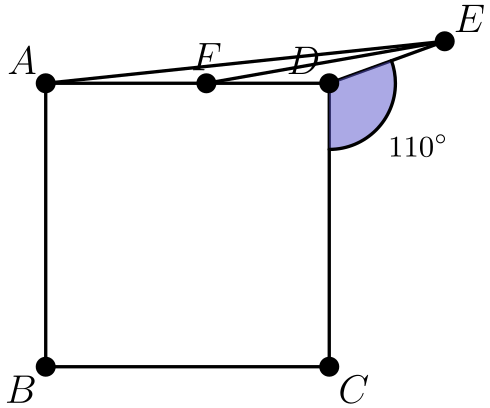
As shown in the figure below, point $E$ lies on the opposite half-plane determined by line $CD$ from point $A$ so that $\angle CDE = 110^\circ.$ Point $F$ lies on $\overline{AD}$ so that $DE = DF,$ and $ABCD$ is a square. What is the degree measure of $\angle AFE?$
A school has $100$ students and $5$ teachers. In the first period, each student is taking one class, and each teacher is teaching one class. The enrollments in the classes are $50,$ $20,$ $20,$ $5,$ and $5.$ Let $t$ be the average value obtained if a teacher is picked at random and the number of students in their class is noted. Let $s$ be the average value obtained if a student was picked at random and the number of students in their class, including the student, is noted. What is $t - s?$
Let $M$ be the least common multiple of all the integers $10$ through $30,$ inclusive. Let $N$ be the least common multiple of $M,$ $32,$ $33,$ $34,$ $35,$ $36,$ $37,$ $38,$ $39,$ and $40.$ What is the value of $\dfrac{N}{M}?$
Consider two concentric circles of radius $17$ and $19.$ The larger circle has a chord, half of which lies inside the smaller circle. What is the length of the chord in the larger circle?
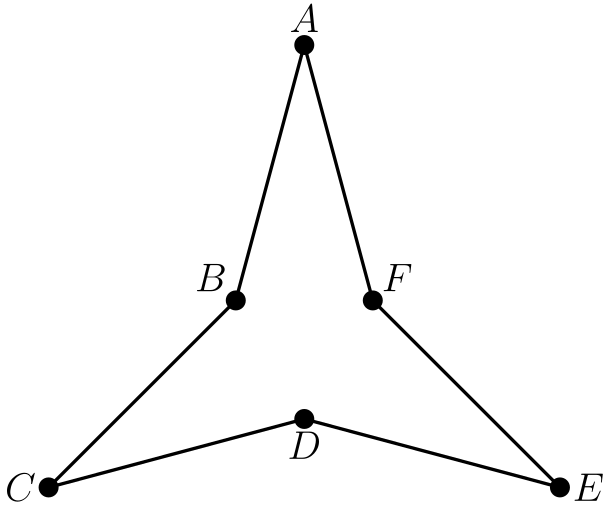
In the figure, equilateral hexagon $ABCDEF$ has three nonadjacent acute interior angles that each measure $30^\circ.$ The enclosed area of the hexagon is $6\sqrt{3}.$ What is the perimeter of the hexagon?
Recall that the conjugate of the complex number $w = a + bi,$ where $a$ and $b$ are real numbers and $i = \sqrt{-1},$ is the complex number $\overline{w} = a - bi.$ For any complex number $z,$ let $f(z) = 4i\overline{z}.$ The polynomial $$
P(z) = z^4 + 4z^3 + 3z^2 + 2z + 1
$$ has four complex roots: $z_1,$ $z_2,$ $z_3,$ and $z_4.$ Let $$
\begin{aligned} &Q(z) = z^4 + Az^3 + Bz^2 \\ &\quad {}+ Cz + D \end{aligned}
$$ be the polynomial whose roots are $f(z_1),$ $f(z_2),$ $f(z_3),$ and $f(z_4),$ where the coefficients $A,$ $B,$ $C,$ and $D$ are complex numbers. What is $B + D?$
An organization has $30$ employees, $20$ of whom have a brand A computer while the other $10$ have a brand B computer. For security, the computers can only be connected to each other and only by cables. The cables can only connect a brand A computer to a brand B computer. Employees can communicate with each other if their computers are directly connected by a cable or by relaying messages through a series of connected computers. Initially, no computer is connected to any other. A technician arbitrarily selects one computer of each brand and installs a cable between them, provided there is not already a cable between that pair. The technician stops once every employee can communicate with each other. What is the maximum possible number of cables used?
Each of $20$ balls is tossed independently and at random into one of $5$ bins. Let $p$ be the probability that some bin ends up with $3$ balls, another with $5$ balls, and the other three with $4$ balls each. Let $q$ be the probability that every bin ends up with $4$ balls. What is $\dfrac{p}{q}?$
Let $x$ be the least real number greater than $1$ such that $\sin(x) = \sin(x^2),$ where the arguments are in degrees. What is $x$ rounded up to the closest integer?
For each positive integer $n,$ let $f_1(n)$ be twice the number of positive integer divisors of $n,$ and for $j \ge 2,$ let $f_j(n) = f_1(f_{j-1}(n)).$ For how many values of $n \le 50$ is $f_{50}(n) = 12?$