Scoring for this platform: initial 0; Q1–15 correct +2, Q16–25 correct +4; wrong or blank 0; maximum 70. Official SASMO rules (reference only): initial 15; Section A correct +2, wrong −1, blank 0; Section B correct +4, wrong or blank 0; maximum 85.
Find the value of $2020\times999-9999\times202+9999$.
Each of six countries brought a team of 5 players to a tennis tournament. Each pair of players from different countries played once. How many games were there?
A “Nicely Seven” is a two-digit positive integer with exactly two positive factors, whose factors have a sum divisible by 7. How many Nicely Seven numbers are there?
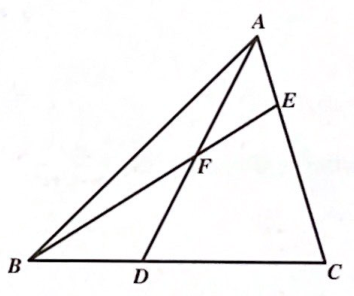
In the diagram, $E$ lies on $AC$ and $D$ lies on $BC$, with $AE=\frac13AC$ and $BD=\frac13BC$. The lines $AD$ and $BE$ intersect at $F$. Find the ratio of the area of triangle $AEF$ to that of triangle $ABC$.
Dennis wrote all 3-digit numbers in increasing order. He used red ink for even numbers and blue ink for odd numbers. How many red digits 6 are on the paper?
Interpretation: Check that the original real-number conditions are consistent. If no real triple exists, use E (“None of the above”); do not assign a value merely from formal manipulation.
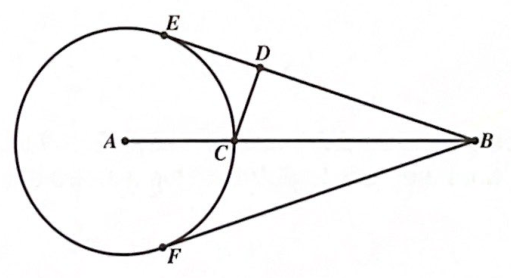
The circle is centred at $A$. Segments $BE,BF$ are tangents. Point $C$ lies on $AB$ and the circle, as shown. Point $D$ is on $BE$ with $CD\perp BE$. If $BE=12$ and $BC=8$, find $CD$.
Diana, Alexa, Jason, Tom and Michael are Secondary 2 or Secondary 4 students at either Silver Oak Secondary School or Grand Mountain Secondary School. It is given that:
- Tom and Michael attend different schools.
- Diana and Jason attend the same school.
- Three attend Silver Oak and two attend Grand Mountain.
- Alexa and Michael are in the same grade.
- Jason and Tom are in different grades.
- Three are in Secondary 2 and two in Secondary 4.
If one of them is a Secondary 4 student at Grand Mountain, who is that person?
Find the value of $\frac{3\times111.111}{6\times1.001}+\frac{3\times222.222}{6\times2.002}+\frac{3\times333.333}{6\times3.003}+\cdots+\frac{3\times666.666}{6\times6.006}$.
Interpretation: The dots within 111.111, 1.001, etc. are decimal points. The ellipsis means the six terms k=1 through k=6.
Answer format: enter the integer answer without units. Leading zeros are optional; the original paper uses four-digit boxes.