Scoring for this entire paper: on this platform, start at 0; Q1–15 earn 2 points each and Q16–25 earn 4 points each. Incorrect or blank answers earn 0; maximum 70. Official SASMO rules: start with 15 points; Section A (Q1–15) awards +2/−1/0 for correct/incorrect/blank, and Section B (Q16–25) awards +4/0/0; maximum 85.
Define $n\mathbin{\Delta}m=(n-1)(n-2)\cdots(n-m)$. For example, $5\mathbin{\Delta}3=4\times3\times2$. If $8\mathbin{\Delta}x=840$, find $x\mathbin{\Delta}(x-3)$. Interpret the operator for positive integers with the displayed number of factors.
The value of $\dfrac{2022^3-2\times2022^2-2020}{2021^3+2\times2021^2-2023}$ is $\dfrac ab$, where $\operatorname{HCF}(a,b)=1$. Find $a+b$. Take $a,b$ to be positive integers.
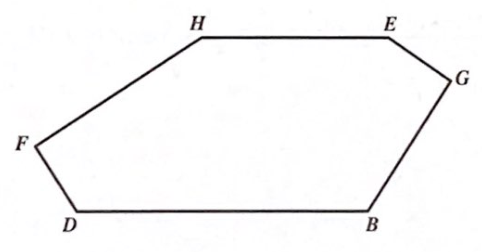
In the figure, $HE\parallel DB$, $GE\perp BG$, and $DF\perp HF$. If $\angle H=138^\circ$ and $\angle B$ is $4^\circ$ greater than $\angle D$, find $\angle E$.
Boris writes five-digit numbers using all the digits 1, 2, 3, 4 and 5 exactly once. The even digits must occur in increasing order from left to right, for example 32145 and 25341. How many numbers can he write?
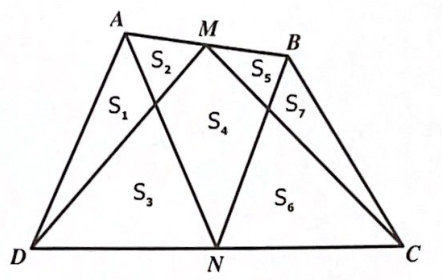
In quadrilateral $ABCD$, $M,N$ are midpoints of $AB,DC$, respectively. Segments $AN,BN,DM,CM$ divide it into seven regions of different areas $S_1,S_2,\ldots,S_7$ as shown. Which relationship is true?
Ellie, Violet, Audrey, Tom and Chris are Secondary 1 or Secondary 3 students at either Greenwich Secondary School or Westwood Secondary School.
- Tom and Chris attend different schools.
- Ellie and Audrey attend the same school.
- Three students attend Greenwich and two attend Westwood.
- Violet and Chris are in the same grade.
- Audrey and Tom are in different grades.
- Three students are in Secondary 1 and two in Secondary 3.
If one of them is a Secondary 3 student at Westwood, who is that person?
The factorial $n!=n(n-1)\cdots1$ is the product of the first $n$ positive integers; for example, $2!=2\times1$ and $7!=7\times6\times5\times4\times3\times2\times1$. How many integers from 1 to 40 cannot be the number of consecutive zeros at the end of $n!$, for any positive integer $n$?
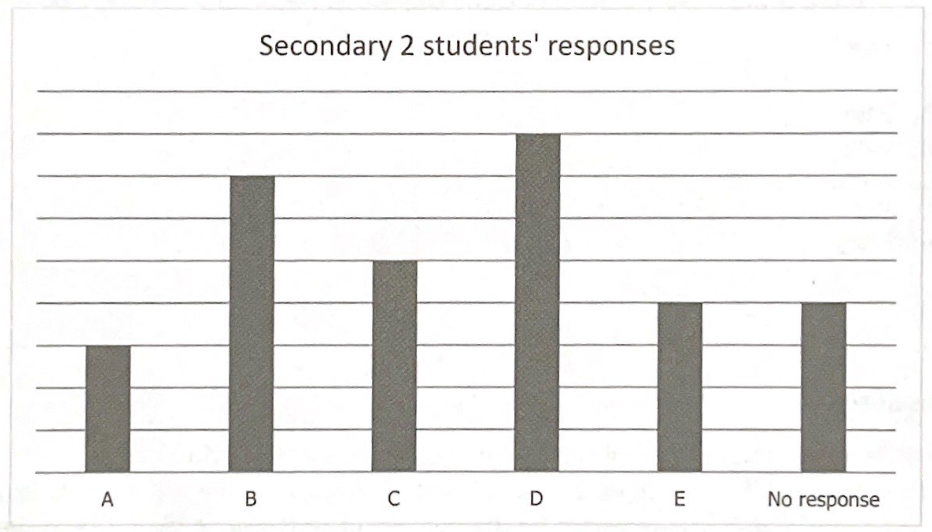
The bar chart shows the responses of all Secondary 2 students at Integrity Secondary School to a multiple-choice question. All horizontal lines are equally spaced. A correct answer earns 2 points, no response earns 0, and a wrong answer earns −1. The total score is −240. If B is correct, how many students answered correctly?
The scoring described here is part of this word problem. Chart labels: “No response” means no answer.
Answer format: enter one whole number without units; leading zeros are optional. The source answer sheet uses four digits (for example, 7 is shaded as 0007).
Answer format: enter one whole number without units; leading zeros are optional. The source answer sheet uses four digits (for example, 7 is shaded as 0007).
Chloe and her cousin left home for the cinema at 11:40 a.m. Chloe walked at 100 metres per minute and her cousin at 60 metres per minute. Ten minutes after reaching the cinema, Chloe realized she had forgotten her wallet and walked back home. At 12:10 p.m., she met her cousin, who was still on the way to the cinema. How far, in metres, is Chloe’s home from the cinema? Assume they use the same route and Chloe keeps her stated speed on the return trip.
Answer format: enter one whole number without units; leading zeros are optional. The source answer sheet uses four digits (for example, 7 is shaded as 0007).
Find the sum of all positive integers $n$ for which $n^2+11n+52$ is a perfect square.
Answer format: enter one whole number without units; leading zeros are optional. The source answer sheet uses four digits (for example, 7 is shaded as 0007).
The six-digit number $\overline{7A34B4}$ is divisible by 36. If digit $B$ is prime, find digit $A$.
Answer format: enter one whole number without units; leading zeros are optional. The source answer sheet uses four digits (for example, 7 is shaded as 0007).