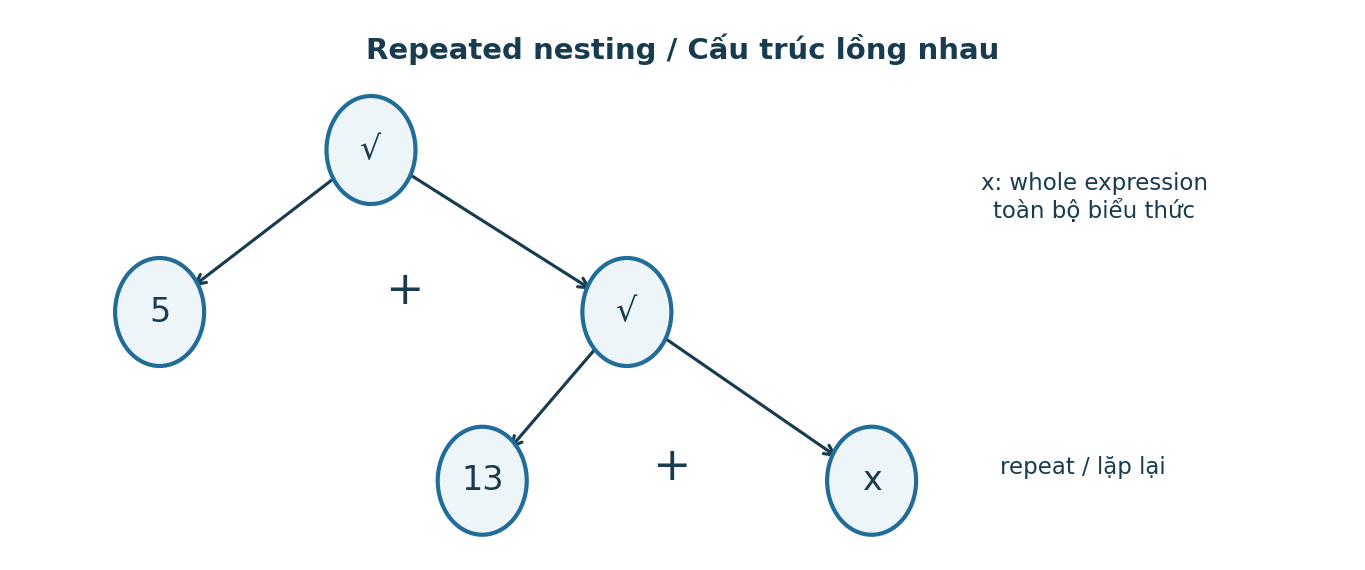
Find the value of a positive integer $x$. $$x=\sqrt{5+\sqrt{13+\sqrt{5+\sqrt{13+\cdots}}}}.$$ The radical continues with alternating 5 and 13, using nonnegative square roots.
A tangential quadrilateral $ABCD$ is a convex quadrilateral whose sides are tangent to a circle. Given that $AD=16$, $BC=8$ and the radius of the circle is 4, find the area of the quadrilateral.
What is the total number of different ways that the blanks below can be filled in so that the resulting four-digit number is a multiple of 11? $$9\ \square\ 5\ \square.$$ Each blank holds one digit; the two digits need not be different.
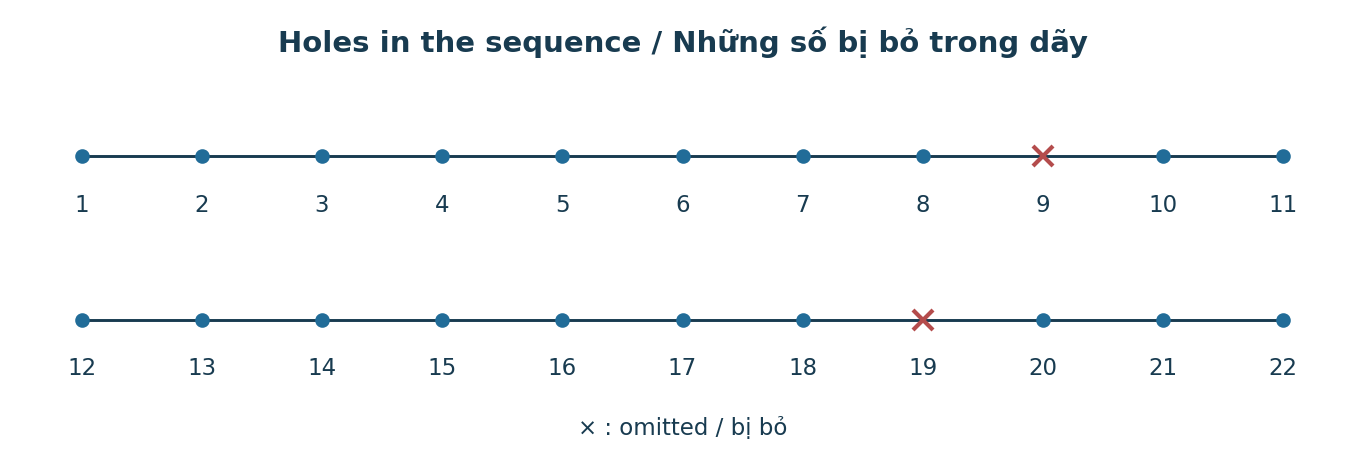
The sequence $1,2,3,\ldots,7,8,10,\ldots$ consists of all positive integers except integers which contain the digit 9. What is the $300$th term in the sequence?
Six boys of differing heights are arranged in 2 rows of 3 each. Each boy is taller than the boys in front of him and also taller than the boys to his left. How many arrangements for the six boys are possible?
Interpretation used in the source: height increases from front to back in each column, and from left to right in each row.
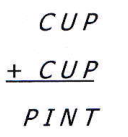
Different letters stand for different digits in the cryptarithm shown. Find the last three digits of the least possible value of $PINT$. Assume both $P$ and $C$ are not 0. Preserve any leading zero among the last three digits.
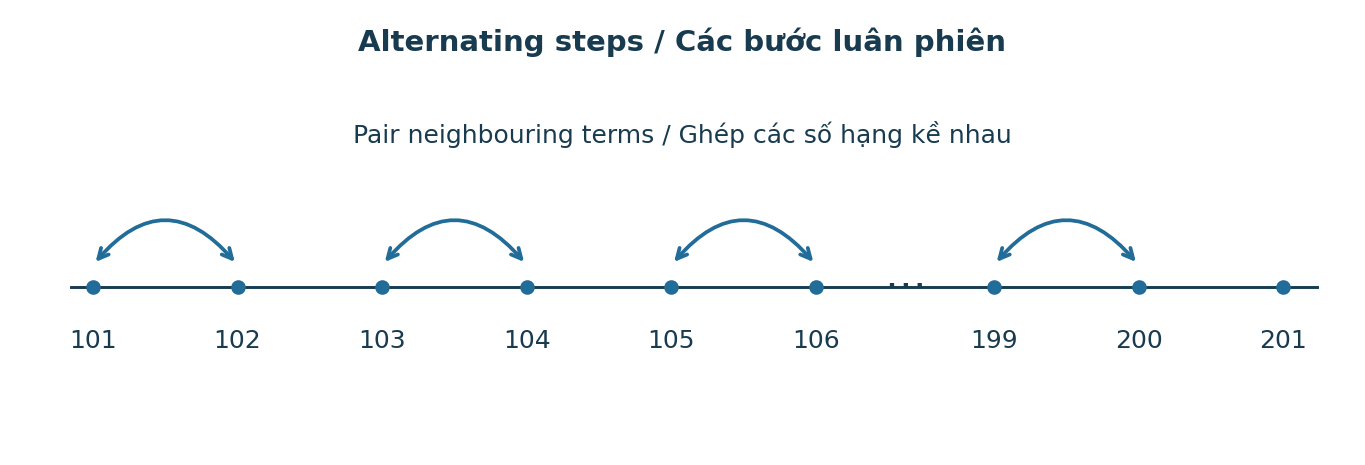
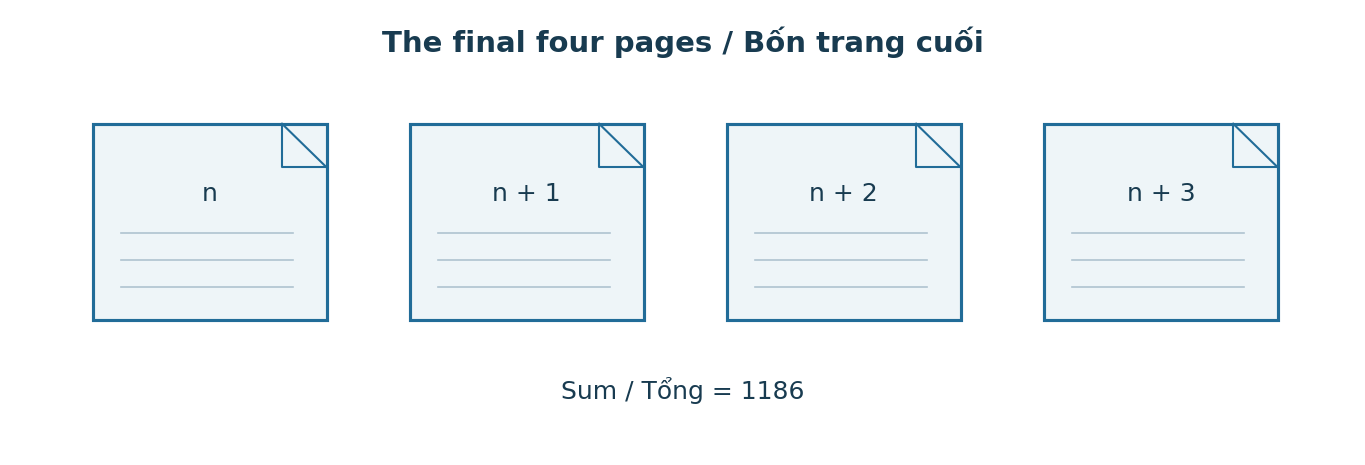
If the sum of the last 4 pages in a puzzle book is 1186, find the first page number among these last 4 pages. Here the sum means the sum of their four consecutive page numbers.
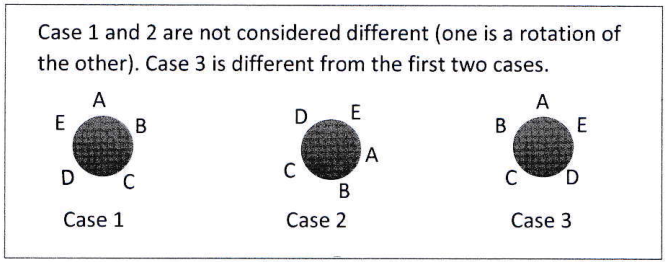
Mr and Mrs Hansen and their three children are to be seated at a circular table. Let $m/n$ be the probability that children A and B are seated next to one another. If $\operatorname{HCF}(m,n)=1$, find the value of $m+n$. Rotations are considered the same arrangement, but reflections can be different, as in the source figure. Assume all circular arrangements are equally likely.
The points $(0,1)$ and $(1,2)$ are the coordinates of the adjacent corners of a square. Find the sum of the $y$-coordinates of the points diagonally opposite to $(0,1)$ in a square.
Clarification of the source wording: consider both possible squares on this common side, one on each side of the segment, and add the two resulting $y$-coordinates.
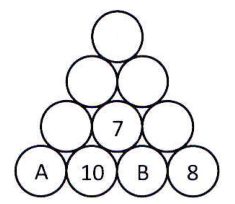
The integers from 1 through 10 inclusive are placed in the 10 circles shown, with one integer in each circle. Each number in the upper 3 rows is the positive difference between the numbers in the 2 circles immediately below it. Find the sum of A and B. Each integer is used exactly once.