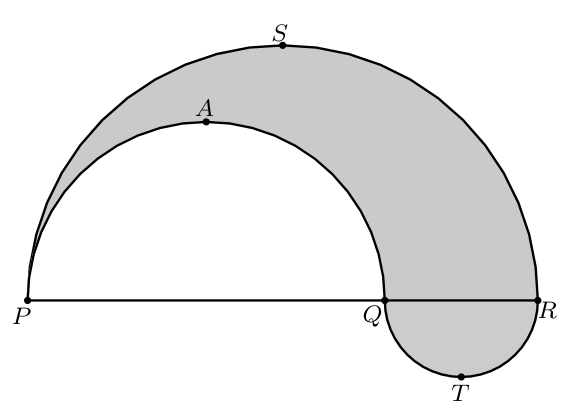
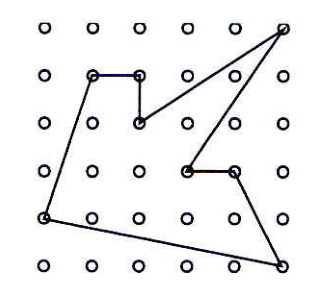
In the figure below, $PSR$, $RTQ$ and $PAQ$ are three semicircles of diameters 10cm, 3cm and 7cm respectively. Given that the area of the shaded region is $k\pi$. Find $k$.
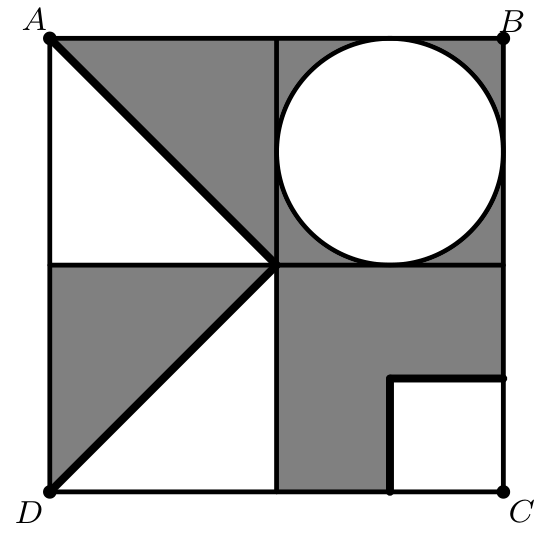
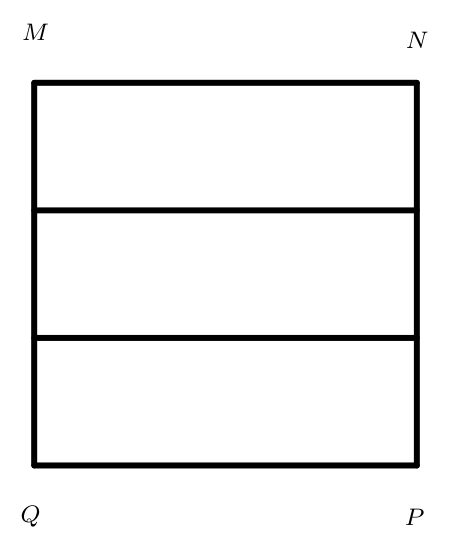
Square $ABCD$, shown here, has side length 8 units and is divided into four congruent squares. One of these squares contains an inscribed circle, two other squares contain diagonals and the fourth square has perpendicular line segments drawn from the midpoints of adjacent sides to form a square in the interior. In square units, what is the total area of the shaded regions? Take $\pi=22/7$.
Use the standard factorial definition $n!=n(n-1)\cdots2\cdot1$. Simplify
$$\frac{20!+21!}{2\times19!+4\times19!+16\times19!}.$$
Source clarification: the printed definition is $n!=n\times(n-1)!\times\cdots\times2\times1$, with an extra factorial sign after $(n-1)$. We use the standard definition stated above.
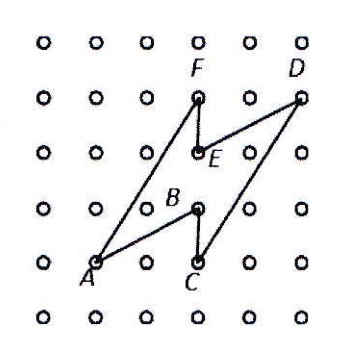
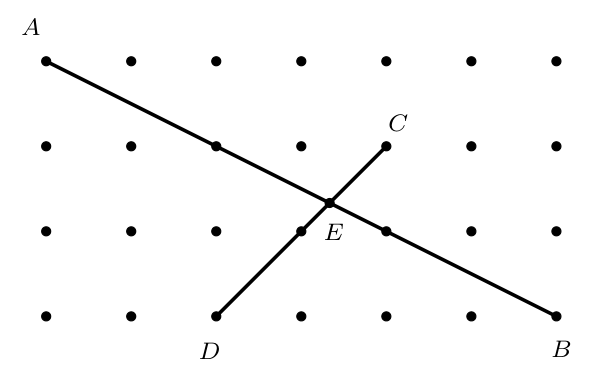
The diagram shows 28 lattice points, each one unit from its nearest neighbors. Segment $AB$ meets segment $CD$ at $E$. Find the length of segment $AE$.
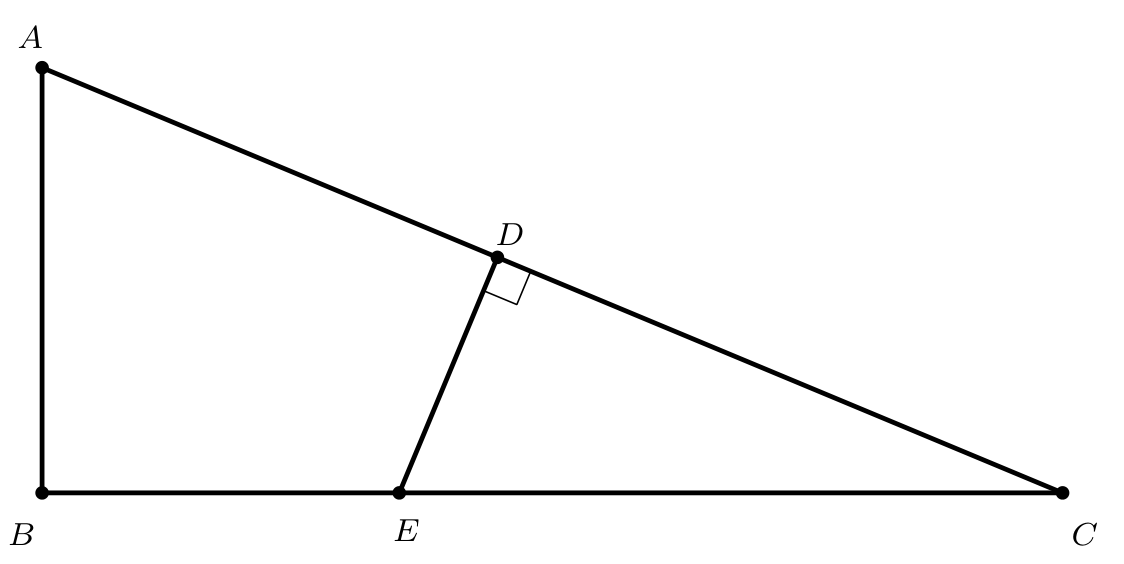
In the diagram, $ABC$ is a right triangle. Given that $DE$ is perpendicular to $AC$, $AB=5$ cm, $AC=13$ cm and $DE=3$ cm, find the area of the polygon $ABED$.