A metal cylinder is recast into a cone with twice the cylinder's radius. If the cylinder's height was 12 m, what is the new cone's height? Assume no metal is lost.
Each term after the first in a sequence is the sum of the cubes of the digits of the preceding term. The first term is 244. Find the 2021st term. Enter the integer.
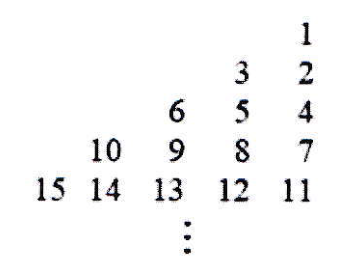
Continue the right-aligned rows shown: row $n$ contains $n$ consecutive positive integers in descending order, using every integer once. What number is directly below 526, in the same vertical column?
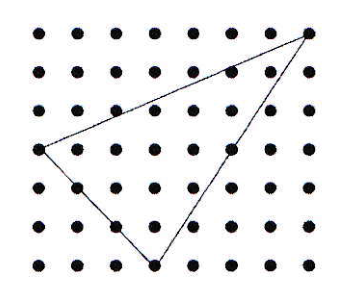
In the figure, the distance between neighbouring horizontal or vertical dots is 1 unit. Find the area of the triangle. Enter the numerical area in square units.
A semiprime is a number $p_1p_2$, where $p_1,p_2$ are primes; they may be equal. Three independent fair standard six-sided dice are rolled. The probability that their sum is semiprime is $a/b$ in lowest terms, with $a,b>0$. Find $a+b$.
The first five terms of a sequence are $5,9,16,28,47$. Find the sum of the 8th and 7th terms. For this self-study question, continue the pattern in which the third differences are constant.
Constants $M,N$ satisfy the identity
$$\frac{52x+73}{14x^2+83x+33}=\frac{M}{7x+3}+\frac{N}{2x+11}.$$
Find $MN-M-N$. The identity holds for all real $x$ for which the denominators are nonzero.
How many distinct 4-letter words can be formed from the letters of MATHS? A word means any ordered arrangement, whether meaningful or not; each letter may be used at most once.
Jacob initially had 5 biscuits for every 3 that Sheila had. After Jacob gave Sheila 1 biscuit, he had 3 biscuits for every 2 that she had. How many biscuits did Jacob have at first?
The product of two or more consecutive integers is a six-digit palindrome beginning with the digits 47. Find the sum of those integers. A palindrome reads the same backwards and forwards. Use consecutive positive integers, as intended by the source.
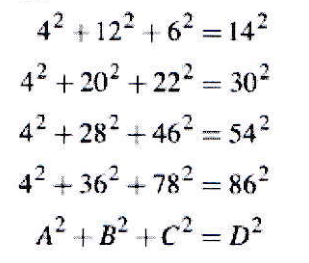
The first five instances of a pattern involving three squares are shown below. Find $B+D-A-C$.
$$4^2+12^2+6^2=14^2$$
$$4^2+20^2+22^2=30^2$$
$$4^2+28^2+46^2=54^2$$
$$4^2+36^2+78^2=86^2$$
$$A^2+B^2+C^2=D^2$$
Continue with positive bases: the first column stays constant, the second has constant first differences, and the third and fourth have constant second differences.