Skip to content / Đến nội dung
ThichHocToan.com

IMSO 2025 Science International — Theory I

Question 1

Original source text (the exact panel preserves diagram labels, tables and choices):

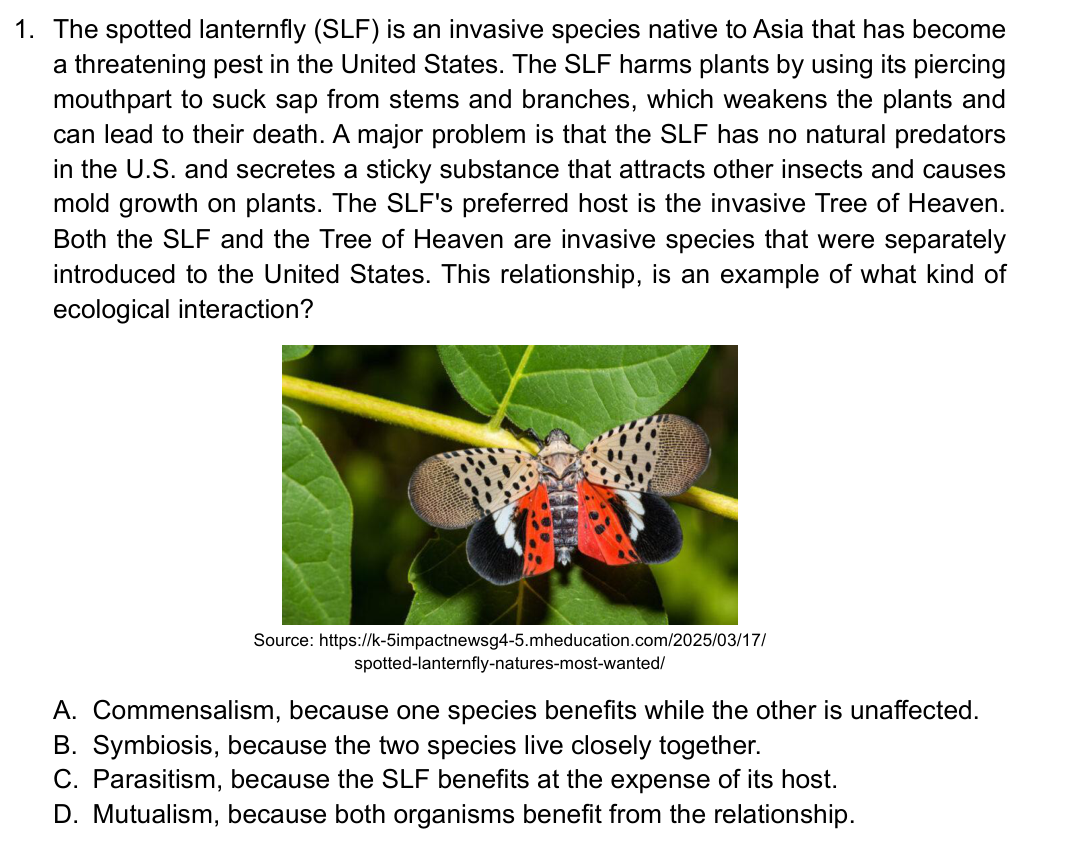
The spotted lanternfly (SLF) is an invasive species native to Asia that has become
a threatening pest in the United States. The SLF harms plants by using its piercing
mouthpart to suck sap from stems and branches, which weakens the plants and
can lead to their death. A major problem is that the SLF has no natural predators
in the U.S. and secretes a sticky substance that attracts other insects and causes
mold growth on plants. The SLF's preferred host is the invasive Tree of Heaven.
Both the SLF and the Tree of Heaven are invasive species that were separately
introduced to the United States. This relationship, is an example of what kind of
ecological interaction?


Source: https://k-5impactnewsg4-5.mheducation.com/2025/03/17/
spotted-lanternfly-natures-most-wanted/

A. Commensalism, because one species benefits while the other is unaffected.
B. Symbiosis, because the two species live closely together.
C. Parasitism, because the SLF benefits at the expense of its host.
D. Mutualism, because both organisms benefit from the relationship.
Question illustration

Question 2

Original source text (the exact panel preserves diagram labels, tables and choices):

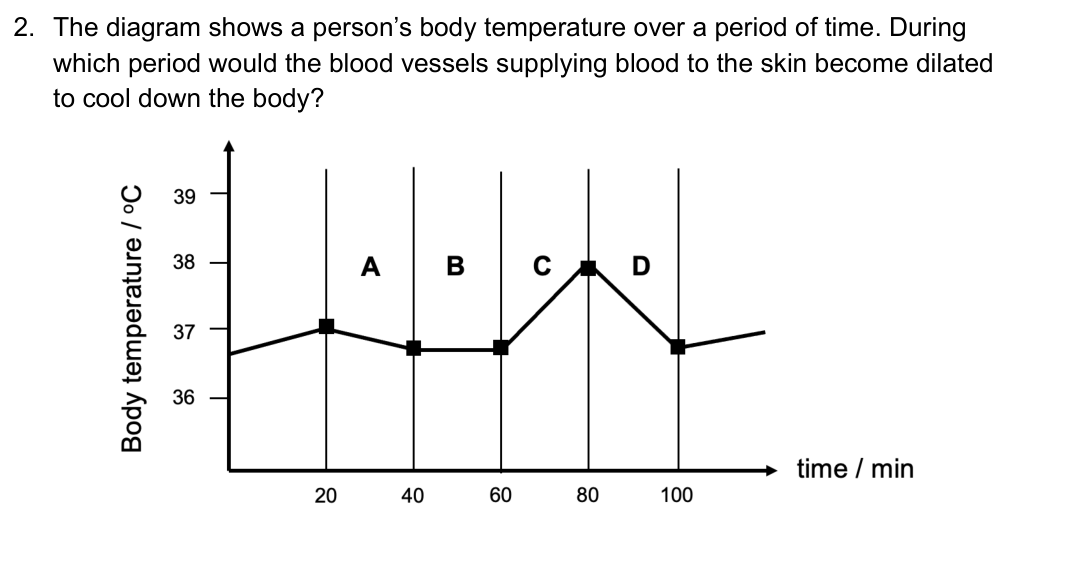
The diagram shows a person’s body temperature over a period of time. During
which period would the blood vessels supplying blood to the skin become dilated
to cool down the body?

Question illustration

Question 3

Original source text (the exact panel preserves diagram labels, tables and choices):

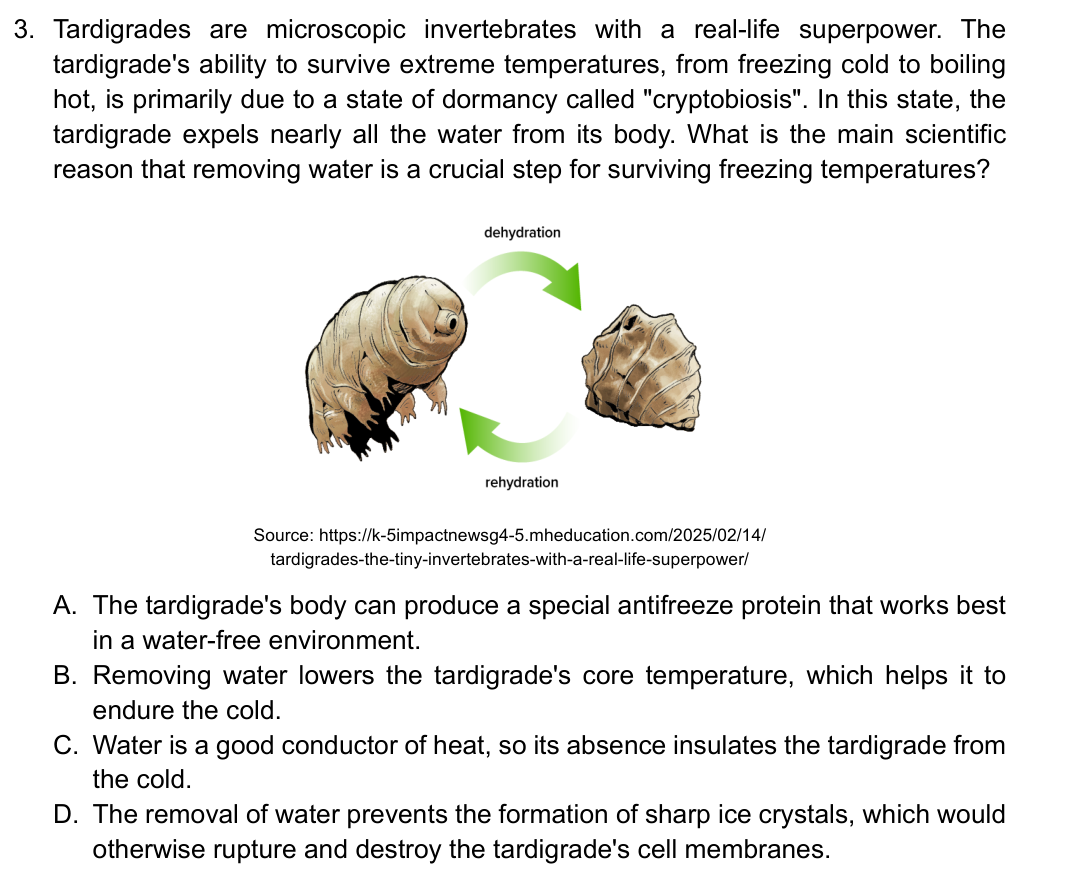
Tardigrades are microscopic invertebrates with a real-life superpower. The
tardigrade's ability to survive extreme temperatures, from freezing cold to boiling
hot, is primarily due to a state of dormancy called "cryptobiosis". In this state, the
tardigrade expels nearly all the water from its body. What is the main scientific
reason that removing water is a crucial step for surviving freezing temperatures?


Source: https://k-5impactnewsg4-5.mheducation.com/2025/02/14/
tardigrades-the-tiny-invertebrates-with-a-real-life-superpower/

A. The tardigrade's body can produce a special antifreeze protein that works best
in a water-free environment.
B. Removing water lowers the tardigrade's core temperature, which helps it to
endure the cold.
C. Water is a good conductor of heat, so its absence insulates the tardigrade from
the cold.
D. The removal of water prevents the formation of sharp ice crystals, which would
otherwise rupture and destroy the tardigrade's cell membranes.

Question illustration
  1. The tardigrade's body can produce a special antifreeze protein that works best in a water-free environment.
  2. Removing water lowers the tardigrade's core temperature, which helps it to endure the cold.
  3. Water is a good conductor of heat, so its absence insulates the tardigrade from the cold.
  4. The removal of water prevents the formation of sharp ice crystals, which would otherwise rupture and destroy the tardigrade's cell membranes.

Question 4

Original source text (the exact panel preserves diagram labels, tables and choices):

Leech therapy is a traditional treatment that uses live medicinal leeches to treat
diseases. The leeches’ saliva contains anticoagulants, anti-inflammatories, and
anaesthetic substances. By sucking blood, the leeches inject this saliva into the
patient’s body, which may improve blood flow, reduce pain and inflammation, and
promote healing. It is used for conditions such as arthritis, varicose veins,
cardiovascular diseases, and skin disorders.

Why does bleeding often continue for some time after the leech is removed?
A. Leeches secrete a specific toxin that reduces the blood’s ability to clot.
B. Leech saliva contains an anticoagulant substance called hirudin, which
prevents blood clotting.
C. Leeches rupture blood vessels, and the body does not have enough time to
repair them.
D. Leeches introduce bacteria into the body that disrupt the blood clotting process.

Question illustration
  1. Leeches secrete a specific toxin that reduces the blood’s ability to clot.
  2. Leech saliva contains an anticoagulant substance called hirudin, which prevents blood clotting.
  3. Leeches rupture blood vessels, and the body does not have enough time to repair them.
  4. Leeches introduce bacteria into the body that disrupt the blood clotting process.

Question 5

Original source text (the exact panel preserves diagram labels, tables and choices):

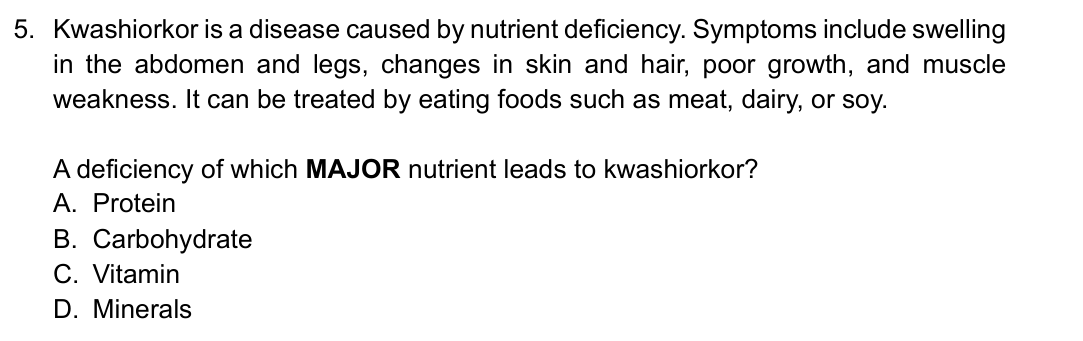
Kwashiorkor is a disease caused by nutrient deficiency. Symptoms include swelling
in the abdomen and legs, changes in skin and hair, poor growth, and muscle
weakness. It can be treated by eating foods such as meat, dairy, or soy.

A deficiency of which MAJOR nutrient leads to kwashiorkor?
A. Protein
B. Carbohydrate
C. Vitamin
D. Minerals

Question illustration
  1. Protein
  2. Carbohydrate
  3. Vitamin
  4. Minerals

Question 6

Original source text (the exact panel preserves diagram labels, tables and choices):

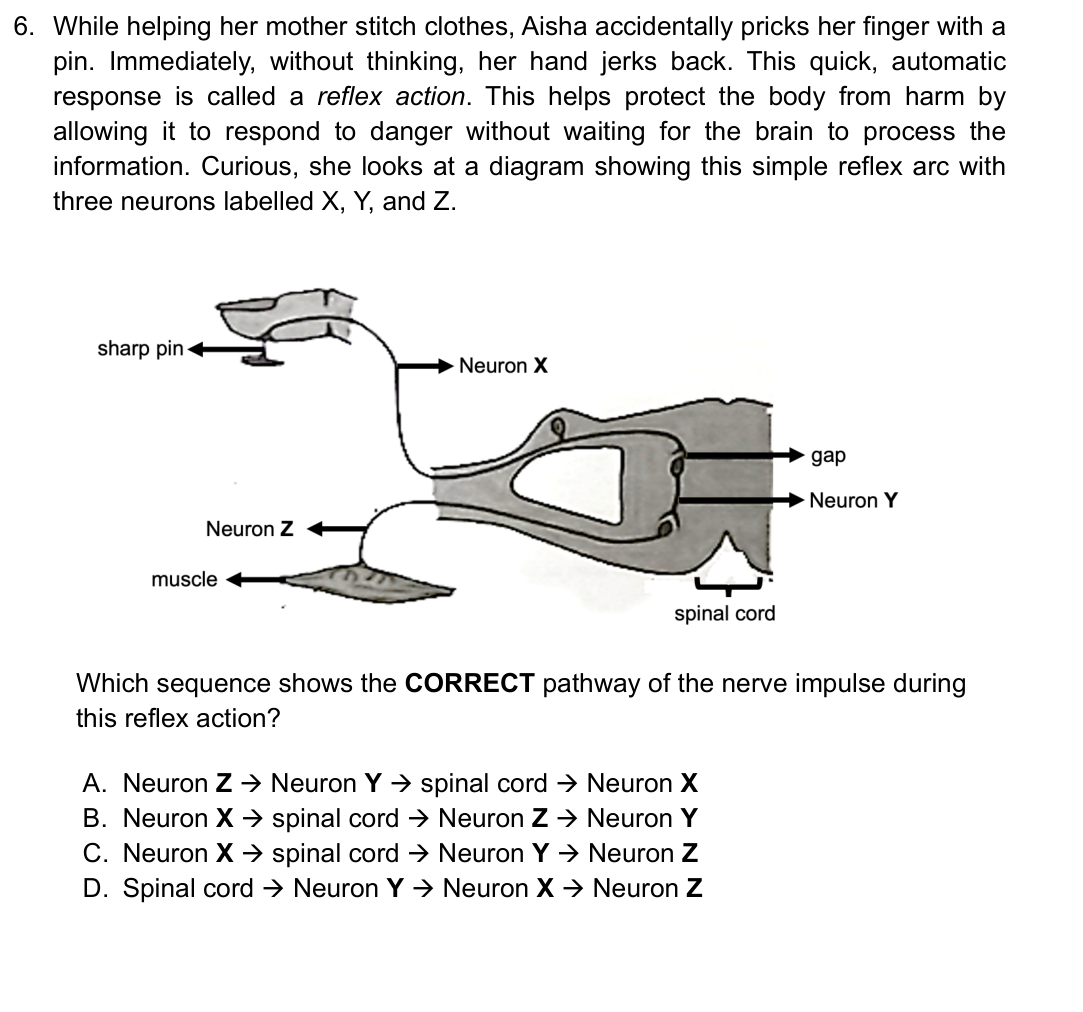
While helping her mother stitch clothes, Aisha accidentally pricks her finger with a
pin. Immediately, without thinking, her hand jerks back. This quick, automatic
response is called a reflex action. This helps protect the body from harm by
allowing it to respond to danger without waiting for the brain to process the
information. Curious, she looks at a diagram showing this simple reflex arc with
three neurons labelled X, Y, and Z.


Which sequence shows the CORRECT pathway of the nerve impulse during
this reflex action?

A. Neuron Z → Neuron Y → spinal cord → Neuron X
B. Neuron X → spinal cord → Neuron Z → Neuron Y
C. Neuron X → spinal cord → Neuron Y → Neuron Z
D. Spinal cord → Neuron Y → Neuron X → Neuron Z

Question illustration
  1. Neuron Z → Neuron Y → spinal cord → Neuron X
  2. Neuron X → spinal cord → Neuron Z → Neuron Y
  3. Neuron X → spinal cord → Neuron Y → Neuron Z
  4. Spinal cord → Neuron Y → Neuron X → Neuron Z

Question 7

Original source text (the exact panel preserves diagram labels, tables and choices):

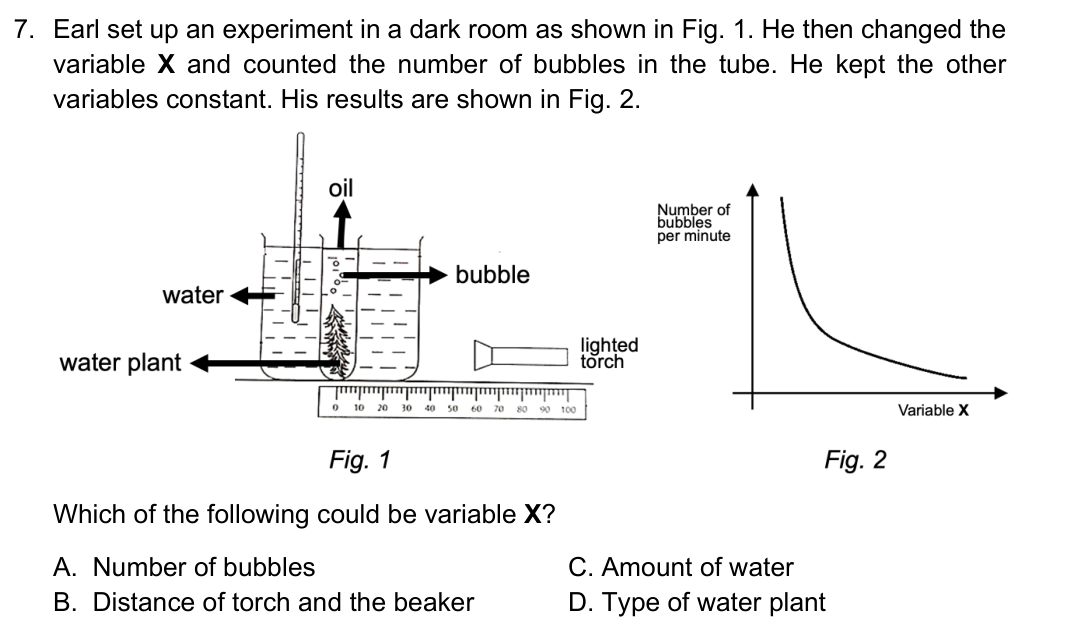
Earl set up an experiment in a dark room as shown in Fig. 1. He then changed the
variable X and counted the number of bubbles in the tube. He kept the other
variables constant. His results are shown in Fig. 2.


Which of the following could be variable X?

A. Number of bubbles C. Amount of water
B. Distance of torch and the beaker D. Type of water plant

Question illustration
  1. Number of bubbles
  2. Distance of torch and the beaker
  3. Amount of water
  4. Type of water plant

Question 8

Original source text (the exact panel preserves diagram labels, tables and choices):

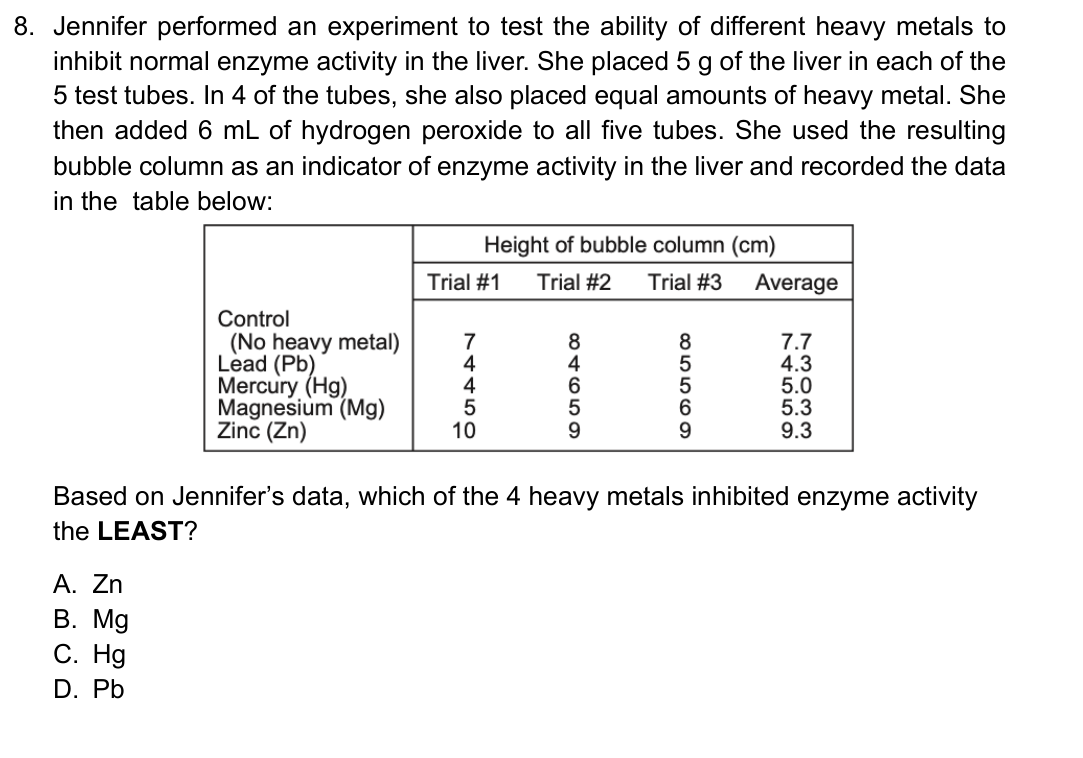
Jennifer performed an experiment to test the ability of different heavy metals to
inhibit normal enzyme activity in the liver. She placed 5 g of the liver in each of the
5 test tubes. In 4 of the tubes, she also placed equal amounts of heavy metal. She
then added 6 mL of hydrogen peroxide to all five tubes. She used the resulting
bubble column as an indicator of enzyme activity in the liver and recorded the data
in the table below:


Based on Jennifer’s data, which of the 4 heavy metals inhibited enzyme activity
the LEAST?

A. Zn
B. Mg
C. Hg
D. Pb

Question illustration
  1. Zn
  2. Mg
  3. Hg
  4. Pb

Question 9

Original source text (the exact panel preserves diagram labels, tables and choices):

In a pond, life is interconnected through a food chain. Algae, small green
organisms, are primary producers, creating their own food using sunlight. They
serve as the main food source for consumers like aquatic insects and small fish.
These insects and small fish, in turn, become food for larger predators such as
frogs.

Consider a scenario where environmental pollution causes a significant decline in
the algae population. This change directly impacts the availability of food for the
insects and small fish, potentially affecting their numbers. Based on these
observations, what is the MOST likely result of the algae disappearing?

A. All animals in the pond will grow faster due to less competition.
B. Small fish and insects may decrease because their main food source is gone.
C. Frogs will have more food since algae are not blocking the water.
D. Insects will start making their own food and become producers.

Question illustration
  1. All animals in the pond will grow faster due to less competition.
  2. Small fish and insects may decrease because their main food source is gone.
  3. Frogs will have more food since algae are not blocking the water.
  4. Insects will start making their own food and become producers.

Question 10

Original source text (the exact panel preserves diagram labels, tables and choices):

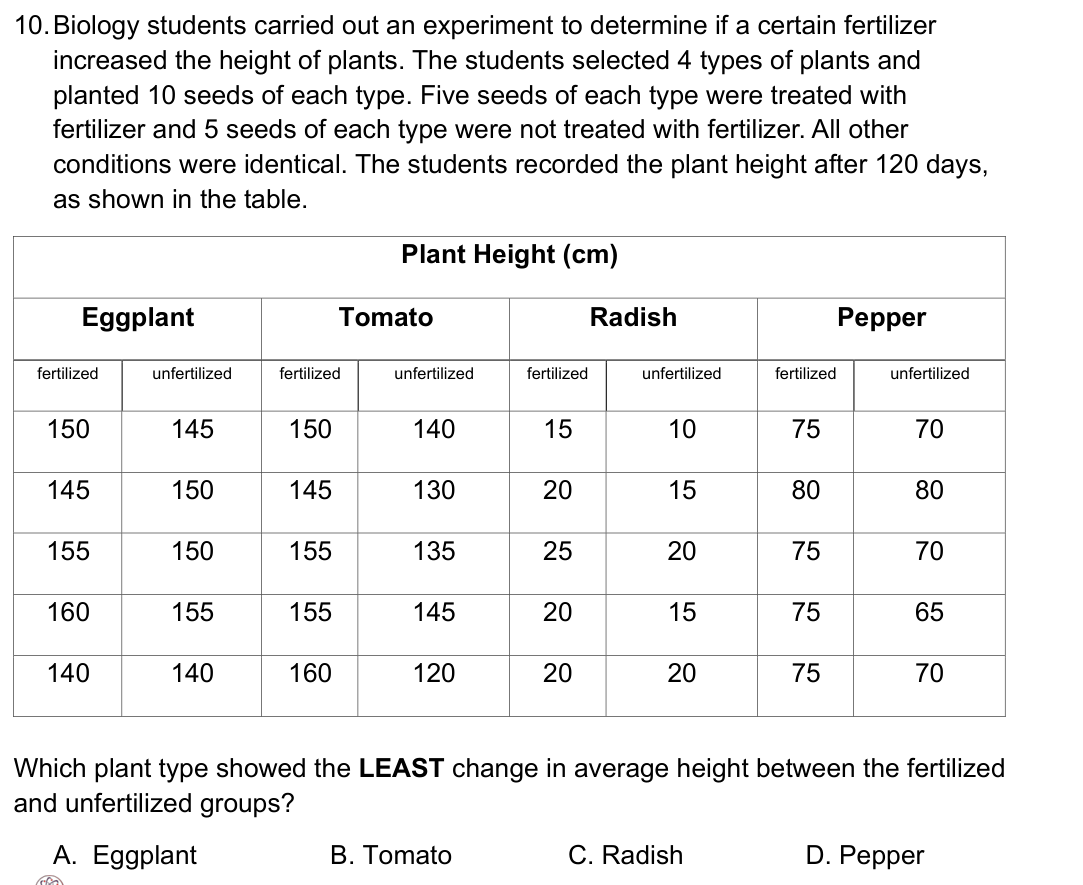
Biology students carried out an experiment to determine if a certain fertilizer
increased the height of plants. The students selected 4 types of plants and
planted 10 seeds of each type. Five seeds of each type were treated with
fertilizer and 5 seeds of each type were not treated with fertilizer. All other
conditions were identical. The students recorded the plant height after 120 days,
as shown in the table.

Plant Height (cm)

Eggplant Tomato Radish Pepper


fertilized unfertilized fertilized unfertilized fertilized unfertilized fertilized unfertilized

150 145 150 140 15 10 75 70

145 150 145 130 20 15 80 80

155 150 155 135 25 20 75 70

160 155 155 145 20 15 75 65

140 140 160 120 20 20 75 70


Which plant type showed the LEAST change in average height between the fertilized
and unfertilized groups?

A. Eggplant B. Tomato C. Radish D. Pepper

Question illustration
  1. Eggplant
  2. Tomato
  3. Radish
  4. Pepper

Question 11

Original source text (the exact panel preserves diagram labels, tables and choices):

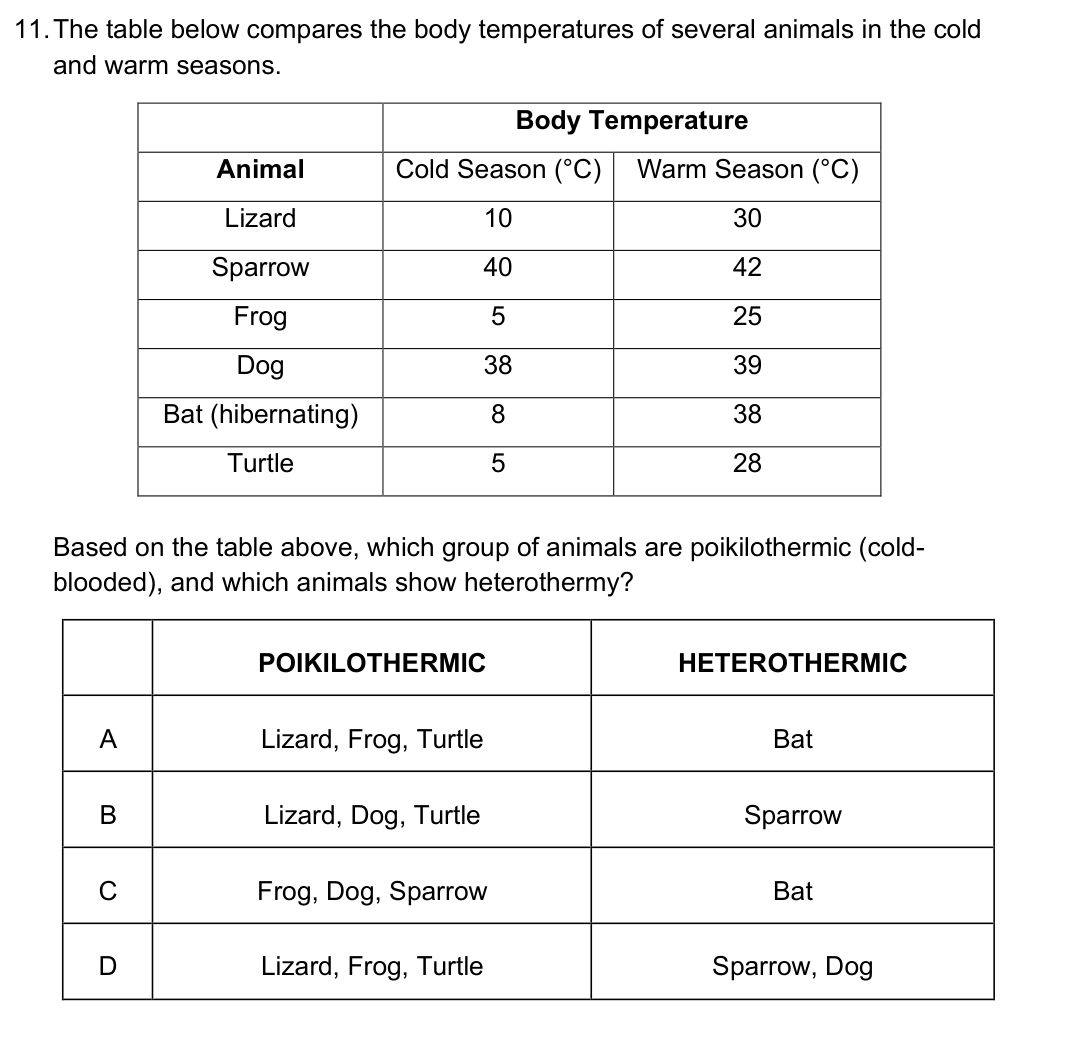
The table below compares the body temperatures of several animals in the cold
and warm seasons.

Body Temperature

Animal Cold Season (°C) Warm Season (°C)

Lizard 10 30

Sparrow 40 42

Frog 5 25

Dog 38 39

Bat (hibernating) 8 38

Turtle 5 28


Based on the table above, which group of animals are poikilothermic (cold-
blooded), and which animals show heterothermy?


POIKILOTHERMIC HETEROTHERMIC


A Lizard, Frog, Turtle Bat


B Lizard, Dog, Turtle Sparrow


C Frog, Dog, Sparrow Bat


D Lizard, Frog, Turtle Sparrow, Dog

Question illustration
  1. Lizard, Frog, Turtle; Bat
  2. Lizard, Dog, Turtle; Sparrow
  3. Frog, Dog, Sparrow; Bat
  4. Lizard, Frog, Turtle; Sparrow, Dog

Question 12

Original source text (the exact panel preserves diagram labels, tables and choices):

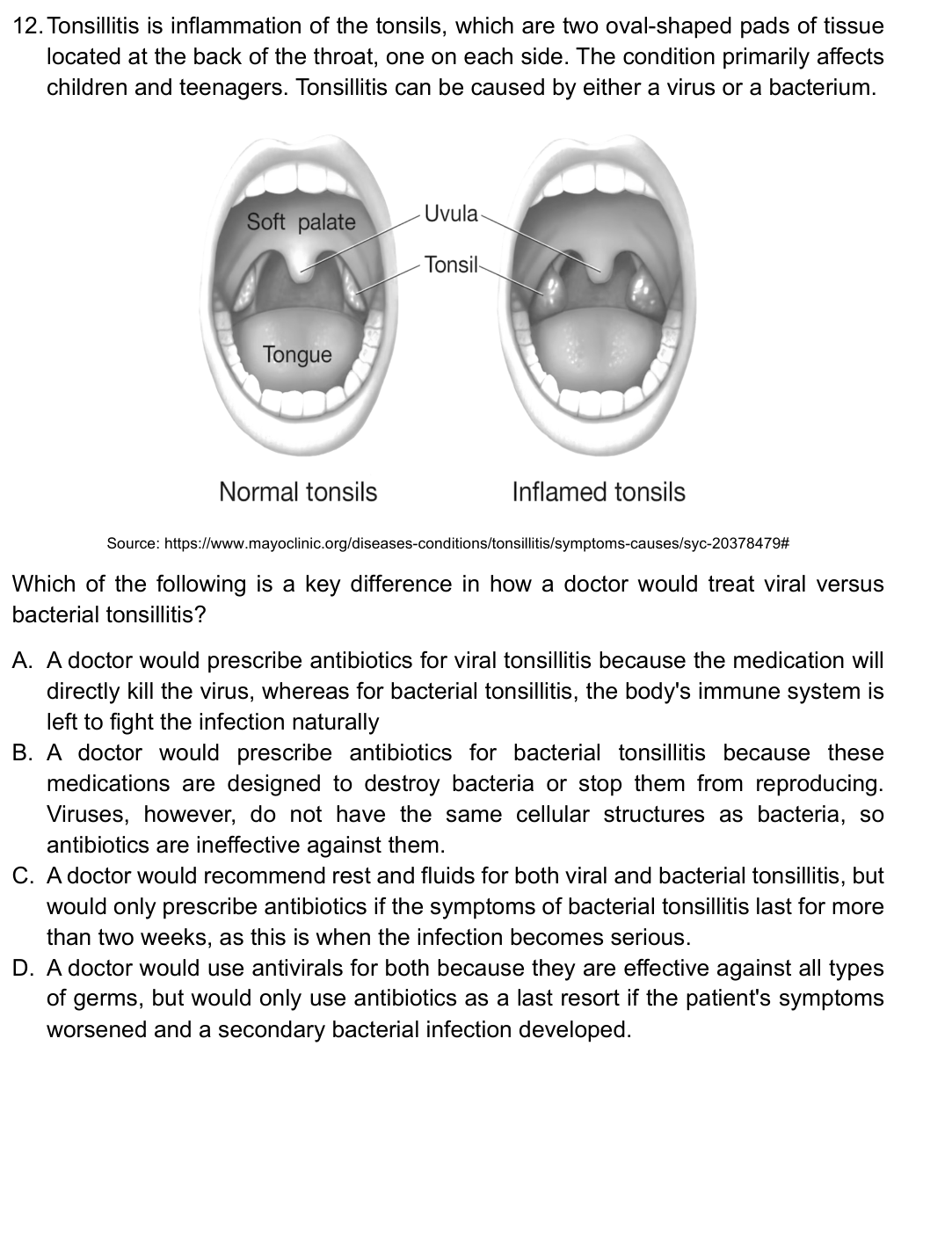
Tonsillitis is inflammation of the tonsils, which are two oval-shaped pads of tissue
located at the back of the throat, one on each side. The condition primarily affects
children and teenagers. Tonsillitis can be caused by either a virus or a bacterium.


Source: https://www.mayoclinic.org/diseases-conditions/tonsillitis/symptoms-causes/syc-20378479#

Which of the following is a key difference in how a doctor would treat viral versus
bacterial tonsillitis?

A. A doctor would prescribe antibiotics for viral tonsillitis because the medication will
directly kill the virus, whereas for bacterial tonsillitis, the body's immune system is
left to fight the infection naturally
B. A doctor would prescribe antibiotics for bacterial tonsillitis because these
medications are designed to destroy bacteria or stop them from reproducing.
Viruses, however, do not have the same cellular structures as bacteria, so
antibiotics are ineffective against them.
C. A doctor would recommend rest and fluids for both viral and bacterial tonsillitis, but
would only prescribe antibiotics if the symptoms of bacterial tonsillitis last for more
than two weeks, as this is when the infection becomes serious.
D. A doctor would use antivirals for both because they are effective against all types
of germs, but would only use antibiotics as a last resort if the patient's symptoms
worsened and a secondary bacterial infection developed.

Question illustration
  1. A doctor would prescribe antibiotics for viral tonsillitis because the medication will directly kill the virus, whereas for bacterial tonsillitis, the body's immune system is left to fight the infection naturally.
  2. A doctor would prescribe antibiotics for bacterial tonsillitis because these medications are designed to destroy bacteria or stop them from reproducing. Viruses, however, do not have the same cellular structures as bacteria, so antibiotics are ineffective against them.
  3. A doctor would recommend rest and fluids for both viral and bacterial tonsillitis, but would only prescribe antibiotics if the symptoms of bacterial tonsillitis last for more than two weeks, as this is when the infection becomes serious.
  4. A doctor would use antivirals for both because they are effective against all types of germs, but would only use antibiotics as a last resort if the patient's symptoms worsened and a secondary bacterial infection developed.

Question 13

Original source text (the exact panel preserves diagram labels, tables and choices):

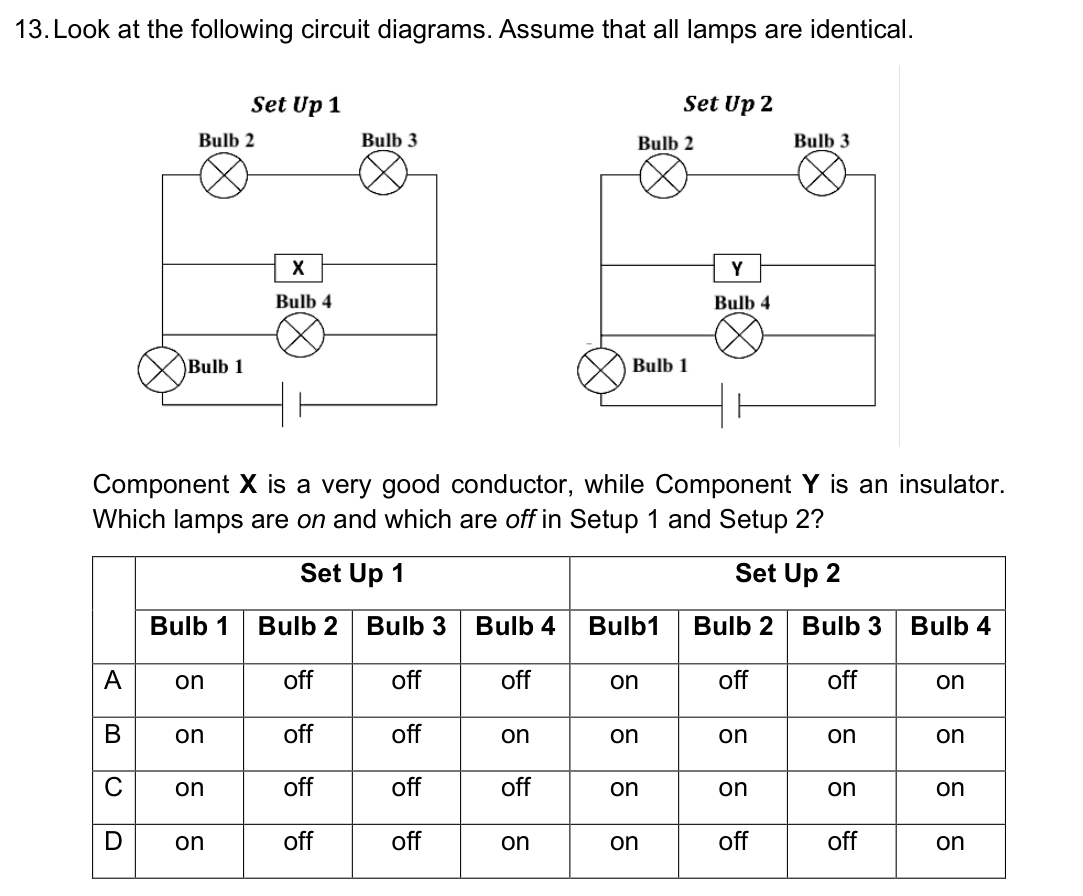
Look at the following circuit diagrams. Assume that all lamps are identical.


Component X is a very good conductor, while Component Y is an insulator.
Which lamps are on and which are off in Setup 1 and Setup 2?

Set Up 1 Set Up 2

Bulb 1 Bulb 2 Bulb 3 Bulb 4 Bulb1 Bulb 2 Bulb 3 Bulb 4

A on off off off on off off on

B on off off on on on on on

C on off off off on on on on

D on off off on on off off on

Question illustration
  1. Setup 1: on/off/off/off; Setup 2: on/off/off/on
  2. Setup 1: on/off/off/on; Setup 2: on/on/on/on
  3. Setup 1: on/off/off/off; Setup 2: on/on/on/on
  4. Setup 1: on/off/off/on; Setup 2: on/off/off/on

Question 14

Original source text (the exact panel preserves diagram labels, tables and choices):

Alex and Bella are playing their guitars together. Alex plays a note with a
frequency of 528 Hz, while Bella plays a note with a frequency of 396 Hz. Bella's
guitar sounds noticeably louder than Alex's. The speed of sound in air is 330 m/s.

Based on this information, which statement is INCORRECT?

A. The pitch of the note played by Alex is higher than that played by Bella.
B. The amplitude of the sound wave from Bella's guitar is greater than that from
Alex's guitar.
C. The period of the sound wave from Alex's guitar is shorter than that from
Bella's guitar.
D. If this experiment were repeated on the Moon, the difference in loudness
would be even more pronounced.

Question illustration
  1. The pitch of the note played by Alex is higher than that played by Bella.
  2. The amplitude of the sound wave from Bella's guitar is greater than that from Alex's guitar.
  3. The period of the sound wave from Alex's guitar is shorter than that from Bella's guitar.
  4. If this experiment were repeated on the Moon, the difference in loudness would be even more pronounced.

Question 15

Original source text (the exact panel preserves diagram labels, tables and choices):

Several common optical phenomena are listed below:
i. A rainbow after rain
ii. A straw appearing bent in a glass of water
iii. The bottom of a clear lake appearing shallower than it really is.
iv. The Sun appearing slightly above the horizon when it has already set

Which statement BEST describes the role of refraction in these cases?

A. Refraction is the only mechanism in all four phenomena.
B. Refraction is irrelevant for (i), but explains (ii), (iii), and (iv).
C. Refraction is important only for (i) and (ii), while (iii) and (iv) are caused by
reflection and scattering.
D. Refraction alone explains (ii), (iii), and (iv), but (i) requires both refraction and
internal reflection.

Question illustration
  1. Refraction is the only mechanism in all four phenomena.
  2. Refraction is irrelevant for (i), but explains (ii), (iii), and (iv).
  3. Refraction is important only for (i) and (ii), while (iii) and (iv) are caused by reflection and scattering.
  4. Refraction alone explains (ii), (iii), and (iv), but (i) requires both refraction and internal reflection.

Question 16

Original source text (the exact panel preserves diagram labels, tables and choices):

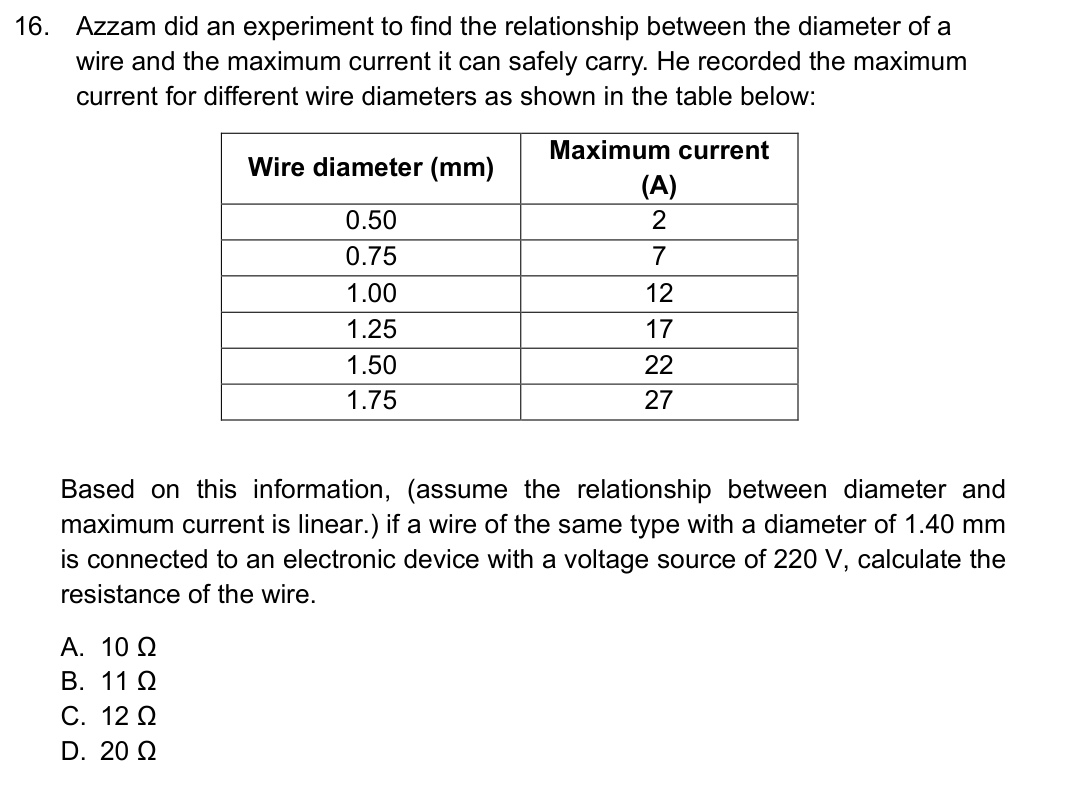
Azzam did an experiment to find the relationship between the diameter of a
wire and the maximum current it can safely carry. He recorded the maximum
current for different wire diameters as shown in the table below:

Maximum current
Wire diameter (mm)
(A)
0.50 2
0.75 7
1.00 12
1.25 17
1.50 22
1.75 27


Based on this information, (assume the relationship between diameter and
maximum current is linear.) if a wire of the same type with a diameter of 1.40 mm
is connected to an electronic device with a voltage source of 220 V, calculate the
resistance of the wire.

A. 10 Ω
B. 11 Ω
C. 12 Ω
D. 20 Ω

Question illustration

Question 17

Original source text (the exact panel preserves diagram labels, tables and choices):

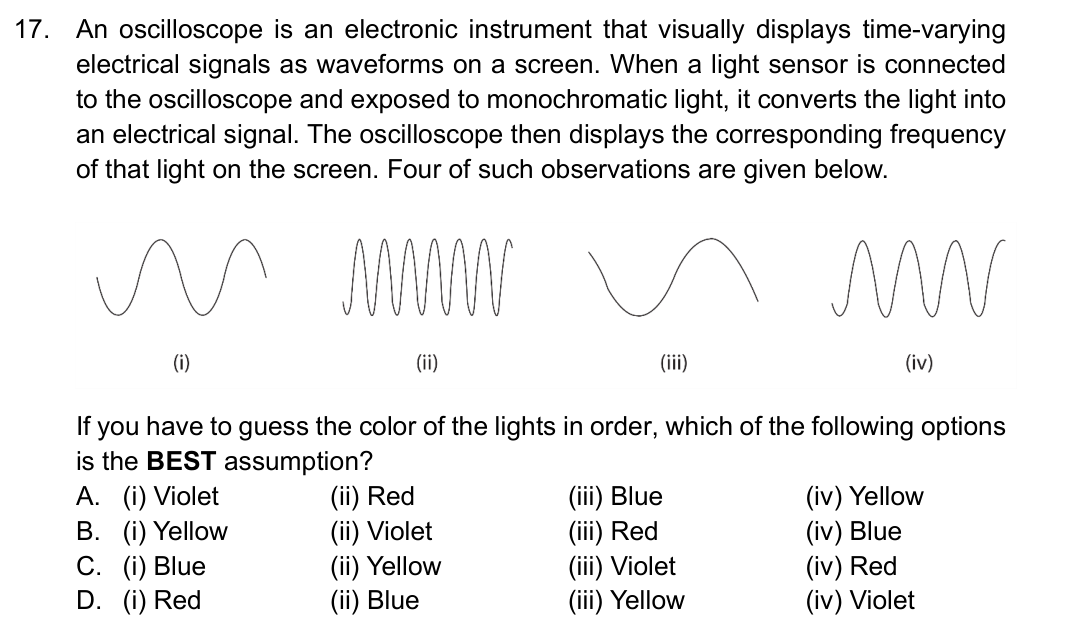
An oscilloscope is an electronic instrument that visually displays time-varying
electrical signals as waveforms on a screen. When a light sensor is connected
to the oscilloscope and exposed to monochromatic light, it converts the light into
an electrical signal. The oscilloscope then displays the corresponding frequency
of that light on the screen. Four of such observations are given below.


If you have to guess the color of the lights in order, which of the following options
is the BEST assumption?
A. (i) Violet (ii) Red (iii) Blue (iv) Yellow
B. (i) Yellow (ii) Violet (iii) Red (iv) Blue
C. (i) Blue (ii) Yellow (iii) Violet (iv) Red
D. (i) Red (ii) Blue (iii) Yellow (iv) Violet

Question illustration

Question 18

Original source text (the exact panel preserves diagram labels, tables and choices):

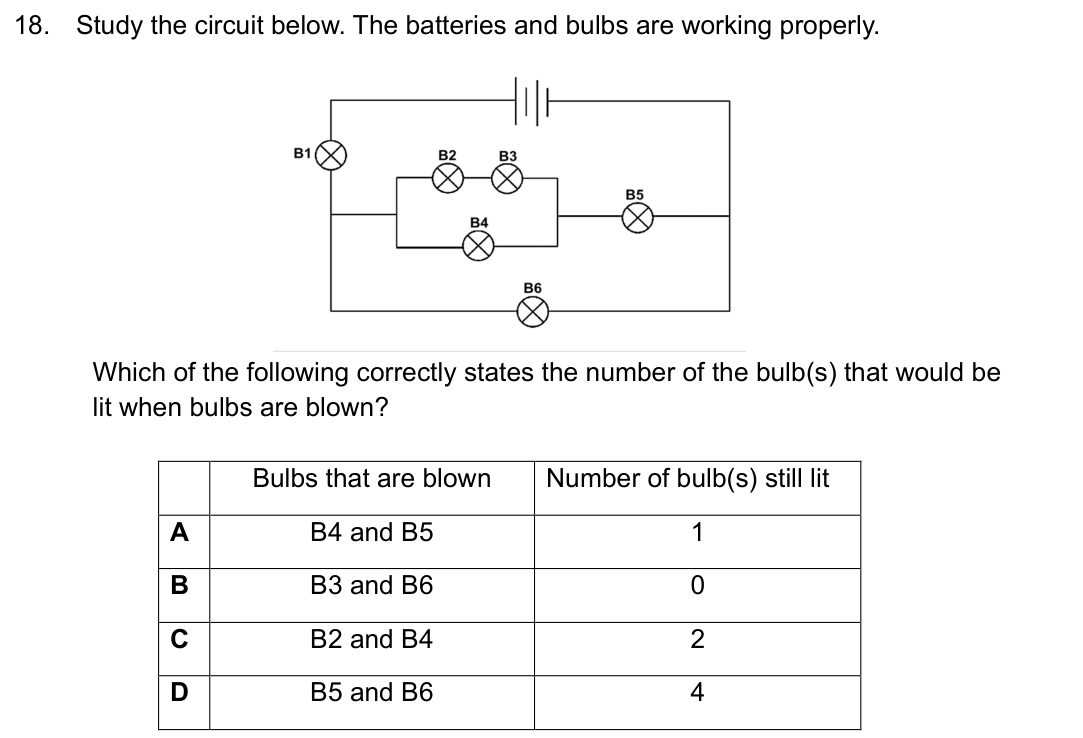
Study the circuit below. The batteries and bulbs are working properly.


Which of the following correctly states the number of the bulb(s) that would be
lit when bulbs are blown?

Bulbs that are blown Number of bulb(s) still lit

A B4 and B5 1

B B3 and B6 0

C B2 and B4 2

D B5 and B6 4

Question illustration
  1. B4 and B5; 1
  2. B3 and B6; 0
  3. B2 and B4; 2
  4. B5 and B6; 4

Question 19

Original source text (the exact panel preserves diagram labels, tables and choices):

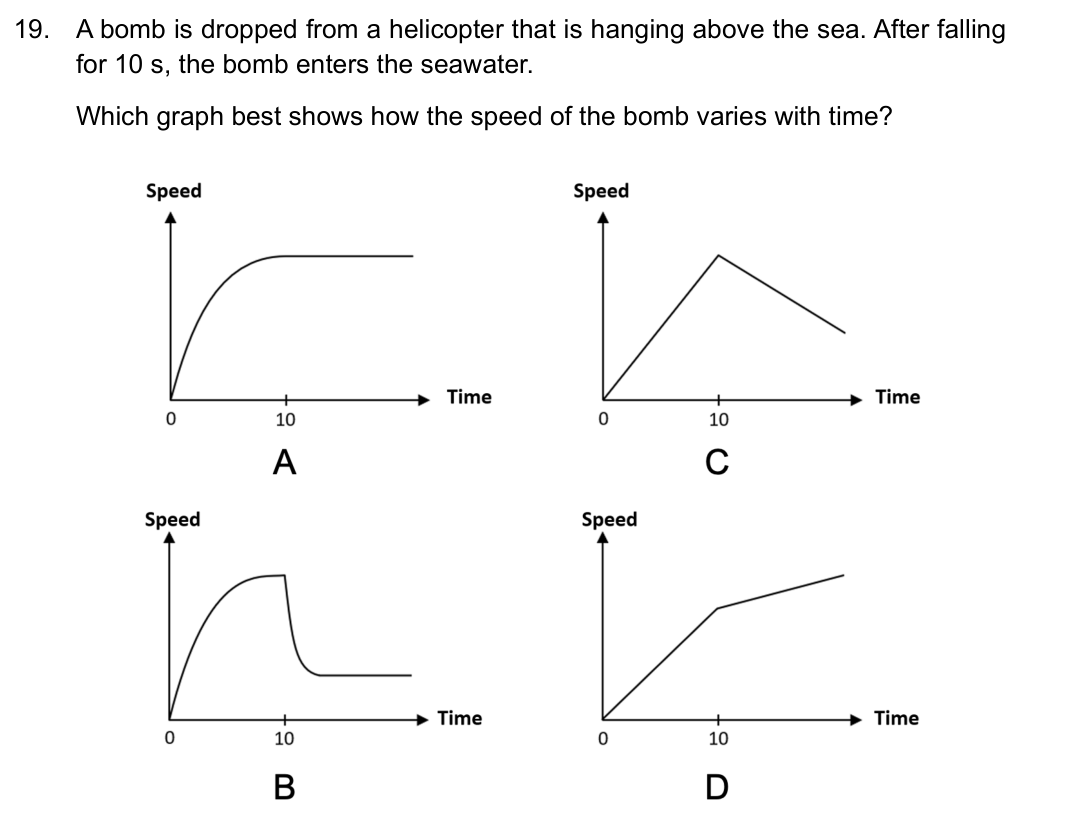
A bomb is dropped from a helicopter that is hanging above the sea. After falling
for 10 s, the bomb enters the seawater.

Which graph best shows how the speed of the bomb varies with time?

Question illustration
  1. Graph A
  2. Graph B
  3. Graph C
  4. Graph D

Question 20

Original source text (the exact panel preserves diagram labels, tables and choices):

A grandmother with presbyopia gets a new pair of reading glasses from her
doctor. The glasses are designed to provide clear vision at a standard reading
distance of 30 cm. However, when she first uses them to read a newspaper on
the table, the letters appear blurry. She experiments with a few actions.

Which action is MOST LIKELY to resolve the blurriness and allow her to see the
letters clearly with her new glasses?

A. Exchanging the glasses for a pair with larger lenses.
B. Tilting her head to view the text through the edge of the lenses.
C. Switching the table lamp to a brighter bulb to improve illumination.
D. Leaning her head back from the table to increase the reading distance to
approximately 40 cm.

Question illustration