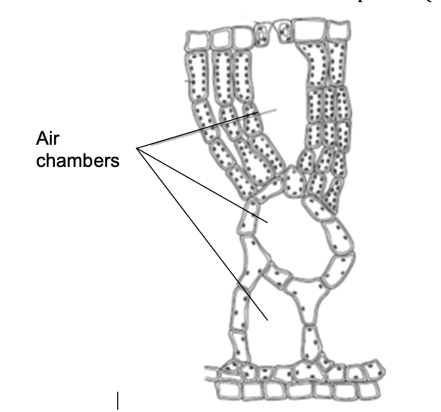
(2) Figure 2 shows the transverse section of a leaf taken from plant A.
(i) Identify the type of environment that plant A is adapted to live in. [1 mark]
(ii) Describe and explain how ONE structural feature of plant A aids in photosynthesis and allows the plant to be adapted to live in the environment mentioned in part (i). [2 marks]
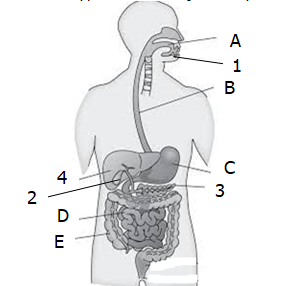
(3) Figure 3 on the right shows a typical human digestive system.
(i) Explain the role of parts 2 and 4 in a healthy digestive system? [2 marks]
(ii) Explain how a blockage in the tube connecting structures 2 and D affect complete digestion of fats? [1 mark]
(iii) Considering your answer in (i) and (ii), construct a bar graph to show the amount of undigested fats in the alimentary canal (structures A, B, C, D, and E). [4 marks]
(4) In the mid-1980s, scientists discovered a hole in the ozone layer over the Antarctic region. This is largely caused by the release of chlorofluorocarbons (CFCs) in the stratosphere. Ozone (O3) is constantly produced and depleted in the stratosphere from molecular oxygen (O2) and atomic oxygen (O).
(i) Explain the importance of ozone layer to humans. [1 mark]
(ii) CFCs are harmful because they introduce chlorine atoms that reacts with ozone. Even though ozone is constantly produced and depleted, Describe and explain how a single chlorine atom can accelerate the depletion of the ozone layer? [2 marks]
(iii) Suggest two ways to prevent the further depletion of the ozone layer. [2 marks]
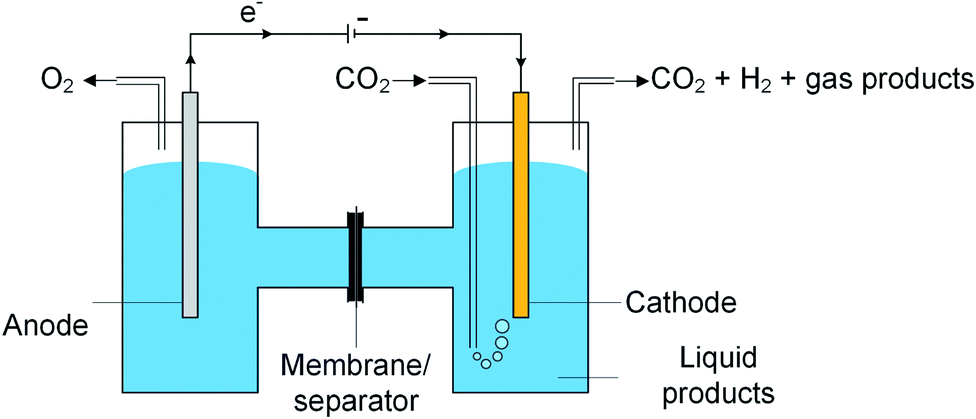
(5) Carbon dioxide concentration is now at 400 ppm, a dangerous level for our planet. One possible solution to this problem is transforming carbon dioxide back to fuel (e.g. methane, ethane) using electricity by a process known as electrocatalytic carbon dioxide reduction as shown in the diagram (Figure 4).
The process makes use of a copper catalyst as the cathode. Carbon dioxide is dissolved in water. As carbon dioxide attaches to the surface of the cathode, it uses electricity to transform it into the desired gas products. Excess CO2 and hydrogen by-product are also collected.
(i) Fossil fuels are burnt to produce energy. Explain how can the electrocatalytic reduction of carbon dioxide possibly address this problem? [2 marks]
(ii) Electricity is needed to successfully convert carbon dioxide to fuel. Describe three energy sources where we can get the electricity needed in order to make this technology sustainable? [3 marks]
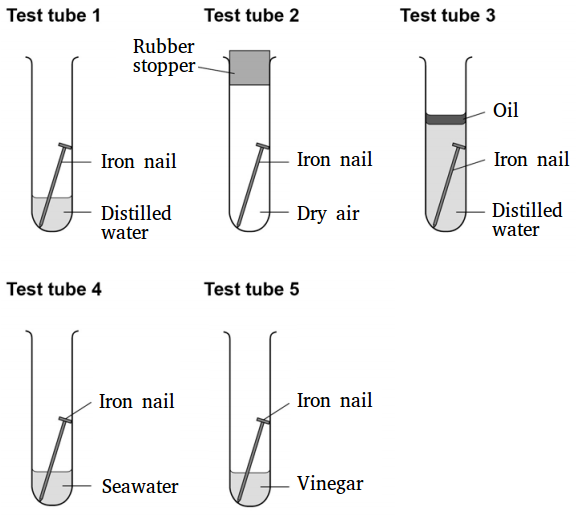
(6) Nathan was investigating the rusting of iron. He set up five test tubes as shown below, and left them for three days.
| Test tube | Observation after three days |
| --- | --- |
| 1 | Nail slightly rusty |
| 2 | Nail still shiny |
| 3 | Nail still shiny |
| 4 | Nail very rusty |
| 5 | Nail slightly rusty, bubbles of gas seen |
(i) Explain why the nails had not rusted in Test tubes 2 and 3. [1 mark]
(ii) List down the required conditions for rusting to occur. [1 mark]
(iii) Explain how salt affects the rate of rusting. [1.5 marks]
(iv) Name the gas formed in Test tube 5? [1 mark]
(v) Suggest three ways to decrease the nail’s rate of rusting. [1.5 marks]
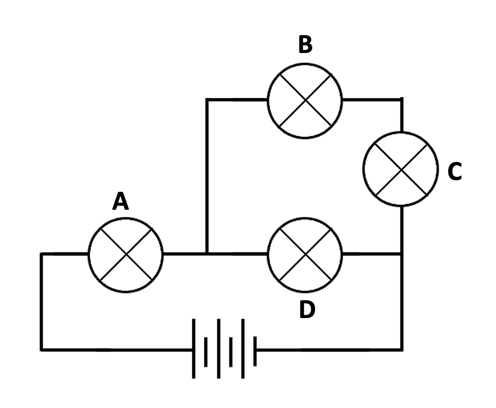
(8) A. Three identical light bulbs, A, B, C and D are connected as shown on Figure 6 on the right.
(i) A switch S is placed along the circuit such that when S is closed, all the bulbs will light up but when S is opened, only bulbs A and D will light up. On the circuit, locate the possible location of S by placing a slash (/) on it. [1 mark]
(ii) When switch S is closed, identify which light bulb/bulbs will be the [2 marks]
a. brightest
b. least bright
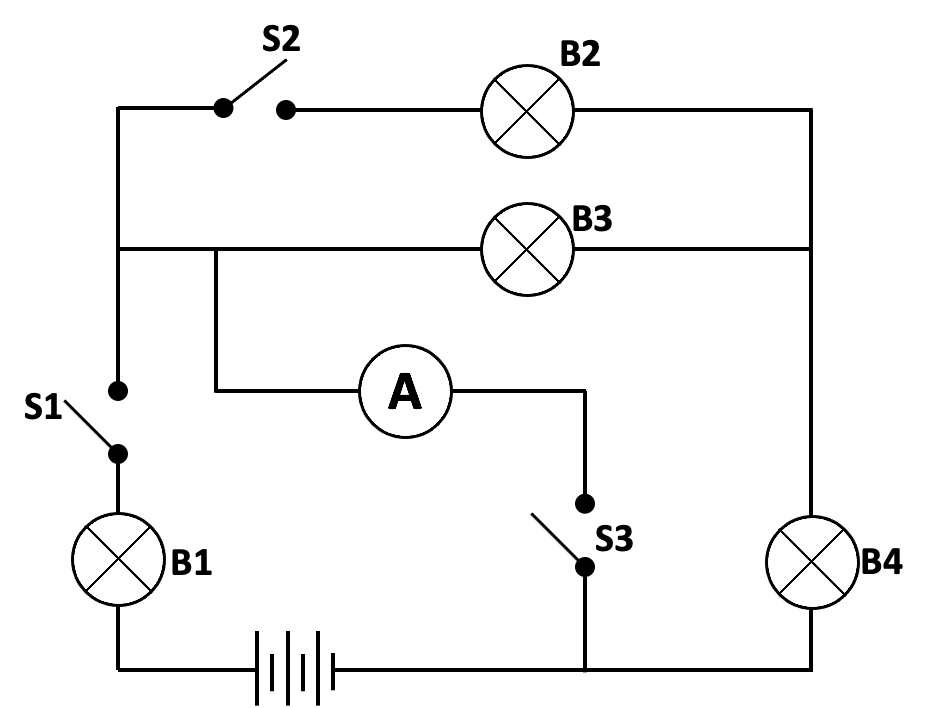
B. Study the circuit diagram (Figure 7) on the right carefully. All bulbs are identical.
(i) When switches S1 and S2 are closed, identify which of the bulbs will be brightest? [1 mark]
(ii) In the diagram, when both switches S1 and S3 are closed and S2 remain open, identify which of the bulb(s) will NOT light up? [1.5 marks]
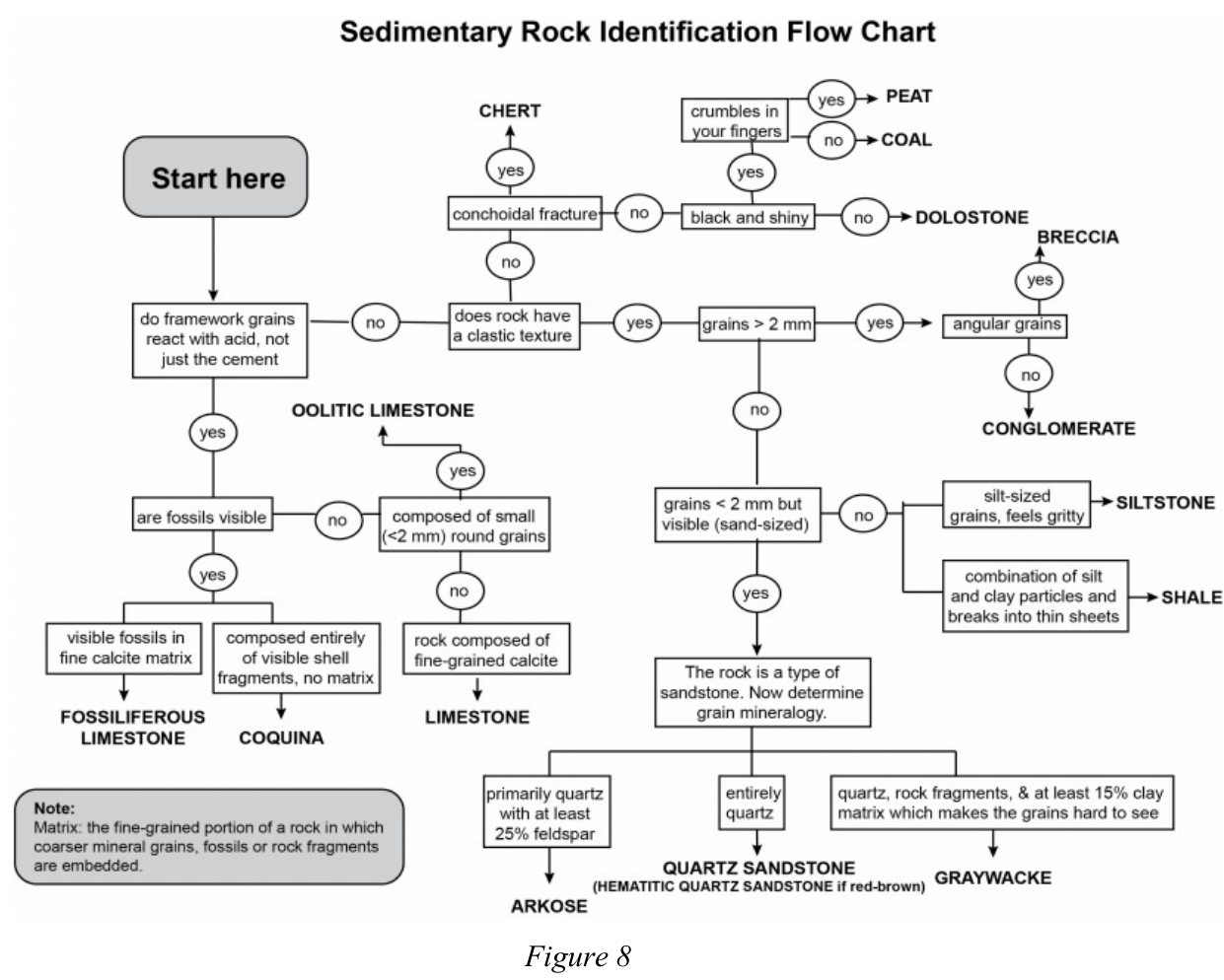
(9) Sedimentary rocks are a combination of many things – small fragments of rocks, minerals, and soil even remnants of living organisms like bones, shells, and plant matters that dissolves in water. These particles accumulate and are deposited until such time it is turned into rocks through a process called lithification.
Since particles that accumulate varies in type, shape, and sizes, sedimentary rocks are often diverse in appearance and characteristics. That is why geologists often devise and use an identification flowchart (Figure 8) to ease the process of identifying sedimentary rocks.
(i) A geologist wants to identify a white rock he found in a river. He added a few drops of hydrochloric acid on it and observed that bubbles formed. There were no traces of fossils and the grains are not visible with the naked eye. Using a microscope, he determined that the grains are 1 mm in diameter on average. Using Figure 8, identify the rock. [2 marks]
(ii) A small fragment of sedimentary rock consisting of siltstone, limestone and breccia. Devise a three-step plan to separate these rocks. [3 marks]