Question 1
PART I: FLOATING AND SINKING
Archimedes of Syracuse (c. 287–212 BC), an ancient Greek mathematician, physicist, engineer, inventor and astronomer, discovered around 250 BC the relationship between buoyancy and the weight of displaced fluid. Archimedes’ Principle states that the upward buoyant force on an object immersed in a fluid equals the weight of fluid displaced:
$F_{\mathrm{buoyant}}=W_{\mathrm{fluid}}=m_{\mathrm{fluid}}g=\rho_{\mathrm{fluid}}Vg$, where $g\approx10\,\mathrm{m/s^2}$, $\rho$ is fluid density and $V$ is displaced fluid volume.
Aim: Determine the density of unknown liquid X using Archimedes’ Principle.
Apparatus: Iron stand with clamp; spring balance; 250 ml graduated cylinder; 250 ml beaker; scissors; string; modelling clay (also called plasticine); beaker containing liquid X; cloth/paper towels for drying.
Safety: Handle glassware carefully; broken glassware results in deductions in the original test. Do not drink or taste liquid X. Do not eat or taste the clay.
Procedure (the source skips step number 6):
1\. Use the spring balance to measure 50 g of modelling clay.
2\. Use the graduated cylinder to measure the clay volume $V$. Record all measurements in the answer table.
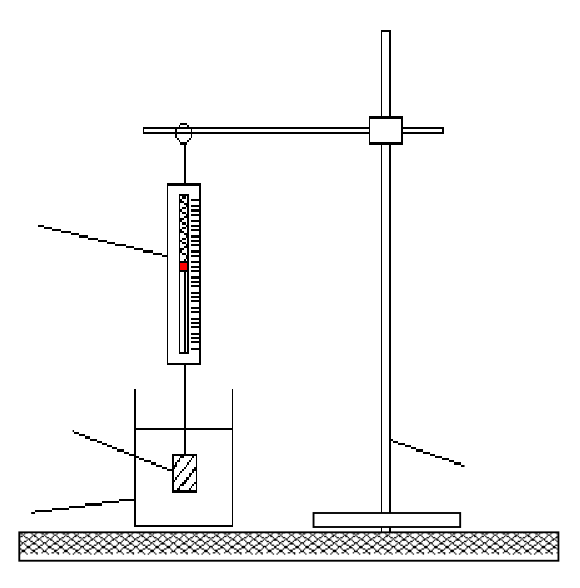
3\. Attach the 50 g clay again to the spring balance. Fill a beaker with 250 ml of liquid X and lower the balance so that the clay is completely submerged, without touching the beaker. Refer to the setup figure.
4\. Record the new mass reading of the clay on the spring balance.
5\. Find the mass $m_X$ of displaced liquid X from the difference between the balance readings before and after immersion.
7\. Repeat steps 1–5 for 70 g and 100 g of clay.
8\. Plot mass of displaced liquid against volume of clay on Graph 1.
Practical editorial safety note: The source lists a 250 ml beaker and also says to fill it with 250 ml before immersion. Use a sufficiently large vessel with headroom, or ask the supervisor for a safe adjustment; prevent overflow and keep the clay fully immersed. Record any adjustment.
Results: Complete three rows using your own measurements. No observations are supplied.
| Volume $V$ (ml) | Clay mass in air (g) | Clay mass reading in X (g) | Displaced liquid mass $m_X$ (g) |
| --- | --- | --- | --- |
| ____ | ____ | ____ | ____ |
| ____ | ____ | ____ | ____ |
| ____ | ____ | ____ | ____ |
(a) What is the correlation between the mass of liquid X displaced and the volume of modelling clay? [2 source points]
(b) From this relationship, how do you determine the density of X from your graph? Calculate it. [3 source points]
(c) Which measured values should you plot to determine the density of the clay? Plot them on Graph 2 and calculate the clay density from the graph.
(d) Will this experiment work for masses that float partially in the liquid? Briefly explain and state the modifications needed.
Response spaces (a)–(d): __________________________________________________
Graph 1: Floating and sinking. Add axes, units, scale and your measured points to the blank grid. Do not invent readings.

Graph 2: Floating and sinking. Choose the variables requested in (c), label axes and plot your measured points.
Archimedes of Syracuse (c. 287–212 BC), an ancient Greek mathematician, physicist, engineer, inventor and astronomer, discovered around 250 BC the relationship between buoyancy and the weight of displaced fluid. Archimedes’ Principle states that the upward buoyant force on an object immersed in a fluid equals the weight of fluid displaced:
$F_{\mathrm{buoyant}}=W_{\mathrm{fluid}}=m_{\mathrm{fluid}}g=\rho_{\mathrm{fluid}}Vg$, where $g\approx10\,\mathrm{m/s^2}$, $\rho$ is fluid density and $V$ is displaced fluid volume.
Aim: Determine the density of unknown liquid X using Archimedes’ Principle.
Apparatus: Iron stand with clamp; spring balance; 250 ml graduated cylinder; 250 ml beaker; scissors; string; modelling clay (also called plasticine); beaker containing liquid X; cloth/paper towels for drying.
Safety: Handle glassware carefully; broken glassware results in deductions in the original test. Do not drink or taste liquid X. Do not eat or taste the clay.
Procedure (the source skips step number 6):
1\. Use the spring balance to measure 50 g of modelling clay.
2\. Use the graduated cylinder to measure the clay volume $V$. Record all measurements in the answer table.
3\. Attach the 50 g clay again to the spring balance. Fill a beaker with 250 ml of liquid X and lower the balance so that the clay is completely submerged, without touching the beaker. Refer to the setup figure.
4\. Record the new mass reading of the clay on the spring balance.
5\. Find the mass $m_X$ of displaced liquid X from the difference between the balance readings before and after immersion.
7\. Repeat steps 1–5 for 70 g and 100 g of clay.
8\. Plot mass of displaced liquid against volume of clay on Graph 1.
Practical editorial safety note: The source lists a 250 ml beaker and also says to fill it with 250 ml before immersion. Use a sufficiently large vessel with headroom, or ask the supervisor for a safe adjustment; prevent overflow and keep the clay fully immersed. Record any adjustment.
Results: Complete three rows using your own measurements. No observations are supplied.
| Volume $V$ (ml) | Clay mass in air (g) | Clay mass reading in X (g) | Displaced liquid mass $m_X$ (g) |
| --- | --- | --- | --- |
| ____ | ____ | ____ | ____ |
| ____ | ____ | ____ | ____ |
| ____ | ____ | ____ | ____ |
(a) What is the correlation between the mass of liquid X displaced and the volume of modelling clay? [2 source points]
(b) From this relationship, how do you determine the density of X from your graph? Calculate it. [3 source points]
(c) Which measured values should you plot to determine the density of the clay? Plot them on Graph 2 and calculate the clay density from the graph.
(d) Will this experiment work for masses that float partially in the liquid? Briefly explain and state the modifications needed.
Response spaces (a)–(d): __________________________________________________
Graph 1: Floating and sinking. Add axes, units, scale and your measured points to the blank grid. Do not invent readings.
Graph 2: Floating and sinking. Choose the variables requested in (c), label axes and plot your measured points.