Question 1
### FUN WITH DIGITALS
Name: ___; Country: ___. Jakarta, Indonesia, Wednesday, 14 November 2007. The complete experimental examination lasts 120 minutes.
Mrs. Ana is driving her new car which is equipped with a good safety system. The engine of the car can only be started if its doors are locked and the seat belt is fastened. If both conditions are not fulfilled, the engine cannot be started. In science, these conditions are described as the “AND” logic.

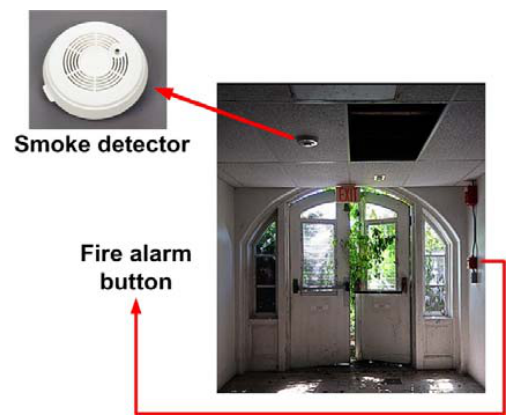
Many buildings are equipped with fire detection alarm system. The alarm will be automatically turned on if the system detects smoke, or the fire alarm button is pushed. The alarm will turn on if at least one of the above conditions is fulfilled. In science, these conditions are described as the “OR” logic.
There are many electric appliances such as lamps, refrigerators, TV and so on in our homes that are equipped with switches to turn them on and off. If the switch is in the ON position, those appliances will turn on because electric current can flow through them.
Now, we shall play with circuit board. The lamp will be turned on and off with the help of digital circuits with “AND” logic and “OR” logic principles using switches.
### Provided electronic kits
Item 1. One set of main board consisting of:
- (a) a socket for extension board;
- (b) a main lamp (actually it is a LED, light emitting diode);
- (c) indicator lamps (LEDs);
- (d) four switches (S1, S2, S3, “AND” S4);
- (e) a buzzer;
- (f) batteries in a black box.
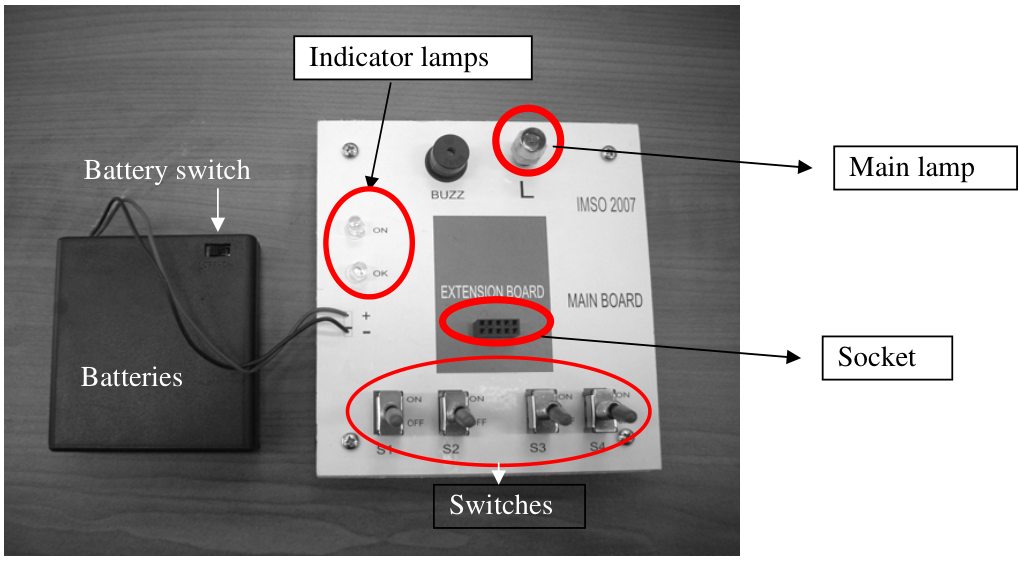
Picture labels: indicator lamps; battery switch; main lamp; batteries; socket; switches.
Item 2. Five extension boards (logic boards):
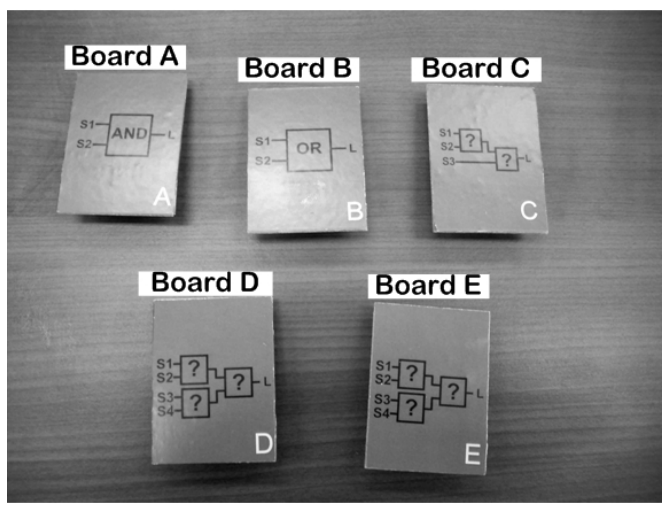
**Editorial practical note:** Use only the supplied low-voltage battery kit. Switch off the batteries before changing boards; align pins gently. Do not connect this kit to household mains. ON and OFF are retained as the required table entries. Board Z appears later but is absent from the list of five boards; its availability must be checked.
### ACTIVITY 1
Step 1. Plug the pins found at the bottom of Board A (“AND” logic) into the socket on the main board properly (see the picture below).
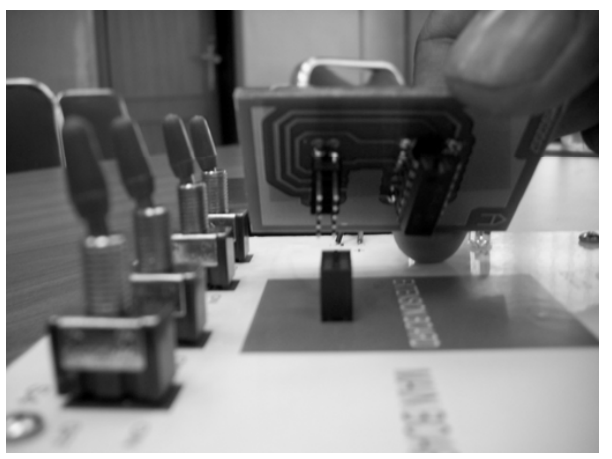
Step 2. Switch on the batteries. Batteries are working properly if the red indicator lamp lights up.
Step 3. The logic board is working properly if the green indicator lamp lights up.
Step 4. In this activity, you will have to change the positions of S1 and S2 switches to ON or OFF according to Table 1 below. Do not use S3 and S4. Write “ON” in the Main Lamp column (L) if the main lamp lights up; write “OFF” if the main lamp does not light up.
Table 1. Board A (AND)
| No. | S1 | S2 | Main lamp L |
| --- | --- | --- | --- |
| 1 | OFF | OFF | ___ |
| 2 | OFF | ON | ___ |
| 3 | ON | OFF | ___ |
| 4 | ON | ON | ___ |
(Total score 4)
Step 5. When you have completed Table 1, switch off the batteries.
### ACTIVITY 2
Step 1. Remove Board A and plug in Board B (OR logic).
Step 2. Repeat Activity 1.
Table 2. Board B (OR Logic)
| No. | S1 | S2 | Main lamp L |
| --- | --- | --- | --- |
| 1 | OFF | OFF | ___ |
| 2 | OFF | ON | ___ |
| 3 | ON | OFF | ___ |
| 4 | ON | ON | ___ |
(Total score 4)
**Question 1.** From Tables 1 and 2, what is your conclusion on how the “AND” logic and the “OR” logic work? Answer: ___ (Score 4)
### ACTIVITY 3
You are requested to find the unknown logics (X1 and X2) on Board C.
Step 1. Remove Board B and plug in Board C.
Step 2. Repeat Activity 1 by using S1, S2 and S3 only. Do not use S4.
Table 3. Board C
| No. | S1 | S2 | S3 | Main lamp L |
| --- | --- | --- | --- | --- |
| 1 | OFF | OFF | OFF | ___ |
| 2 | OFF | OFF | ON | ___ |
| 3 | OFF | ON | OFF | ___ |
| 4 | OFF | ON | ON | ___ |
| 5 | ON | OFF | OFF | ___ |
| 6 | ON | OFF | ON | ___ |
| 7 | ON | ON | OFF | ___ |
| 8 | ON | ON | ON | ___ |
(Score 4)
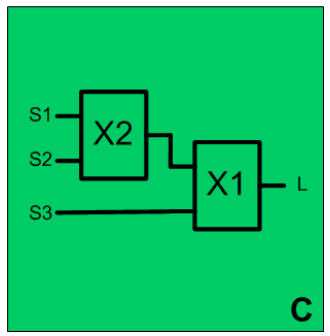
**Question 2.** Use Table 3 to answer:
(a) What is the logic of X1, is it “AND” or “OR”? Explain your answer. (Score 2)
(b) What is the logic of X2, is it “AND” or “OR”? Explain your answer. (Score 2)
### ACTIVITY 4
You are requested to find the unknown logics (X3, X4 and X5) on Board D.
Step 1. Remove Board C and plug in Board D.
Step 2. Repeat Activity 1 by using S1, S2, S3 and S4.
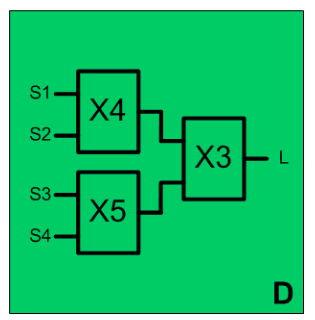
Table 4. Board D
| No. | S1 | S2 | S3 | S4 | Main lamp L |
| --- | --- | --- | --- | --- | --- |
| 1 | OFF | OFF | OFF | OFF | ___ |
| 2 | OFF | OFF | OFF | ON | ___ |
| 3 | OFF | OFF | ON | OFF | ___ |
| 4 | OFF | OFF | ON | ON | ___ |
| 5 | OFF | ON | OFF | OFF | ___ |
| 6 | OFF | ON | OFF | ON | ___ |
| 7 | OFF | ON | ON | OFF | ___ |
| 8 | OFF | ON | ON | ON | ___ |
| 9 | ON | OFF | OFF | OFF | ___ |
| 10 | ON | OFF | OFF | ON | ___ |
| 11 | ON | OFF | ON | OFF | ___ |
| 12 | ON | OFF | ON | ON | ___ |
| 13 | ON | ON | OFF | OFF | ___ |
| 14 | ON | ON | OFF | ON | ___ |
| 15 | ON | ON | ON | OFF | ___ |
| 16 | ON | ON | ON | ON | ___ |
(Score 4)
**Question 3.** Use Table 4 to answer:
(a) What is the logic of X4, is it “AND” or “OR”? (Score 1)
(b) What is the logic of X3, is it “AND” or “OR”? (Score 1)
(c) What is the logic of X3, is it “AND” or “OR”? (Score 1)
**Source note:** Part (c) repeats X3 in the printed question. The activity also asks for X5. The wording is preserved; ask the supervisor whether part (c) is intended to ask for X5.
### ACTIVITY 5
You are requested to find the unknown logics (X6, X7 and X8) on Board E.
Step 1. Remove Board D and plug in Board E.
Step 2. Repeat Activity 1 by using S1, S2, S3 and S4.
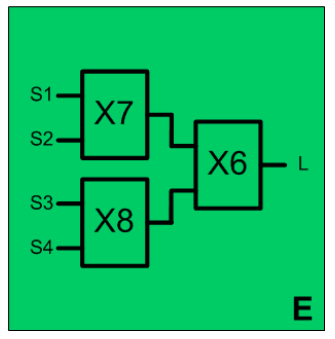
(You could use a table if necessary.)
**Question 4.**
(a) What is the logic of X6, is it “AND” or “OR”? (Score 1)
(b) What is the logic of X7, is it “AND” or “OR”? (Score 1)
(c) What is the logic of X8, is it “AND” or “OR”? (Score 1)
### ACTIVITY 6
In this activity, you are requested to fill in the blank in Table 6, based on the combination of two “OR” logics and one “AND” logic as shown below.
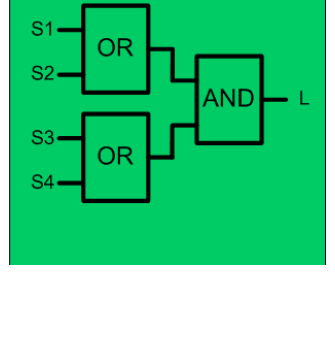
Table 6
| No. | S1 | S2 | S3 | S4 | L |
| --- | --- | --- | --- | --- | --- |
| 1 | OFF | ___ | ON | OFF | OFF |
| 2 | ON | OFF | ON | OFF | ___ |
| 3 | ON | ON | ___ | ON | OFF |
(Score 3)
### ACTIVITY 7
In this activity, you are requested to fill in the blank in Table 7 based on the combination of one “OR” logic and two “AND” logics as shown in the diagram below.
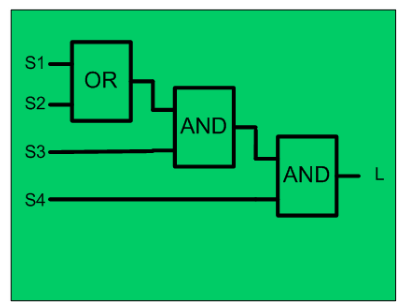
Table 7
| No. | S1 | S2 | S3 | S4 | L |
| --- | --- | --- | --- | --- | --- |
| 1 | ___ | ___ | ___ | ___ | ON |
| 2 | ___ | ___ | ___ | ___ | ON |
| 3 | ___ | ___ | ___ | ___ | ON |
(Score 6)
### ACTIVITY 8
Step 1. Unplug Board E and plug in Board Z into the socket in the main board properly.
Step 2. The Buzz will create a sound only for a single combination of switches S1, S2, S3 and S4. In this activity, you have to find the right combination for the switches by writing “ON” and “OFF” in the table below.
| S1 | S2 | S3 | S4 | Buzz |
| --- | --- | --- | --- | --- |
| ___ | ___ | ___ | ___ | ON |
(Score 2)
Name: ___; Country: ___. Jakarta, Indonesia, Wednesday, 14 November 2007. The complete experimental examination lasts 120 minutes.
Mrs. Ana is driving her new car which is equipped with a good safety system. The engine of the car can only be started if its doors are locked and the seat belt is fastened. If both conditions are not fulfilled, the engine cannot be started. In science, these conditions are described as the “AND” logic.
Many buildings are equipped with fire detection alarm system. The alarm will be automatically turned on if the system detects smoke, or the fire alarm button is pushed. The alarm will turn on if at least one of the above conditions is fulfilled. In science, these conditions are described as the “OR” logic.
There are many electric appliances such as lamps, refrigerators, TV and so on in our homes that are equipped with switches to turn them on and off. If the switch is in the ON position, those appliances will turn on because electric current can flow through them.
Now, we shall play with circuit board. The lamp will be turned on and off with the help of digital circuits with “AND” logic and “OR” logic principles using switches.
### Provided electronic kits
Item 1. One set of main board consisting of:
- (a) a socket for extension board;
- (b) a main lamp (actually it is a LED, light emitting diode);
- (c) indicator lamps (LEDs);
- (d) four switches (S1, S2, S3, “AND” S4);
- (e) a buzzer;
- (f) batteries in a black box.
Picture labels: indicator lamps; battery switch; main lamp; batteries; socket; switches.
Item 2. Five extension boards (logic boards):
**Editorial practical note:** Use only the supplied low-voltage battery kit. Switch off the batteries before changing boards; align pins gently. Do not connect this kit to household mains. ON and OFF are retained as the required table entries. Board Z appears later but is absent from the list of five boards; its availability must be checked.
### ACTIVITY 1
Step 1. Plug the pins found at the bottom of Board A (“AND” logic) into the socket on the main board properly (see the picture below).
Step 2. Switch on the batteries. Batteries are working properly if the red indicator lamp lights up.
Step 3. The logic board is working properly if the green indicator lamp lights up.
Step 4. In this activity, you will have to change the positions of S1 and S2 switches to ON or OFF according to Table 1 below. Do not use S3 and S4. Write “ON” in the Main Lamp column (L) if the main lamp lights up; write “OFF” if the main lamp does not light up.
Table 1. Board A (AND)
| No. | S1 | S2 | Main lamp L |
| --- | --- | --- | --- |
| 1 | OFF | OFF | ___ |
| 2 | OFF | ON | ___ |
| 3 | ON | OFF | ___ |
| 4 | ON | ON | ___ |
(Total score 4)
Step 5. When you have completed Table 1, switch off the batteries.
### ACTIVITY 2
Step 1. Remove Board A and plug in Board B (OR logic).
Step 2. Repeat Activity 1.
Table 2. Board B (OR Logic)
| No. | S1 | S2 | Main lamp L |
| --- | --- | --- | --- |
| 1 | OFF | OFF | ___ |
| 2 | OFF | ON | ___ |
| 3 | ON | OFF | ___ |
| 4 | ON | ON | ___ |
(Total score 4)
**Question 1.** From Tables 1 and 2, what is your conclusion on how the “AND” logic and the “OR” logic work? Answer: ___ (Score 4)
### ACTIVITY 3
You are requested to find the unknown logics (X1 and X2) on Board C.
Step 1. Remove Board B and plug in Board C.
Step 2. Repeat Activity 1 by using S1, S2 and S3 only. Do not use S4.
Table 3. Board C
| No. | S1 | S2 | S3 | Main lamp L |
| --- | --- | --- | --- | --- |
| 1 | OFF | OFF | OFF | ___ |
| 2 | OFF | OFF | ON | ___ |
| 3 | OFF | ON | OFF | ___ |
| 4 | OFF | ON | ON | ___ |
| 5 | ON | OFF | OFF | ___ |
| 6 | ON | OFF | ON | ___ |
| 7 | ON | ON | OFF | ___ |
| 8 | ON | ON | ON | ___ |
(Score 4)
**Question 2.** Use Table 3 to answer:
(a) What is the logic of X1, is it “AND” or “OR”? Explain your answer. (Score 2)
(b) What is the logic of X2, is it “AND” or “OR”? Explain your answer. (Score 2)
### ACTIVITY 4
You are requested to find the unknown logics (X3, X4 and X5) on Board D.
Step 1. Remove Board C and plug in Board D.
Step 2. Repeat Activity 1 by using S1, S2, S3 and S4.
Table 4. Board D
| No. | S1 | S2 | S3 | S4 | Main lamp L |
| --- | --- | --- | --- | --- | --- |
| 1 | OFF | OFF | OFF | OFF | ___ |
| 2 | OFF | OFF | OFF | ON | ___ |
| 3 | OFF | OFF | ON | OFF | ___ |
| 4 | OFF | OFF | ON | ON | ___ |
| 5 | OFF | ON | OFF | OFF | ___ |
| 6 | OFF | ON | OFF | ON | ___ |
| 7 | OFF | ON | ON | OFF | ___ |
| 8 | OFF | ON | ON | ON | ___ |
| 9 | ON | OFF | OFF | OFF | ___ |
| 10 | ON | OFF | OFF | ON | ___ |
| 11 | ON | OFF | ON | OFF | ___ |
| 12 | ON | OFF | ON | ON | ___ |
| 13 | ON | ON | OFF | OFF | ___ |
| 14 | ON | ON | OFF | ON | ___ |
| 15 | ON | ON | ON | OFF | ___ |
| 16 | ON | ON | ON | ON | ___ |
(Score 4)
**Question 3.** Use Table 4 to answer:
(a) What is the logic of X4, is it “AND” or “OR”? (Score 1)
(b) What is the logic of X3, is it “AND” or “OR”? (Score 1)
(c) What is the logic of X3, is it “AND” or “OR”? (Score 1)
**Source note:** Part (c) repeats X3 in the printed question. The activity also asks for X5. The wording is preserved; ask the supervisor whether part (c) is intended to ask for X5.
### ACTIVITY 5
You are requested to find the unknown logics (X6, X7 and X8) on Board E.
Step 1. Remove Board D and plug in Board E.
Step 2. Repeat Activity 1 by using S1, S2, S3 and S4.
(You could use a table if necessary.)
**Question 4.**
(a) What is the logic of X6, is it “AND” or “OR”? (Score 1)
(b) What is the logic of X7, is it “AND” or “OR”? (Score 1)
(c) What is the logic of X8, is it “AND” or “OR”? (Score 1)
### ACTIVITY 6
In this activity, you are requested to fill in the blank in Table 6, based on the combination of two “OR” logics and one “AND” logic as shown below.
Table 6
| No. | S1 | S2 | S3 | S4 | L |
| --- | --- | --- | --- | --- | --- |
| 1 | OFF | ___ | ON | OFF | OFF |
| 2 | ON | OFF | ON | OFF | ___ |
| 3 | ON | ON | ___ | ON | OFF |
(Score 3)
### ACTIVITY 7
In this activity, you are requested to fill in the blank in Table 7 based on the combination of one “OR” logic and two “AND” logics as shown in the diagram below.
Table 7
| No. | S1 | S2 | S3 | S4 | L |
| --- | --- | --- | --- | --- | --- |
| 1 | ___ | ___ | ___ | ___ | ON |
| 2 | ___ | ___ | ___ | ___ | ON |
| 3 | ___ | ___ | ___ | ___ | ON |
(Score 6)
### ACTIVITY 8
Step 1. Unplug Board E and plug in Board Z into the socket in the main board properly.
Step 2. The Buzz will create a sound only for a single combination of switches S1, S2, S3 and S4. In this activity, you have to find the right combination for the switches by writing “ON” and “OFF” in the table below.
| S1 | S2 | S3 | S4 | Buzz |
| --- | --- | --- | --- | --- |
| ___ | ___ | ___ | ___ | ON |
(Score 2)