Skip to content / Đến nội dung
ThichHocToan.com

IMSO 2006 Science International - Theory I

Question 1

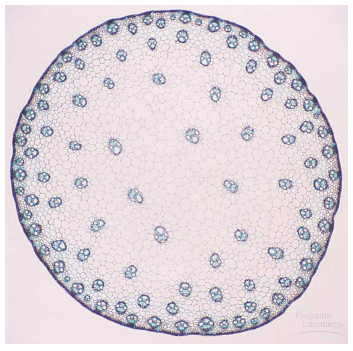
If a plant stem is cut in cross section and the xylem is distributed randomly or scattered throughout the section:

a. We can group this plant as a ____.

b. How many cotyledons does it have?

c. What kind of root system does it have?

The original cross section is shown below. No points are printed for this item; 3 points (one per part) are an editorial allocation.

Question illustration

Question 2

An aphid sucks nutritious liquid from a plant's phloem. An ant eats sugar excreted by the aphid. Name the symbiotic relationship and explain:

a. Aphids and plants. (1 point)

b. Aphids and ants. (1 point)

Question 3

Rainforest in tropical areas is the most humid area on Earth because of ____ and ____. (1 point)

Question 4

The source says a squid is a cephalopod “because the animal moves by using its head.” A snail is a gastropod because ____. (1 point)

Question 5

Plants make carbohydrate by photosynthesis and store it in different parts. Complete the table. (2.5 points)

| Plant | Storage part |
| --- | --- |
| Sugarcane | a. ____ |
| Potato | b. ____ |
| Carrot | c. ____ |
| Banana | d. ____ |
| Spinach | e. ____ |

Which two listed plants store carbohydrate in similar parts? ____ and ____. (0.5 point)

Question 6

Fat occurs in plants and animals. In animals it is stored under the skin. In plants it is mostly stored in ____. (1 point)

Question 7

Plants support life by converting light energy into chemical energy usable by other organisms. What kinds of organisms support life in the ocean in this way? (1 point)

Question 8

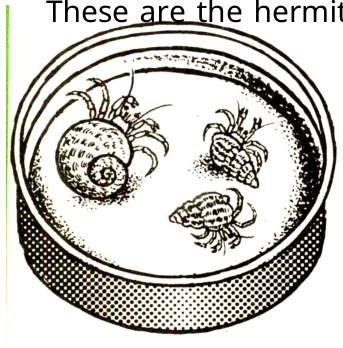
The pictured hermit crabs use a shell for protection. When their body grows bigger, they will ____ (1 point).

a. grow the shell with their body

b. break and reform new shells

c. leave and find new shells

d. thicken and form a hard skeleton

e. undergo metamorphosis

Question illustration

Question 9

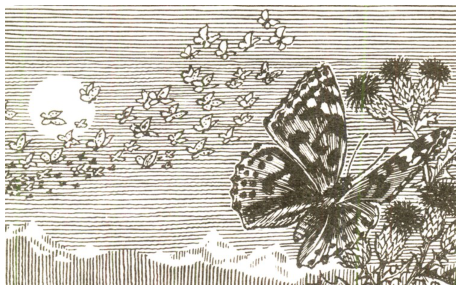
Millions of butterflies travel from North Africa to Europe, flying about 2,000 meters high and passing across an ocean and the Alpen hills, according to the source.

What is this population movement called? (1 point)

a. transmigration; b. migration; c. mitigation; d. immigration; e. emigration.

They move from North Africa to Europe when Europe is in which season? (1 point)

a. summer; b. autumn; c. winter; d. spring.

Question illustration

Question 10

Which statement describes the greenhouse effect? (1 point)

a. Glass buildings reflect sunlight into the atmosphere and increase its temperature.

b. We live in a greenhouse-like environment: sunlight reaches Earth's surface, but heat is reflected back to Earth by a CO₂ layer in the atmosphere.

c. Glass absorbs heat poorly, increasing atmospheric temperature.

d. Broken CO₂ and ozone layers remove the barrier to sunlight, increasing air temperature.

e. Vehicle-engine smoke is a heat source at Earth's surface; it enters the atmosphere and causes global warming.

Question 11

The main aim of food preservation by sweetening, salting/pickling, heating, freezing or radiation is ____ (1 point).

a. preventing growth of food-spoilage microorganisms

b. improving taste

c. creating attractive food color

d. using bacteria for fermentation

e. protecting the original aroma

Question 12

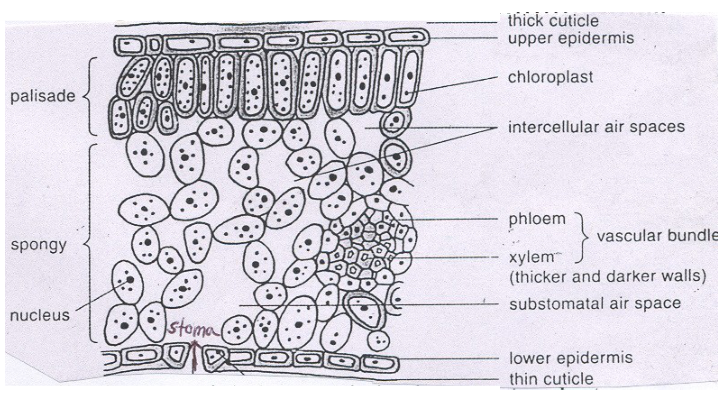
Look at the original cross section of a dicotyledon leaf.

a. Which part has the greatest role in photosynthesis? (1 point)

b. Which structure allows gas exchange? (1 point)

Question illustration

Question 13

Plants growing in dry areas often have structural adaptations. List three such characteristics. (3 points)

Question 14

The source says terrestrial plants need a sophisticated vascular system to carry water from soil to leaves, whereas aquatic plants do not. Why? (2 points)

Question 15

Organisms adapt in body structure and function. Give two adaptations of animals living in cold places. (2 points)

Question 16

An animal that undergoes metamorphosis has a stage valuable to humans because it produces silk thread.

a. Name the animal.

b. Name the stage of its metamorphosis. (2 points total)

Question 17

Which technology imitates the sonar mechanism of bats? (1 point)

a. domestic communication satellite

b. submarine periscope

c. remote control system

d. radio control system

e. air-force radar

Question 18

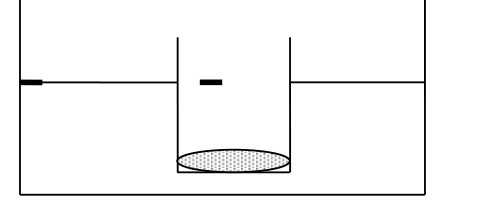
Keith puts a heavy rock in a plastic cup inside a glass container of water, and marks water levels on the cup and the container, as in the source drawing.

a. What happens if the rock is removed from the cup? Draw your answer. (2 points)

b. If she pushes the cup and releases it, what happens? (1 point)

Question illustration

Question 19

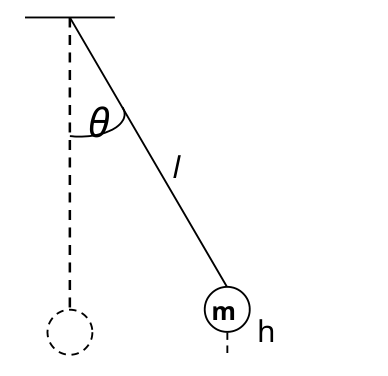
A pendulum has mass m = 0.1 kg. It is displaced through angle θ. Its initial energy is gravitational potential energy, mass × gravitational acceleration × height. The release height above equilibrium is h = 0.2 m. At equilibrium all this energy becomes kinetic energy.

a. Calculate the kinetic energy at the lowest point; use g = 10 m/s². (1.5 points)

b. What types of energy does it have at h = 0.1 m? (1 point)

c. Its oscillation involves conversion between ____ energy and ____ energy. (2 points)
Question illustration

Question 20

Weather is mainly influenced by four factors. Name them: ____, ____, ____ and ____. (1 point)