Question 1
Experiment I — The Secret of Color
I. Introduction
Look at leaves and grass: they are green. Why do some bodies look red and others blue under the same light? In sunlight, grass looks green, roofs brown and paper white. Investigate the behavior of colors.
II. Apparatus
Three light sources emitting blue, green and red; three colored screens (plates), blue, green and red; a solar cell; batteries; a multimeter adjusted to measure electric current; a static pod (stand); a ruler.
III. Method
Use the solar cell as a detector of different colored lights. Follow teacher supervision and the specified low-voltage setup; never short-circuit a battery.
III.1 Determining the color of light that has the highest energy
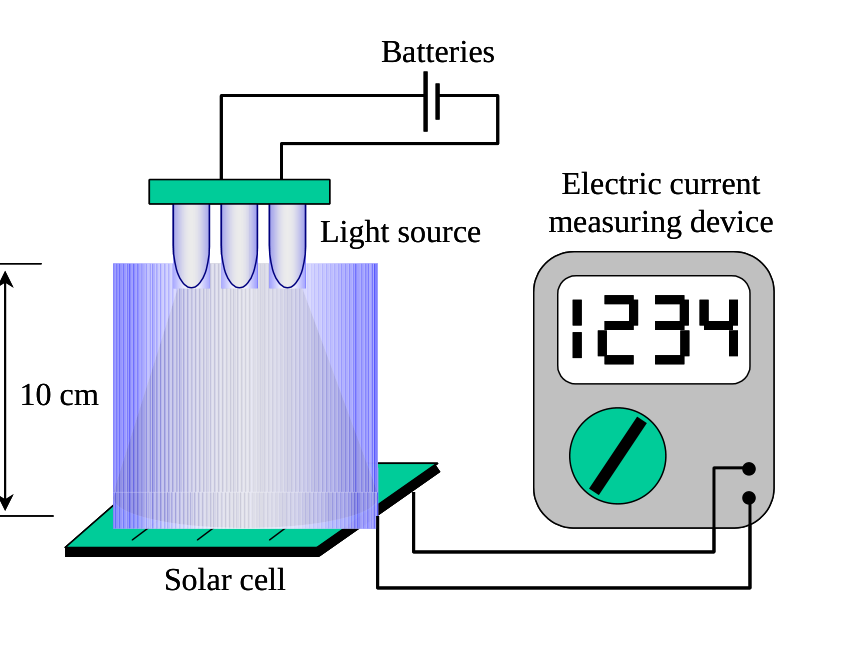
The source states that a solar cell produces current when illuminated, and treats the measured current as representing received light energy: greater energy gives greater current. Set up the apparatus as in Figure 1. (This simplified interpretation is examined in the explanation.)
**1.** Use the blue light source and a 6 volt battery.
**2.** Place the light source 10 cm from the solar cell.
**3.** Adjust the source so the light spot is focused at the center of the solar cell.
**4.** Record the current shown by the multimeter in microamperes.
**5.** Repeat steps 2–4 for green and red sources.
**6.** Complete Table 1 (9 points).
| Light color | Current (microamperes) |
| --- | --- |
| Blue | ____ |
| Green | ____ |
| Red | ____ |
Step 7. Which color has the highest energy? Explain your answer. (4 points)
III.2 Determining the color reflected by a colored body
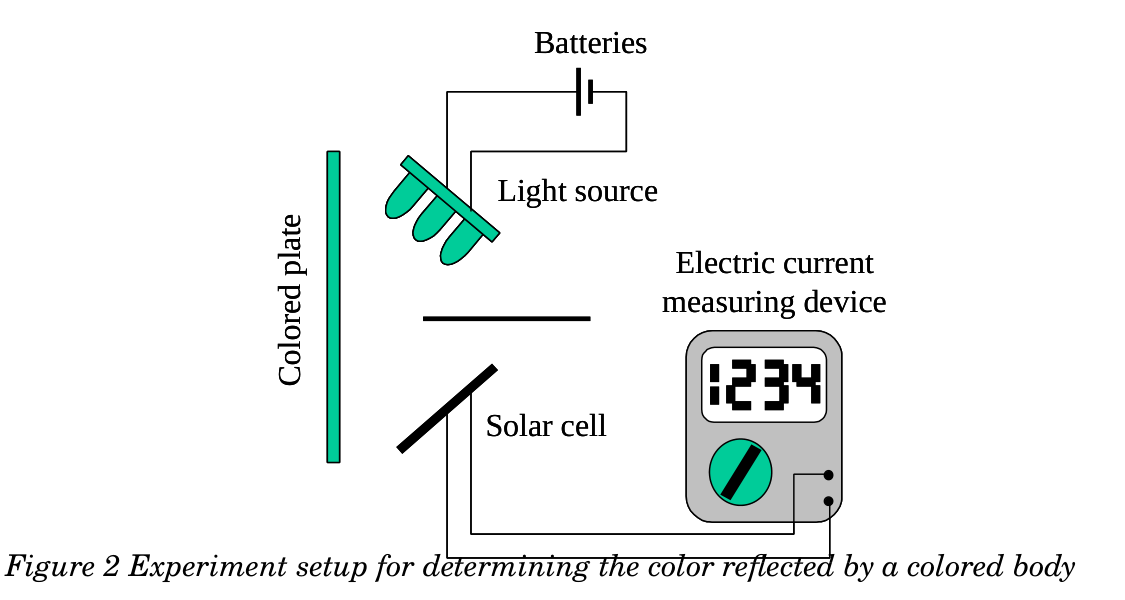
Arrange the apparatus as in Figure 2 to measure light reflected by a colored screen under a specific light color.
**1.** Fix the position of the solar cell.
**2.** Select a blue source and a 9 volt battery.
**3.** Place a blue screen in position.
**4.** Record the current.
**5.** Repeat steps 3–4 for the other two plates.
**6.** Repeat steps 2–5 for the other two light sources.
**7.** Complete Table 2 (18 points).
| Light color | Plate color | Current (microamperes) |
| --- | --- | --- |
| Blue | Blue | ____ |
| Blue | Green | ____ |
| Blue | Red | ____ |
| Green | Blue | ____ |
| Green | Green | ____ |
| Green | Red | ____ |
| Red | Blue | ____ |
| Red | Green | ____ |
| Red | Red | ____ |
Step 8. Based on the table, determine which color is reflected by each colored plate. Explain your answer. (4 points)
III.3 Identifying the wiring of solar cells
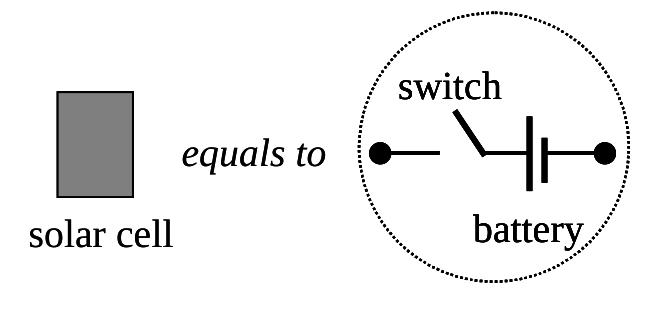
The source models a solar-cell piece as a battery in series with a switch (Figure 3). Light closes the switch, allowing current; an opaque cover opens it so no current is produced. You have four pieces connected in an unknown arrangement. Determine their connections.
Arrange the equipment as in Figure 1.
**1.** Select the blue source and a 3 volt battery.
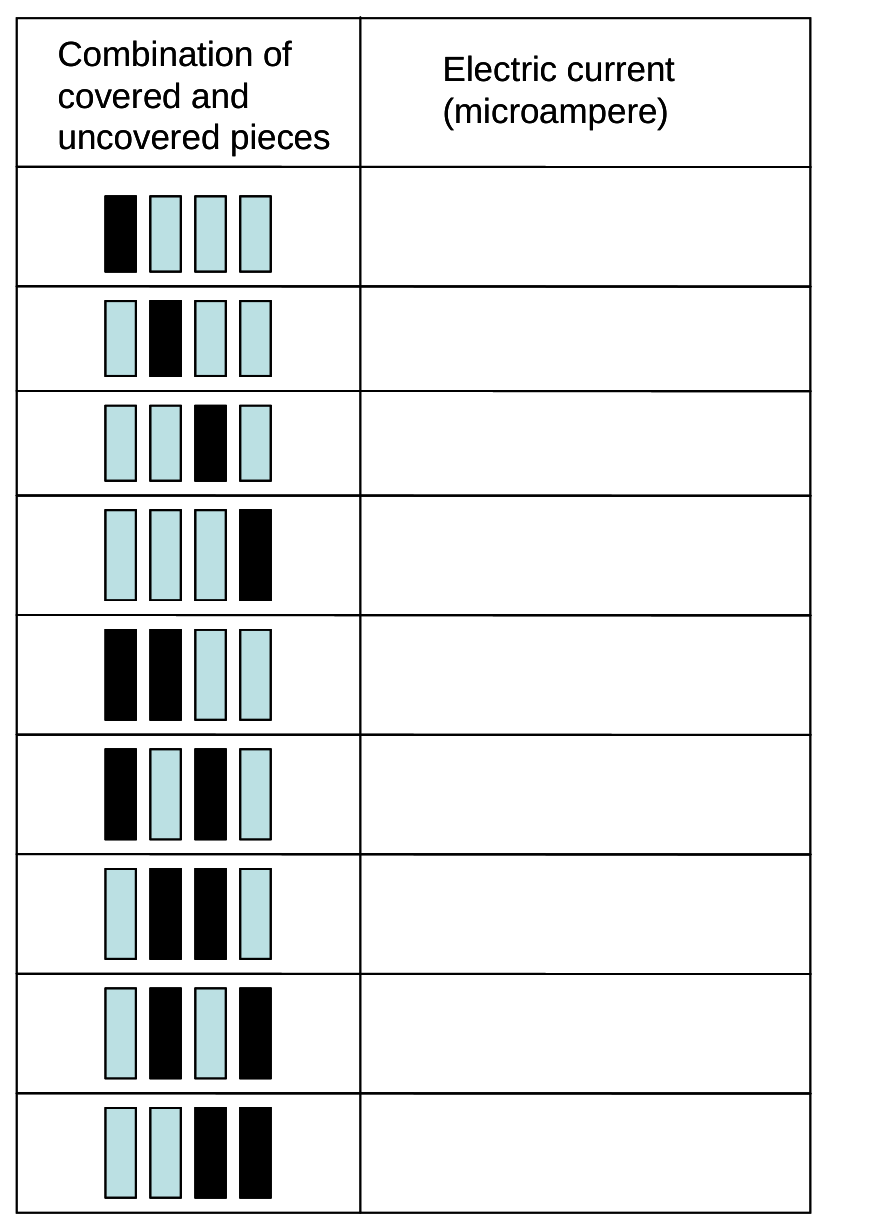
**2.** Cover the pieces in the nine combinations in original Table 3 below. Record each current.
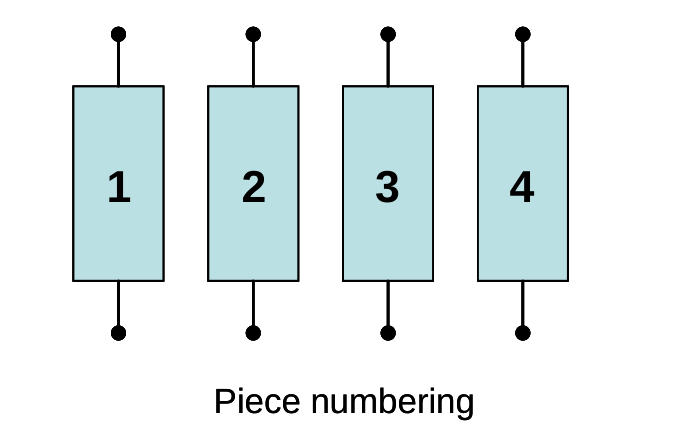
**3.** Complete Table 3 (18 points). Black means covered and gray means uncovered. The equivalent written recording table below uses piece numbers 1–4 from left to right; the original diagram remains authoritative.
| Covered pieces | Current (microamperes) |
| --- | --- |
| 1 | ____ |
| 2 | ____ |
| 3 | ____ |
| 4 | ____ |
| 1 and 2 | ____ |
| 1 and 3 | ____ |
| 2 and 3 | ____ |
| 2 and 4 | ____ |
| 3 and 4 | ____ |
Step 4. From Table 3, draw the connections (series, parallel or a combination). Treat a current below 0.5 microampere as no current. Number the pieces according to the original numbering figure. (10 points)
IV. Designing the Solar Panel
Illuminate the solar cell with blue light at 15 cm. Record the current: ____ microamperes.
a. Calculate the number of solar-cell pieces needed to produce 10 microamperes. (5 points)
b. Calculate their total area. (5 points)
Original Figure 1, Figure 2, Figure 3, Table 3 and piece numbering follow in that order. The multimeter digits in the artwork are illustrative, not supplied measurements.
I. Introduction
Look at leaves and grass: they are green. Why do some bodies look red and others blue under the same light? In sunlight, grass looks green, roofs brown and paper white. Investigate the behavior of colors.
II. Apparatus
Three light sources emitting blue, green and red; three colored screens (plates), blue, green and red; a solar cell; batteries; a multimeter adjusted to measure electric current; a static pod (stand); a ruler.
III. Method
Use the solar cell as a detector of different colored lights. Follow teacher supervision and the specified low-voltage setup; never short-circuit a battery.
III.1 Determining the color of light that has the highest energy
The source states that a solar cell produces current when illuminated, and treats the measured current as representing received light energy: greater energy gives greater current. Set up the apparatus as in Figure 1. (This simplified interpretation is examined in the explanation.)
**1.** Use the blue light source and a 6 volt battery.
**2.** Place the light source 10 cm from the solar cell.
**3.** Adjust the source so the light spot is focused at the center of the solar cell.
**4.** Record the current shown by the multimeter in microamperes.
**5.** Repeat steps 2–4 for green and red sources.
**6.** Complete Table 1 (9 points).
| Light color | Current (microamperes) |
| --- | --- |
| Blue | ____ |
| Green | ____ |
| Red | ____ |
Step 7. Which color has the highest energy? Explain your answer. (4 points)
III.2 Determining the color reflected by a colored body
Arrange the apparatus as in Figure 2 to measure light reflected by a colored screen under a specific light color.
**1.** Fix the position of the solar cell.
**2.** Select a blue source and a 9 volt battery.
**3.** Place a blue screen in position.
**4.** Record the current.
**5.** Repeat steps 3–4 for the other two plates.
**6.** Repeat steps 2–5 for the other two light sources.
**7.** Complete Table 2 (18 points).
| Light color | Plate color | Current (microamperes) |
| --- | --- | --- |
| Blue | Blue | ____ |
| Blue | Green | ____ |
| Blue | Red | ____ |
| Green | Blue | ____ |
| Green | Green | ____ |
| Green | Red | ____ |
| Red | Blue | ____ |
| Red | Green | ____ |
| Red | Red | ____ |
Step 8. Based on the table, determine which color is reflected by each colored plate. Explain your answer. (4 points)
III.3 Identifying the wiring of solar cells
The source models a solar-cell piece as a battery in series with a switch (Figure 3). Light closes the switch, allowing current; an opaque cover opens it so no current is produced. You have four pieces connected in an unknown arrangement. Determine their connections.
Arrange the equipment as in Figure 1.
**1.** Select the blue source and a 3 volt battery.
**2.** Cover the pieces in the nine combinations in original Table 3 below. Record each current.
**3.** Complete Table 3 (18 points). Black means covered and gray means uncovered. The equivalent written recording table below uses piece numbers 1–4 from left to right; the original diagram remains authoritative.
| Covered pieces | Current (microamperes) |
| --- | --- |
| 1 | ____ |
| 2 | ____ |
| 3 | ____ |
| 4 | ____ |
| 1 and 2 | ____ |
| 1 and 3 | ____ |
| 2 and 3 | ____ |
| 2 and 4 | ____ |
| 3 and 4 | ____ |
Step 4. From Table 3, draw the connections (series, parallel or a combination). Treat a current below 0.5 microampere as no current. Number the pieces according to the original numbering figure. (10 points)
IV. Designing the Solar Panel
Illuminate the solar cell with blue light at 15 cm. Record the current: ____ microamperes.
a. Calculate the number of solar-cell pieces needed to produce 10 microamperes. (5 points)
b. Calculate their total area. (5 points)
Original Figure 1, Figure 2, Figure 3, Table 3 and piece numbering follow in that order. The multimeter digits in the artwork are illustrative, not supplied measurements.