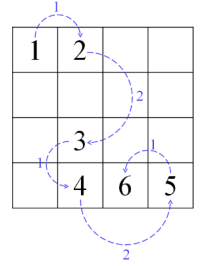
The source example places a chain of consecutive positive integers in a $4\times4$ grid: $1\to2\to3\to4\to5\to6$, with successive distances $1,2,1,2,1$.
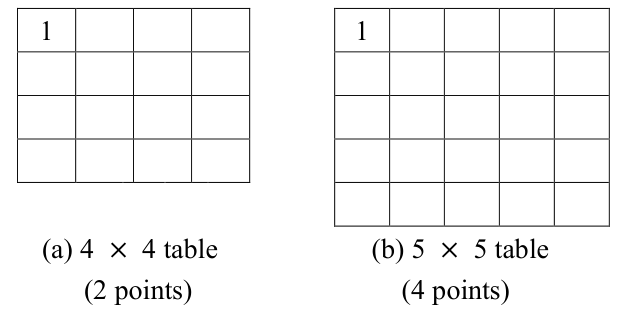
Starting with 1 in the top-left cell, construct the longest possible chain with distances $1,2,1,2,\ldots$ alternately. What is the largest number that can be placed in (i) a $4\times4$ grid, and (ii) a $5\times5$ grid? Draw an example for each.
Choose each number from 1 through 10 exactly once as a length or width to construct five different rectangles. Can these five pieces tile, without overlaps, (I) an $11\times11$ square and (II) a $13\times13$ square? If yes, draw an example; if not, explain why. Rectangles may be rotated or reflected.
A first straight cut divides a square sheet into two polygons. Each subsequent move divides any one resulting polygon into two by a straight cut. No folding and no cutting two papers together are allowed. Find the minimum cuts needed to obtain, together with any other polygons: (a) two polygons with exactly 20 sides each; (b) three polygons with exactly 30 sides each; (c) four polygons with exactly 60 sides each.
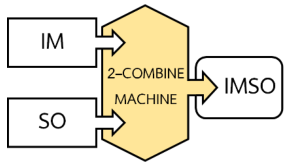
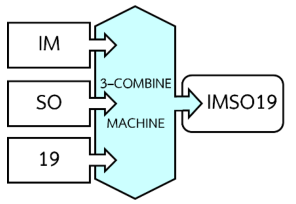
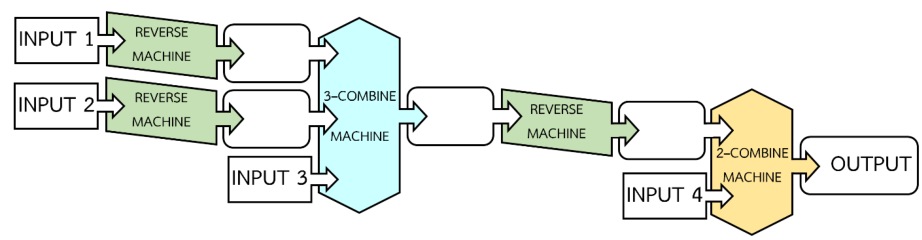
A REVERSE machine reverses the order of the input characters. A 2-COMBINE machine joins the upper input before the lower. A 3-COMBINE machine joins the top, middle, then bottom input.
Use the following network of three REVERSE, one 2-COMBINE and one 3-COMBINE machines.
(a) Give two choices of INPUT 1, INPUT 2, INPUT 3 and INPUT 4 that produce ILOVEIMSO19. (b) How many such choices exist? Each input must contain at least one character. The source says “letter”; its examples include the digits 1 and 9 as characters.
In increasing order, list the positive integers containing only odd digits: $1,3,5,7,9,11,13,15,17,19,31,33,35,37,39,51,53,55,\ldots$. (a) Find the 2022nd term. (b) Find the smallest term whose digit sum is 2022. (c) Find the sum of all terms not exceeding 2022.
He first takes one odd and one even card, then another odd and even card from those remaining, and arranges the four cards in a row. Rule 1: “The product of each and every pair of odd and even cards selected is always a one-digit number.” Rule 2: the positive difference between the two odd cards must differ from the positive difference between the two even cards. (a) How many four-digit numbers satisfy these rules? (b) How many if the product in Rule 1 is instead a two-digit number less than 20? (c) How many if it is instead a multiple of 3 less than 40?