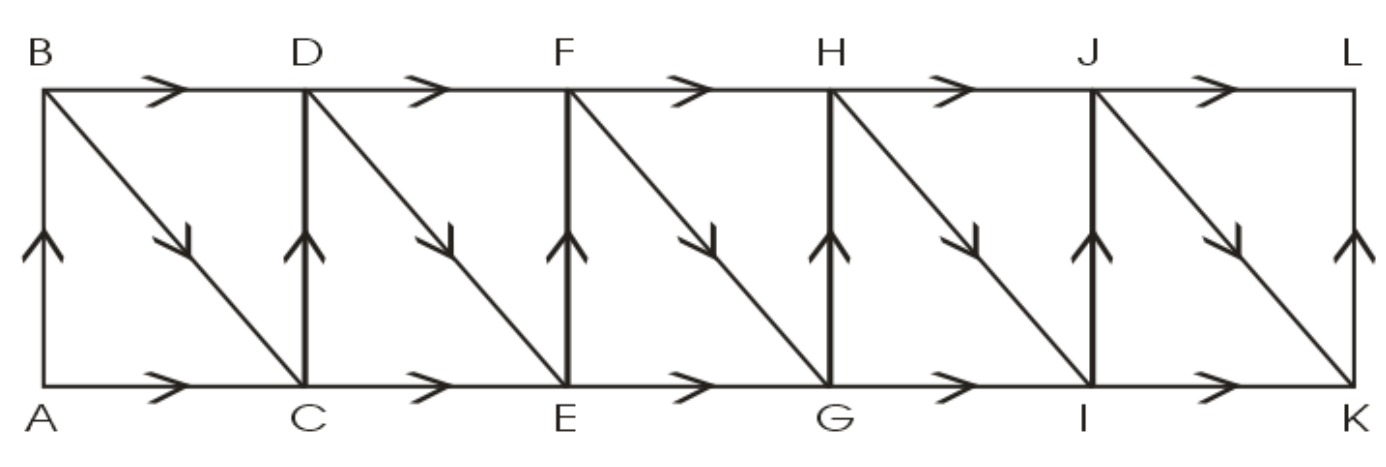
The figure shows a road map of Gotthem City. Every road is one way, as indicated by the arrow.
(a) How many possible routes are there from A to D?
(b) How many possible routes are there from A to H?
(c) How many possible routes are there from A to L?
Some people are playing a card game. On the table are fifty cards, numbered 1 to 50, all facing up. Each player is allowed to choose a certain number of cards. The player whose chosen cards have the highest total is the winner. There is only one winner.
What is the lowest possible score that makes a player a sure winner if each player has to choose:
(a) two cards?
(b) three cards?
(c) five cards?
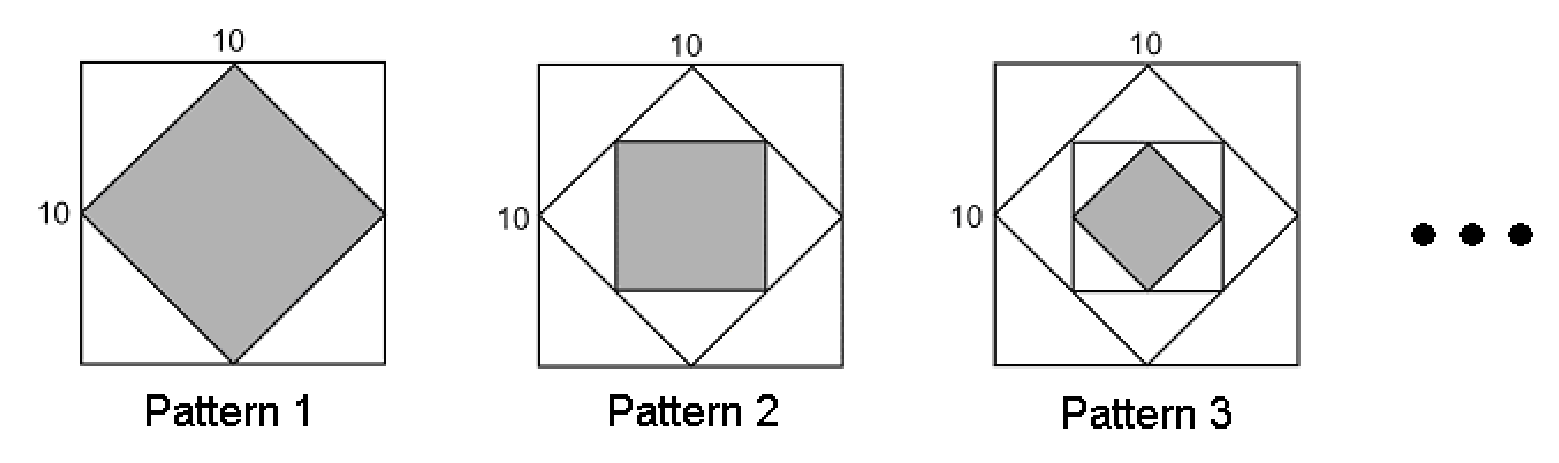
Consider the sequence of figures. The large square in every pattern has side length 10 cm. Successive inner squares are formed by joining the midpoints of the respective sides of the preceding square, as shown.
(a) Determine the area of the shaded region in each of Pattern 1, Pattern 2 and Pattern 3.
(b) If the pattern continues, determine the area of the shaded region in Pattern 10. The source labels “Pattern 1”, “Pattern 2”, “Pattern 3” name the three examples.
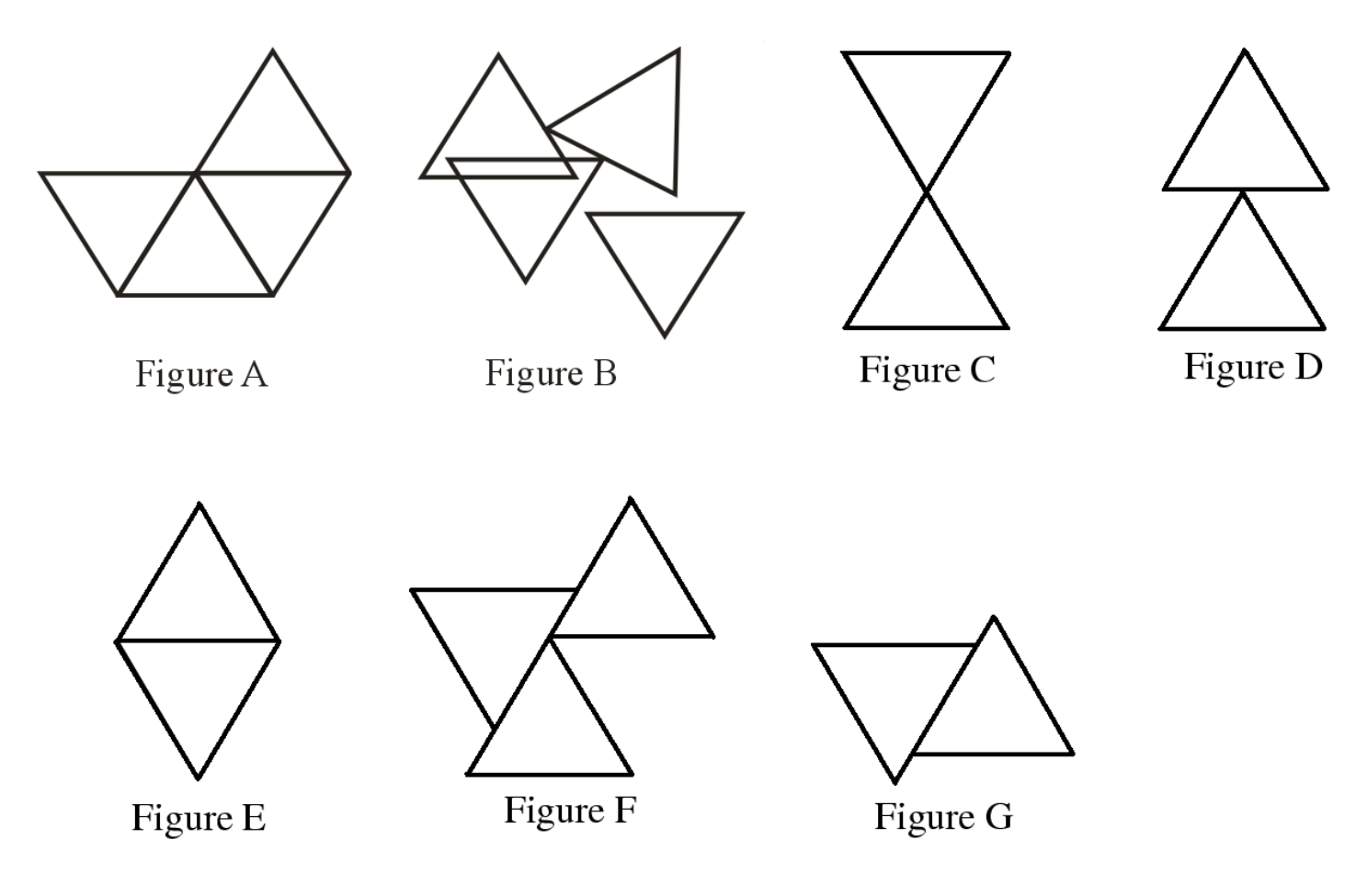
We can put together four equilateral triangles of side length 1 unit to form shapes in the plane, subject to these conditions:
(i) The shape is connected.
(ii) No triangles overlap.
(iii) A triangle is connected to the rest by at least a side or part of a side.
Figure A satisfies the conditions and has perimeter 6 units. Figures B, C and D are not allowed; Figures E, F and G are allowed.
(a) Using four triangles, draw one shape with perimeter 7 units.
(b) Can you make a shape with perimeter 11 units using four triangles? If yes, draw one example.
(c) What is the smallest whole number that can be the perimeter of a shape made with six triangles?
(d) What is the largest whole number that can be the perimeter of a shape made with six triangles?
The source figure labels “Figure A” through “Figure G” identify the seven examples.
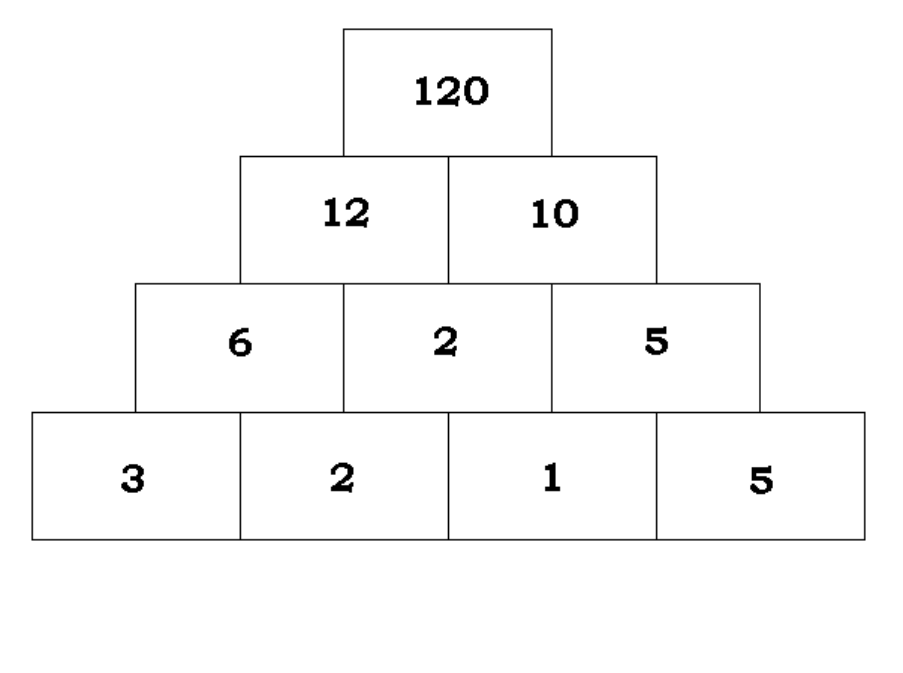
Ten rectangles form a pyramid. Each rectangle is filled with a positive whole number following a certain rule. The bottom numbers 3, 2, 1, 5 produce the displayed pyramid and the top number 120.
(a) What is the rule for filling the rectangles?
(b) Using that rule, what is the top number when the bottom numbers are 1, 2, 1, 3 in this order?
(c) The same rule gives 2160 at the top. Find all possible ordered bottom rows if the number 1 is not used. The order 3,2,2,4 is considered different from 4,2,2,3.
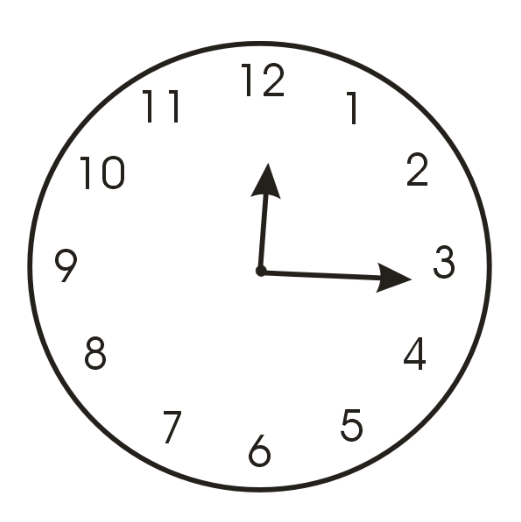
The hands of the clock shown form a right angle. The estimated time, to the nearest minute, is 12:16.
(a) When will the hands form a right angle for the first time after 12:16? Estimate to the nearest minute.
(b) After 1 o’clock, when will the hands form a right angle for the first time? Estimate to the nearest minute.
(c) From 2:00 a.m. to 12 noon of the same day, how many times will the hands form a right angle?