There is a coin machine. Each time somebody use it, the machine doubles the number of inserted coins and then automatically deducts 3 coins as a fee before returning them. Siti uses the machine three times in a row, always inserting in all the coins she has. After the third use, she ends up with 35 coins. How many coins does Siti have at first?
When a positive integer a is divided by a positive integer b, the remainder is 32. However, when 2a is divided by b, the remainder is 11. What is the value of b?
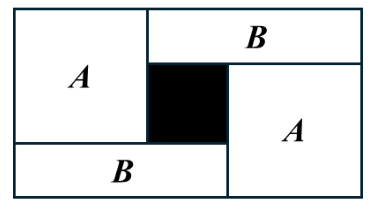
In the diagram below, a rectangular garden with length of 26 m and width of 14 m is shown. It is divided into five sections (two identical squares A, two identical rectangles B and one shaded square). What is the area, in $\mathrm{m}^2$, of the shaded square?
A bag contains balls of four colours: orange, blue, red and yellow. Each student draws two balls from the bag at the same time. What is the least number of students required to guarantee that at least two students draw exactly the same pair of coloured balls?
Let A, B, C, D, E, F, G and H be a re-arrangement of prime numbers 2, 3, 5, 7, 11, 13, 17 and 19. What is the smallest possible value of $A\times B+C\times D+E\times F+G\times H$?
There are three fractions. Their numerators are positive integers in the ratio 3:2:4. While their denominators are also positive integers in the ratio 5:8:20. If the sum of these three fractions is $\frac{21}{40}$, what is the sum of their denominators?
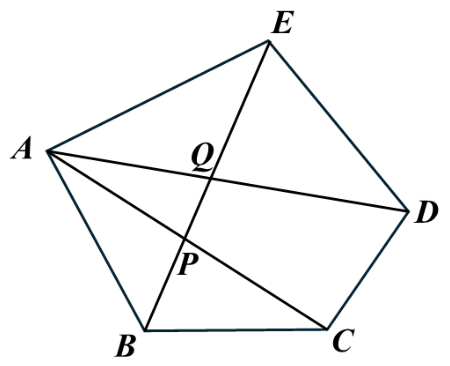
In the diagram below, ABCDE is a pentagon. Let AC and AD intersect BE at P and Q, respectively. Let the areas of ABP, AEQ, BCP, EDQ and CDQP be 6, 8, 9, 12 and $21\ \mathrm{cm}^2$, respectively. What is the area, in $\mathrm{cm}^2$, of APQ?
Hafiz has 15 cards, each showing one positive factor of 2025. He selects one or more cards and adds the numbers written on them. If the sum that he got is the largest possible palindromic number that can be obtained, what is the minimum number of cards he could have selected?
What is the positive difference between the smallest four–digit N and the largest four–digit N such that $\langle\langle N\rangle\times17\rangle=\langle N\rangle-1$?
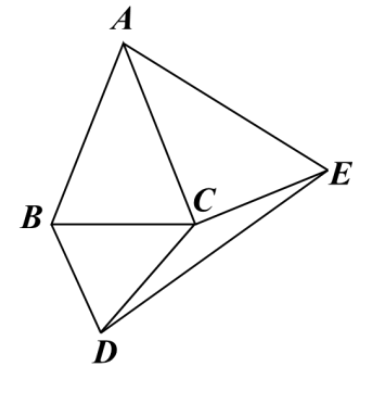
In the diagram below, ABC is an isosceles triangle with $AB=AC$, $\angle BAC=2x$, $AE=AC$ and $\angle CAE=\angle BAC$. Triangle BCD is also isosceles with $BC=BD$ and $\angle CBD=2x+18$. If $\angle CDE=x$ and $\angle DCE=9x-3$, what is the measure, in degrees, of $\angle CED$?
The three-digit number $\overline{abc}$ is reversed to form a new three-digit number $\overline{cba}$ where a, b and c are not necessarily distinct. We know that the original number plus the result of forty-five times the sum of its digits is equal to the new number. How many different numbers of $\overline{abc}$ satisfy the conditions?
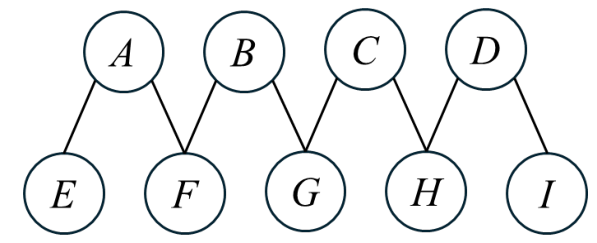
In the diagram below, the integers from 1 to 9 are to be filled into each circle, where each number is used exactly once, such that each number in the top row is equal to the sum of the two numbers in the two connected circles in the bottom row. For example, A = E + F and C = G + H. What is the minimum sum of all the numbers in the top row?
A palindrome is a number that remains the same when its digits are reversed. For example, the numbers 121 and 1331 are palindromes, while 123 is not. How many 6-digit palindromes are divisible by both 7 and 9?
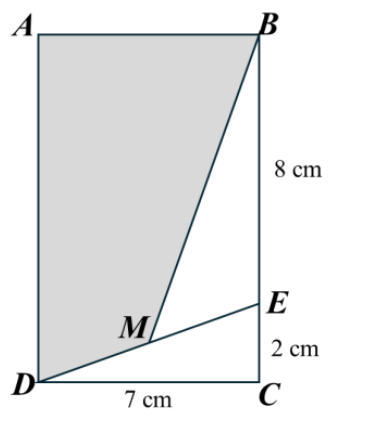
In the diagram, ABCD is a rectangle, where $DC=7$ cm, $CE=2$ cm and $EB=8$ cm. If M is the midpoint of the line segment DE, what is the area, in $\mathrm{cm}^2$, of ABMD?
For any positive integer n, we have $n!=1\times2\times3\times\cdots\times n$. If the last two digits of $1!+2!+3!+4!+\cdots+2025!$ is $\overline{ab}$, what is the value of $\overline{ab}$?
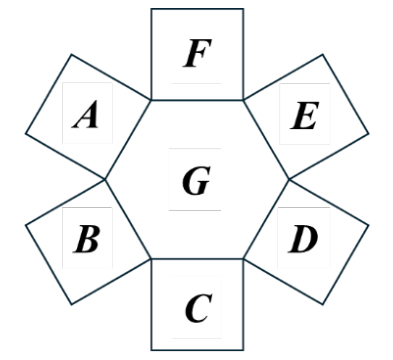
In the diagram below, the figure is divided into seven regions labelled A, B, C, D, E, F and G. Ros wants to fill in the diagram below with the positive integers from 1 to 7 in each region, where each integer can be only used exactly once.
If A + G + D = B + G + E = C + G + F, in how many ways can Ros complete the diagram?
Given a right-angled triangle ABC, with the right angle at B. If AB = 12 and the lengths of all the sides are positive integers, what is the sum of all the possible areas of the triangle ABC?