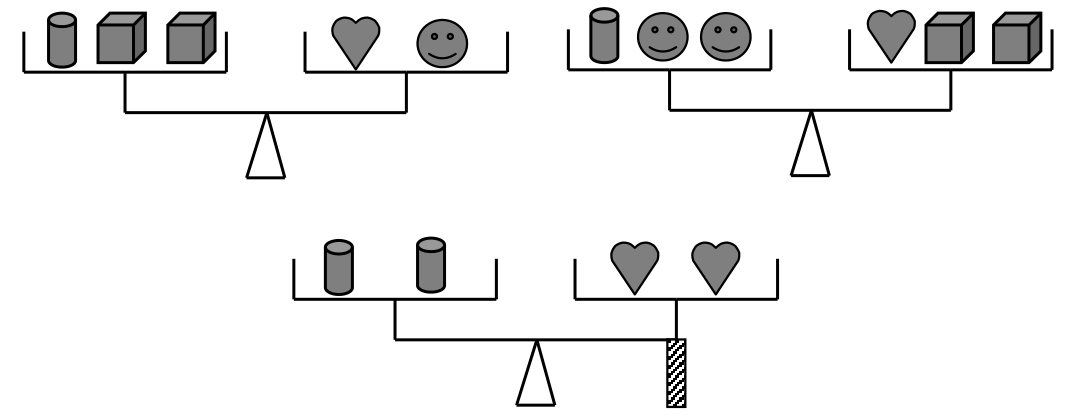
In the diagram the top two sets of scales are in perfect balance. For the third set, the right-hand side is heavier than the left-hand side and has to be supported as shown. What can be added to the left-hand side to achieve a perfect balance in this case as well?
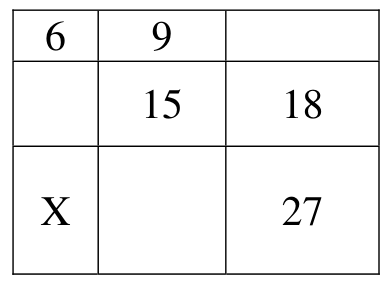
A rectangle is divided into 9 small rectangles, as shown in the diagram, which is not drawn to scale. The areas of 5 of the small rectangles (in suitable units) are given. What is $X$?
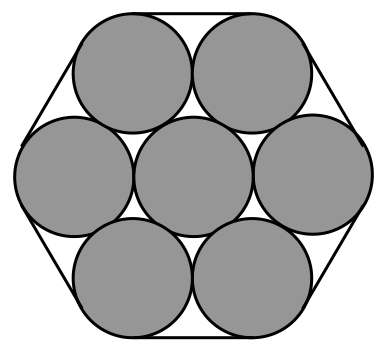
The diagram depicts seven soft-drink cans, seen from above, held tightly together by a ribbon. The circles represent the tops of the cans; the other curve, which is clearly not a circle, represents the edge of the ribbon. The ends of the ribbon meet exactly, with no overlap. All cans have diameter 6 cm. Find the exact length of the ribbon. (Take $\pi=3.14$.)
A, B, C and D are four members of the football team. No two have the same weight. A is 8 kg heavier than C. D is 4 kg heavier than B. The sum of the weights of the heaviest and the lightest is 2 kg less than the sum of the weights of the other two people. If all four weights total 402 kg, what does B weigh?
At a youth club one evening, one quarter of the members were playing pool, one sixth were playing table tennis, and five times the difference between these numbers were watching television. A further twelfth were reading, leaving 7 members wandering around undecided what to do. How many members were present that evening? Nobody was doing more than one thing at a time; for example, nobody was both playing pool and watching television.
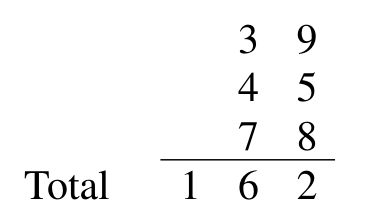
In the sum shown, each digit 1, 2, 3, 4, 5, 6, 7, 8, 9 occurs just once.
There are many similar sums in which three two-digit numbers are added to give a three-digit number and each digit 1–9 occurs exactly once. Find the largest total (the three-digit number).
A duck-pond in the local park has a one-mile path right round it. Grandma walked round the pond for an hour at an average speed of 3 miles per hour. Her grandson Jerry started at the same place and time, ran for an hour at an average speed of 8 miles per hour, and went in the opposite direction. How many times did they meet after starting and before the end of their respective exercise? Do not include the final encounter.
Catriona would like to become an Olympic sprinter. Her younger sister Morag would rather play football, but helps Catriona by racing against her. In a 100-metre dash, Catriona crossed the winning line when Morag was still 20 metres short of it. For a greater challenge, Catriona agreed to start 20 metres behind the normal starting line. Both ran at exactly the same speeds as in the first race. Where was Morag when Catriona crossed the winning line?
Six of seven positions are occupied by frogs numbered 1, 2, 3, 4, 5, 6 as shown. A frog may move to an adjacent vacant position, or leap over another frog into the vacant position two places away; it may move backward or forward. What is the least number of moves needed so that the frogs occupy the same six positions as initially, but in the order 6, 5, 4, 3, 2, 1 from left to right?
A date can be represented by three positive integers. For example, 17 June 1995 is 17.6.95: the 17th day of the 6th month in the 95th year of the 20th century. Define its “date sum” as the sum of these integers, so 17 June 1995 has date sum $17+6+95=118$. Let $n$ be the sum of the date sums of all days from 1 January 2001 to 31 December 2007 inclusive. Find $n$.
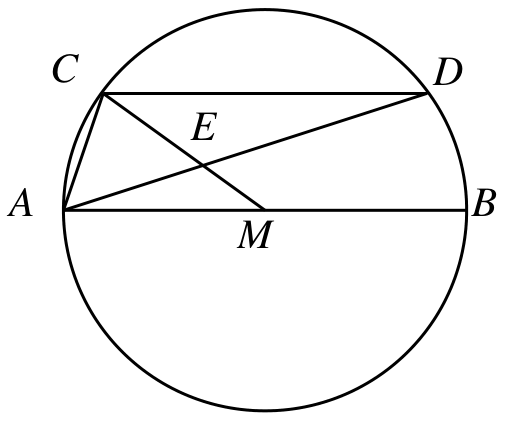
$AB$ is a diameter of a circle with centre $M$. Chord $CD$ is parallel to $AB$, and $C$ is its endpoint nearer to $A$. Line $MC$ meets $AD$ at $E$ such that $AC=EC$. Find the size of angle $CAM$.