An urn is filled with coins and beads, all of which are either silver or gold. Twenty percent of the objects in the urn are beads. Forty percent of the coins in the urn are silver. What percent of the objects in the urn are gold coins?
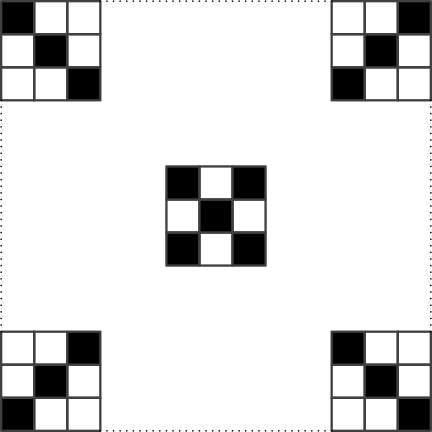
A square floor is tiled with congruent square tiles. The tiles on the two diagonals of the floor are black. The rest of the tiles are white. If there are $101$ black tiles, then the total number of tiles is
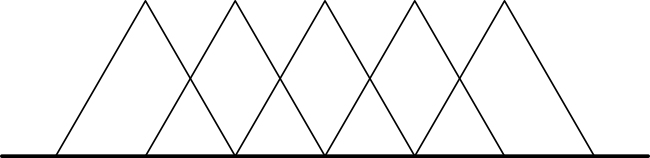
Five equilateral triangles, each with side $2\sqrt3,$ are arranged so they are all on the same side of a line containing one side of each. Along this line, the midpoint of the base of one triangle is a vertex of the next. The area of the region of the plane that is covered by the union of the five triangular regions is
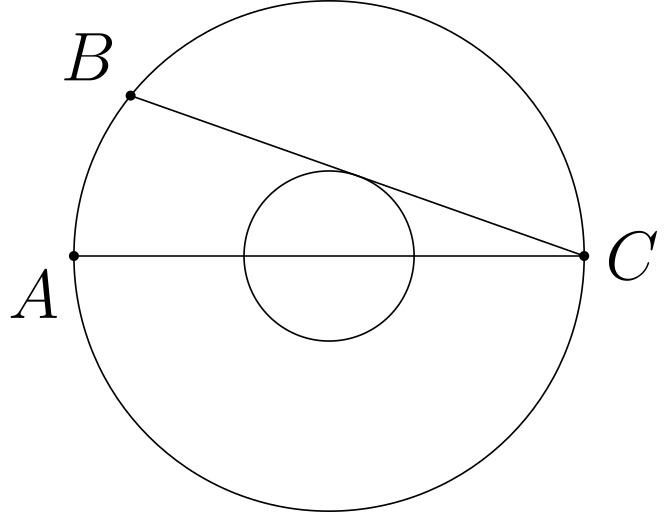
The ratio of the radii of two concentric circles is $1:3.$ If $\overline{AC}$ is a diameter of the larger circle, $\overline{BC}$ is a chord of the larger circle that is tangent to the smaller circle, and $AB=12,$ then the radius of the larger circle is
Which of the following equations have the same graph? $$
\begin{aligned} &\text{I. }y=x-2\\ &\text{II. }y=\dfrac{x^2-4}{x+2}\\ &\text{III. }(x+2)y=x^2-4 \end{aligned}
$$
Let $i=\sqrt{-1}.$ For $n\ge1,$ define a sequence of complex numbers by $$
\begin{aligned} z_1&=0,\\ z_{n+1}&=z_n^2+i. \end{aligned}
$$ In the complex plane, how far from the origin is $z_{111}?$
The two-digit integers from $19$ to $92$ are written consecutively to form the large integer $$
N=19202122\ldots909192.
$$ If $3^k$ is the highest power of $3$ that is a factor of $N,$ then $k=$
The increasing sequence of positive integers $a_1,$ $a_2,$ $a_3,$ $\ldots$ has the property that, for every $n\ge1,$ $$
a_{n+2}=a_n+a_{n+1}.
$$ If $a_7=120,$ then $a_8$ is
For each vertex of a solid cube, consider the tetrahedron determined by the vertex and the midpoints of the three edges that meet at that vertex. The portion of the cube that remains when these eight tetrahedra are cut away is called a *cuboctahedron*. The ratio of the volume of the cuboctahedron to the volume of the original cube is closest to which of these?
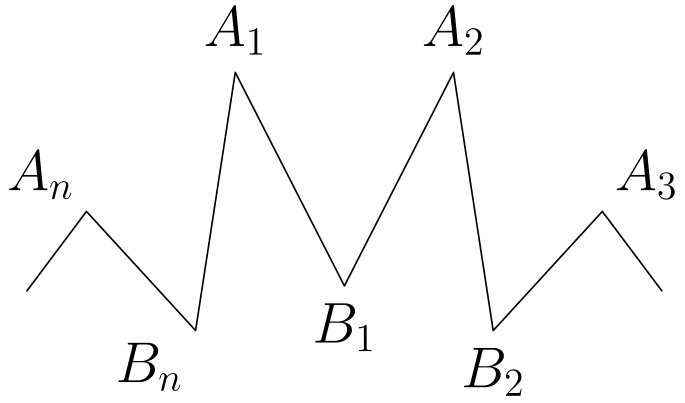
Part of an “$n$-pointed regular star” is shown. It is a simple closed polygon in which all $2n$ edges are congruent, angles $A_1,$ $A_2,$ $\ldots,$ $A_n$ are congruent, and angles $B_1,$ $B_2,$ $\ldots,$ $B_n$ are congruent. If the acute angle at $A_1$ is $10^\circ$ less than the acute angle at $B_1,$ then $n=$