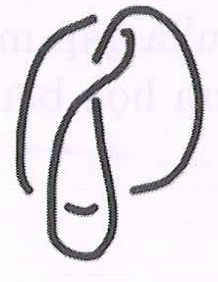
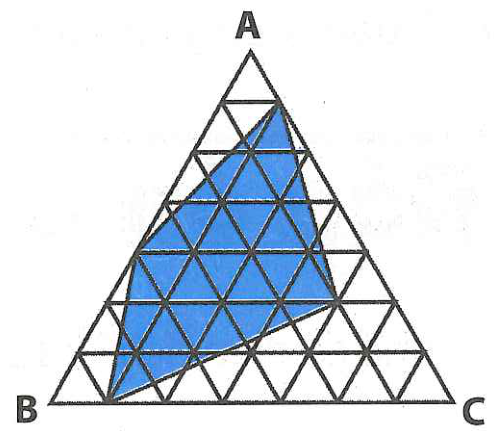
In a piggy-bank collecting game, a player puts a counter on START, then repeatedly jumps it forward by 2 or 3 squares. The journey must end on END. Whenever the counter lands on a square, the player may choose to collect the piggy bank on that square. Which of the following collections is certainly impossible at the end of a turn? In the diagram, Hồng means pink, Tím means purple, and Xanh means green.
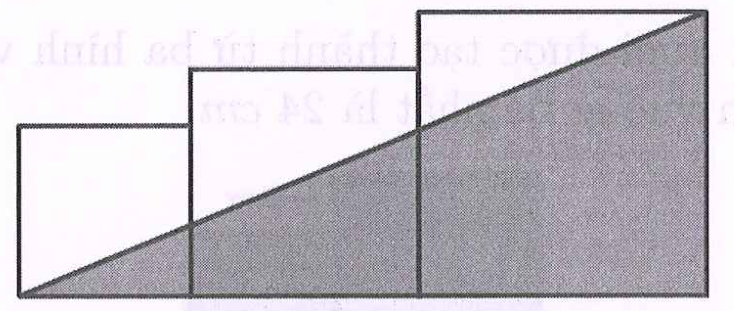
In the diagram, the areas of the three squares, in order, are 9 cm², 16 cm² and 25 cm². What is the area of the black-shaded region in square centimetres?
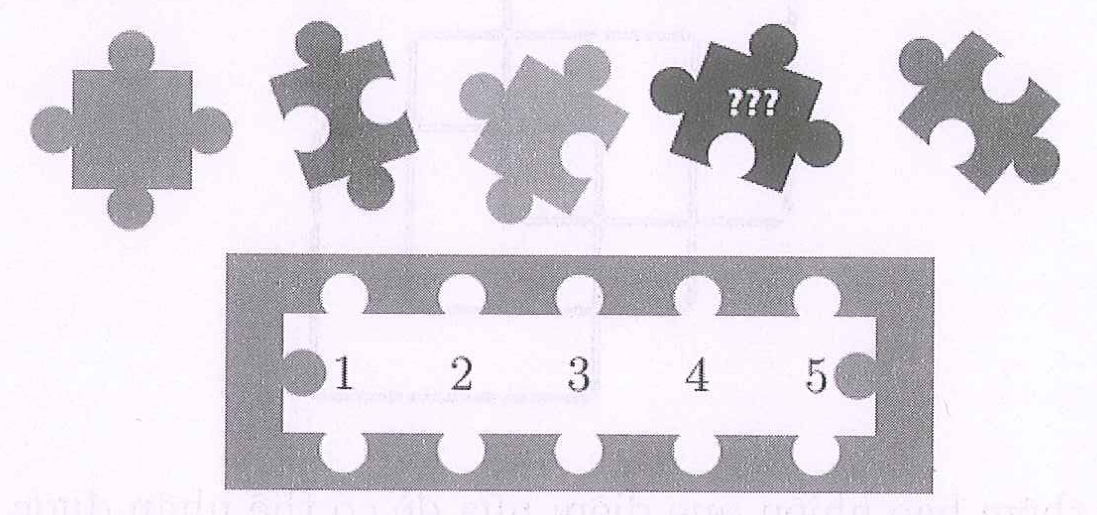
Lisa is playing a jigsaw game. The picture shows her game: she must fit the five pieces into the positions numbered 1 to 5 to cover the frame. In how many positions can the fourth piece from the left be placed so that the other pieces can complete the frame?
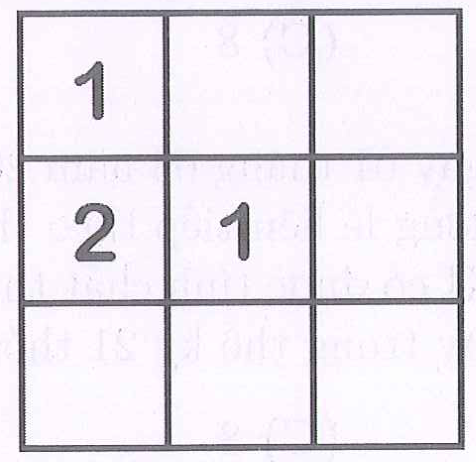
Jenny gives Julia the shown 3 × 3 grid with some numbers already entered. She challenges Julia to fill the remaining cells so that each digit 1, 2, 3 occurs exactly once in every row and every column. How many fillings satisfy this condition?
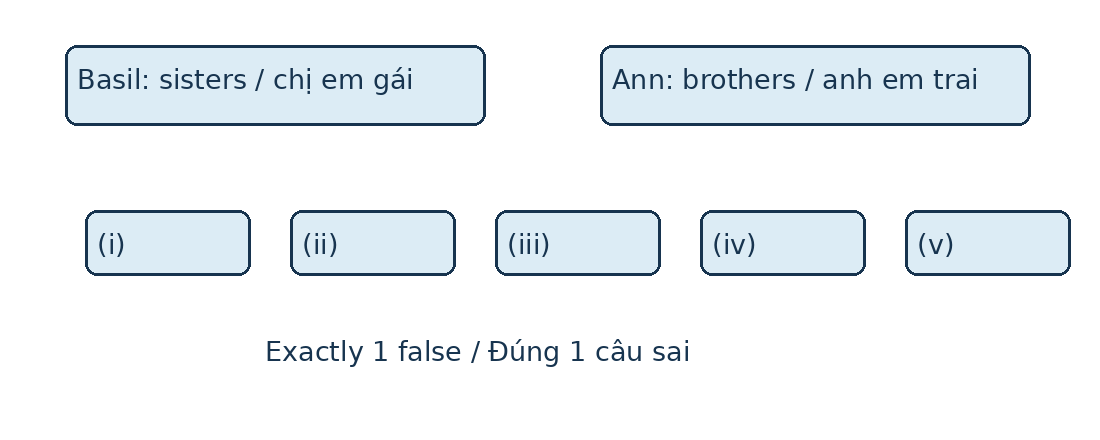
Robert makes five statements: (i) My son Basil has 3 sisters. (ii) My daughter Ann has 2 brothers. (iii) My daughter Ann has 2 sisters. (iv) My son Basil has 2 brothers. (v) I have 5 children altogether. Exactly one statement is false. Which is it?
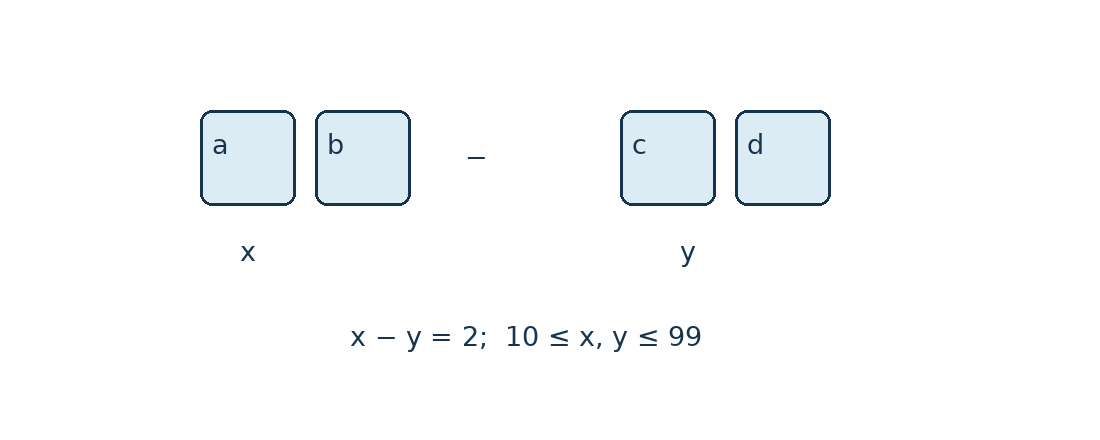
Looking at 2018, Tom notices that the difference of the two two-digit numbers obtained by splitting it in half, in their original order, is 2 (20−18=2). How many four-digit numbers have this property?
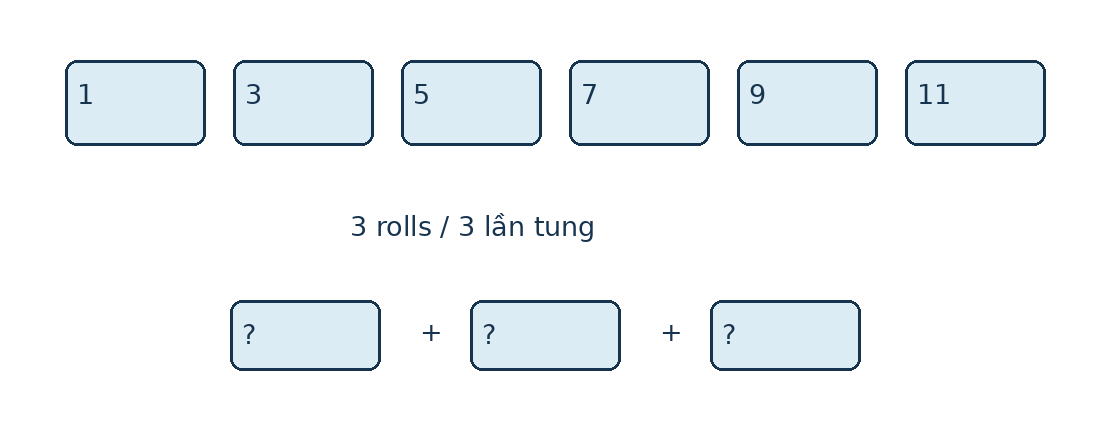
Tony has a die whose six faces show the six smallest positive odd integers. He rolls it three times and adds the three values. Which number cannot be his result?
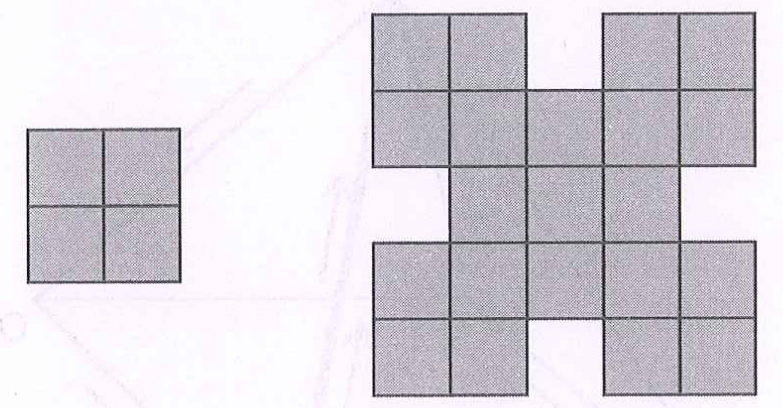
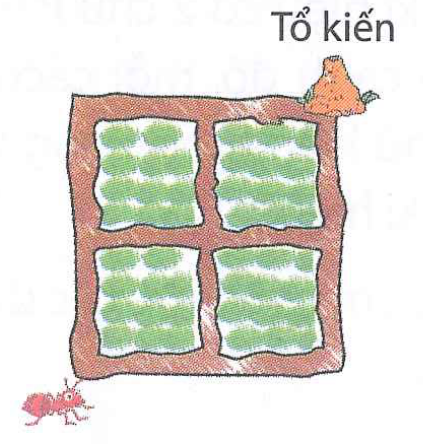
After each search for food, a fire ant follows the field boundaries back to its nest, as shown. To take a shortest route it can move only upwards or to the right. Find the number of routes through the following questions.
1. How many field edges must the ant traverse? How many upwards and how many to the right? Each side of one field cell counts as one edge.
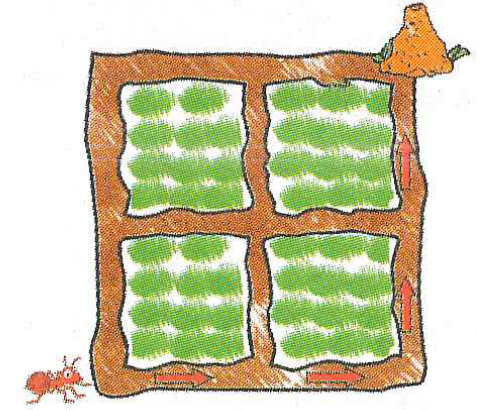
2. List the ant’s routes home. Let P denote right and L denote up. The illustrated example is PPLL.
– List all four-letter strings containing two P letters and two L letters.
– Count and compare the ant’s routes and these strings.
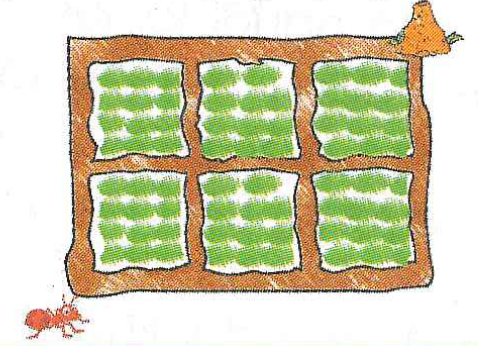
3. A larger field has six cells as shown. Using the preceding questions, determine the number of routes home.
Figures in order: original 2 × 2 field; the PPLL example; the larger 3 × 2 field.
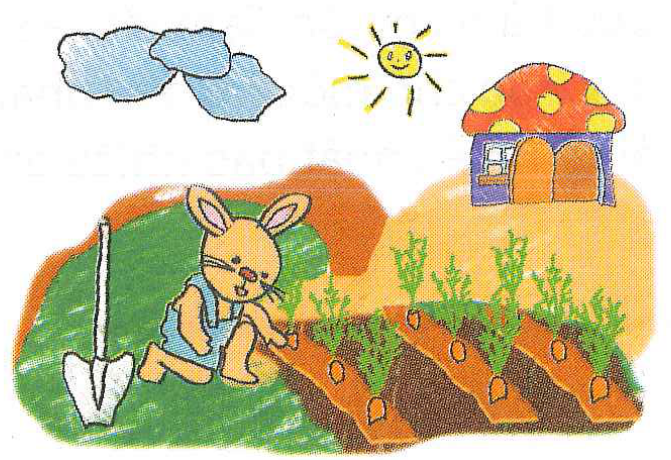
Rabby the rabbit plants carrots along a bed 6 m long. Neighbouring plants are 20 cm apart: the holes are circular, their adjacent centres are 20 cm apart, and the hole size is negligible. After harvesting, he wants to reuse the carrot holes to plant cabbages, but neighbouring cabbages must be 50 cm apart. How many holes stay in use? There is a hole at each end of the bed.
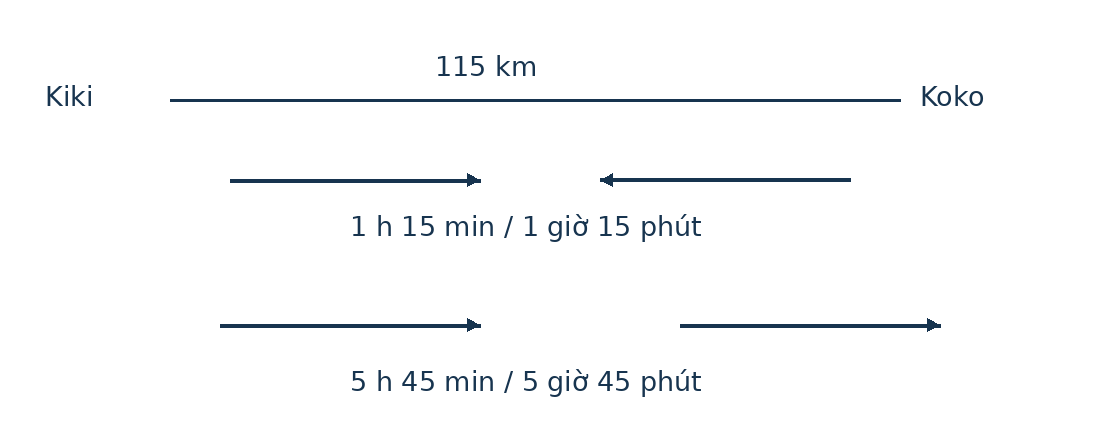
The distance between the two ends of a forest is 115 km. Horses Kiki and Koko start simultaneously from opposite ends. Travelling towards each other, they meet after 1 hour 15 minutes. Travelling in the same direction, with the faster horse chasing the slower one, they meet after 5 hours 45 minutes. What are their speeds?
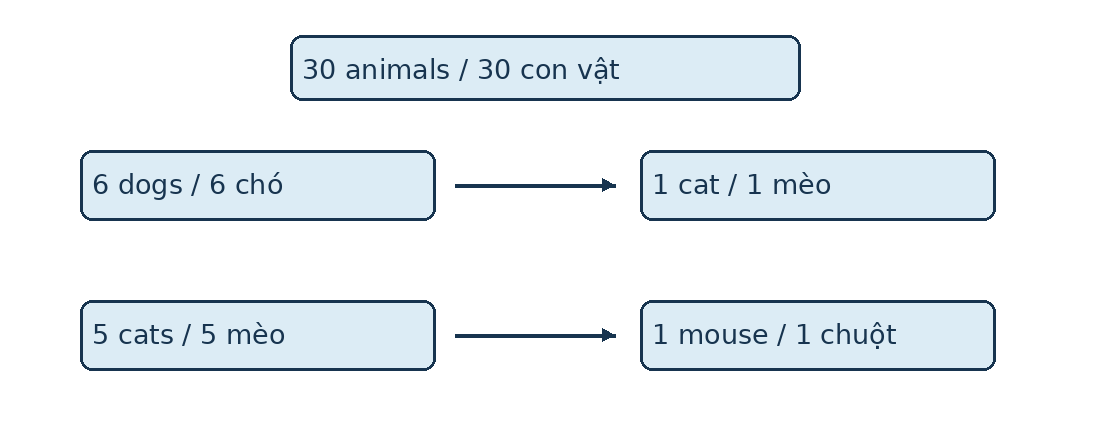
A witch’s farm has 30 pets of three kinds: dogs, cats and mice. She turns 6 dogs into one cat, then turns 5 cats into one mouse. She then finds that all three kinds have equal populations. How many cats were there initially?
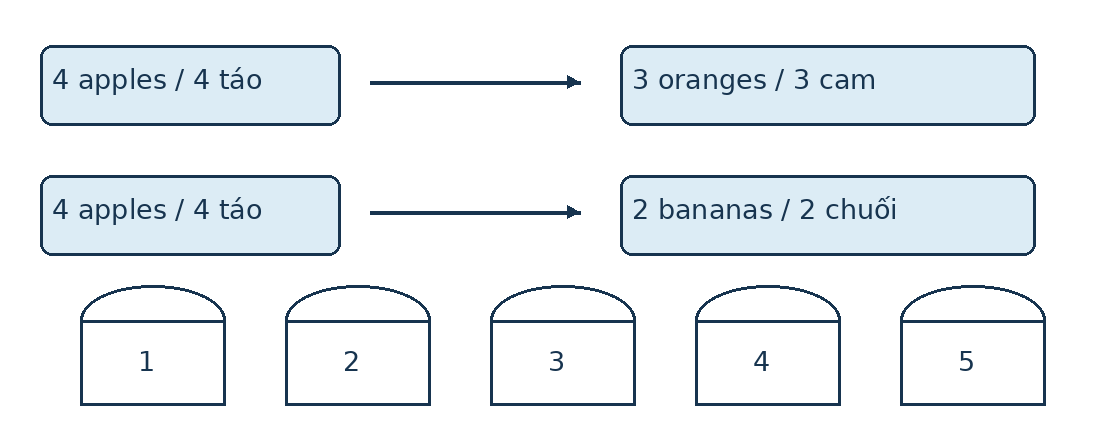
At the fruit market in Kangcity, fruit can be exchanged: 4 apples for 3 oranges or for 2 bananas, in either direction. Fruit cannot be cut up. Ben’s garden grows only apples, and he has harvested many. He wants to exchange some apples so that he can prepare 5 gift baskets, each containing oranges, apples and bananas. Each basket must have the same total number of pieces of fruit. What is the least number of apples he needs?
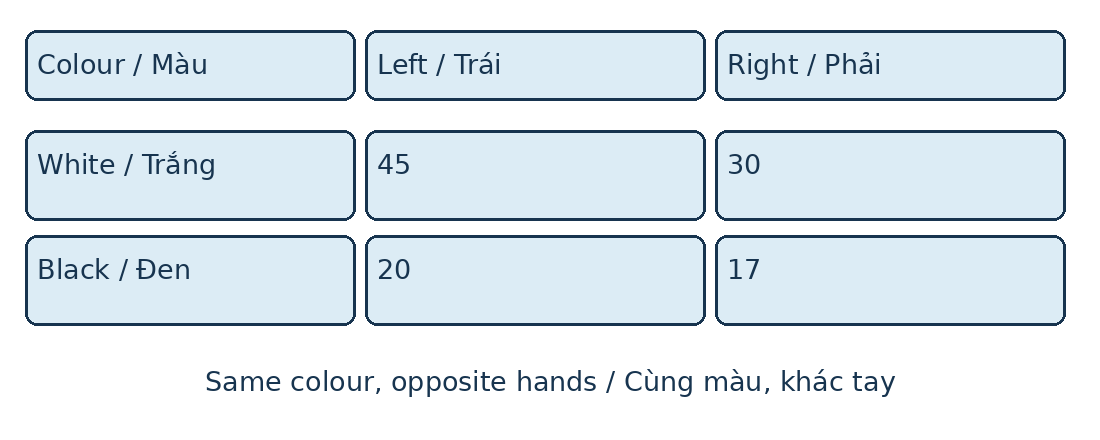
A bag contains 30 white right-hand gloves, 20 black left-hand gloves, 45 white left-hand gloves and 17 black right-hand gloves. You draw gloves one at a time without looking. What is the smallest number of draws that guarantees a matching pair consisting of a left and a right glove of the same colour?
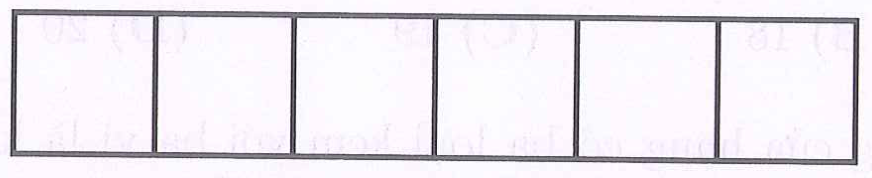
Tom has a horizontal strip of six square cells as shown. He wants to colour each cell green, red or yellow, with neighbouring cells different colours. Two colourings count as the same if one strip can be obtained by rotating the other. How many different colourings are possible?
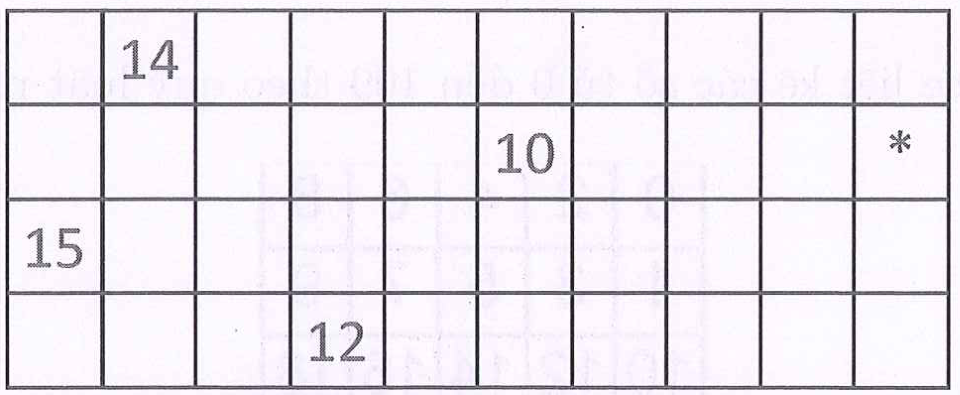
Emily fills every cell of the shown grid with a positive integer so that any three consecutive cells in a row or column sum to 40. Some entries are already given. What number belongs in the cell marked *?