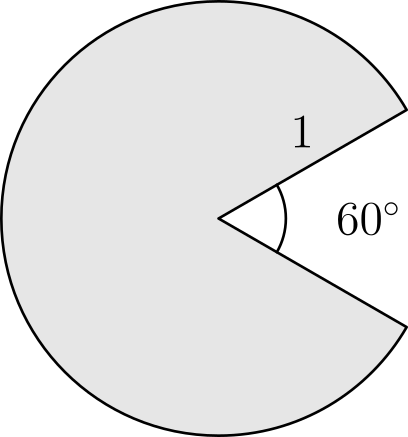
In an arcade game, the “monster” is the shaded sector of a circle of radius $1$ cm, as shown in the figure. The missing piece (the mouth) has central angle $60^\circ.$ What is the perimeter of the monster in cm?
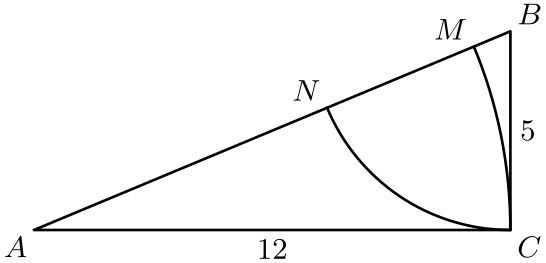
In right $\triangle ABC$ with legs $5$ and $12,$ arcs of circles are drawn, one with center $A$ and radius $12,$ the other with center $B$ and radius $5.$ They intersect the hypotenuse in $M$ and $N.$ Then $MN$ has length
A large bag of coins contains pennies, dimes and quarters. There are twice as many dimes as pennies and three times as many quarters as dimes. An amount of money which could be in the bag is
Which terms must be removed from the sum $$
\frac12+\frac14+\frac16+\frac18+\frac1{10}+\frac1{12}
$$ if the sum of the remaining terms is to equal $1?$
One student in a class of boys and girls is to be chosen to represent the class. Each student is equally likely to be chosen and the probability that a boy is chosen is $\frac23$ of the probability that a girl is chosen. The ratio of the number of boys to the total number of boys and girls is
In some computer languages (such as APL), when there are no parentheses in an algebraic expression, the operations are grouped from right to left. Thus, $a\times b-c$ in such languages means the same as $a(b-c)$ in ordinary algebraic notation. If $a\div b-c+d$ is evaluated in such a language, the result in ordinary algebraic notation would be
The odd positive integers, $1,$ $3,$ $5,$ $7,$ $\ldots,$ are arranged in five columns continuing with the pattern shown. Counting from the left, the column in which $1985$ appears is the $$
\begin{array}{ccccc} &1&3&5&7\\ 15&13&11&9&\\ &17&19&21&23\\ 31&29&27&25&\\ &33&35&37&39\\ 47&45&43&41&\\ &49&51&53&55 \end{array}
$$
How many distinguishable rearrangements of the letters in CONTEST have both the vowels first? (For instance, OETCNST is one such arrangement, but OTETSNC is not.)
Let $p,$ $q$ and $r$ be distinct prime numbers, where $1$ is not considered a prime. Which of the following is the smallest positive perfect cube having $n=pq^2r^4$ as a divisor?
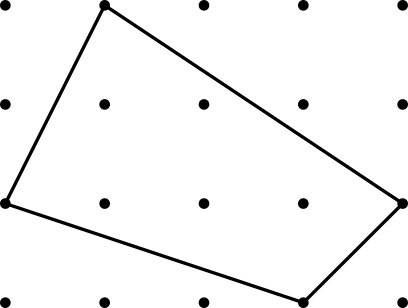
Pegs are put in a board $1$ unit apart both horizontally and vertically. A rubber band is stretched over $4$ pegs as shown in the figure, forming a quadrilateral. Its area in square units is
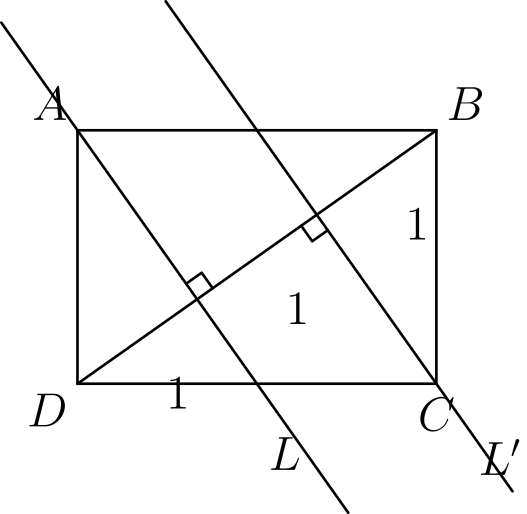
Diagonal $DB$ of rectangle $ABCD$ is divided into three segments of length $1$ by parallel lines $L$ and $L'$ that pass through $A$ and $C$ and are perpendicular to $DB.$ The area of $ABCD,$ rounded to one decimal place, is
Six bags of marbles contain $18,$ $19,$ $21,$ $23,$ $25$ and $34$ marbles, respectively. One bag contains chipped marbles only. The other $5$ bags contain no chipped marbles. Jane takes three of the bags and George takes two of the others. Only the bag of chipped marbles remains. If Jane gets twice as many marbles as George, how many chipped marbles are there?
Consider the graphs of $y=Ax^2$ and $y^2+3=x^2+4y,$ where $A$ is a positive constant and $x$ and $y$ are real variables. In how many points do the two graphs intersect?
exactly $4$
exactly $2$
at least $1,$ but the number varies for different positive
values of $A$
A wooden cube with edge length $n$ units (where $n$ is an integer $\gt2$) is painted black all over. By slices parallel to its faces, the cube is cut into $n^3$ smaller cubes each of unit edge length. If the number of smaller cubes with just one face painted black is equal to the number of smaller cubes completely free of paint, what is $n?$