In triangle $ABC$, $AB = 6$, $BC = 10$, and $CA = 14$. If $D$, $E$, and $F$ are the midpoints of sides $BC$, $CA$, and $AB$, respectively, find $AD^{2} + BE^{2} + CF^{2}$.
How many ways are there to arrange 5 identical red balls and 5 identical blue balls in a line if there cannot be three or more consecutive blue balls in the arrangement?
Let $x$, $y$, and $z$ be real numbers that satisfy the following system:
$$
\begin{aligned}
x+3y+6z &= 1 \\
xy+2xz+6yz &= -8 \\
xyz &= 2
\end{aligned}
$$
Find the smallest possible value of $x+y+z$.
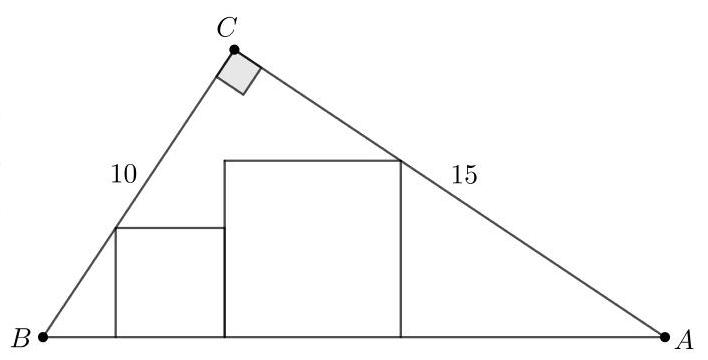
In a right triangle $ABC$ with $\angle C = 90^\circ$, $BC = 10$, and $AC = 15$. Two squares are inscribed in $ABC$ as shown in the figure. Find the minimum sum of the areas of the squares.
Let $\triangle ABC$ be a right triangle with legs $AB = 6$ and $BC = 8$. Let $R$ and $r$ be the circumradius and the inradius of $\triangle ABC$, respectively. Find the sum of $R$ and $r$.
We say that the constant $a$ is a fixed point of a function $f$ if $f(a)=a$. Find all values of $c$ such that $f(x)=x^{2}-2$ and $g(x)=2x^{2}-c$ share a common fixed point.
How many pairs of positive integers $(a, b)$ are there, both not exceeding $10$, such that $a \leq \operatorname{gcd}(a, b) \leq b$ and $a \leq \operatorname{lcm}(a, b) \leq b$?
Suppose that $\log_{a} 125 = \log_{5} 3$ and $\log_{b} 16 = \log_{4} 7$. Find the value of $a^{\left(\log_{5} 3\right)^{2}} - b^{\left(\log_{4} 7\right)^{2}}$.
Two cards are chosen, without replacement, from a deck of 50 cards numbered $1,2,3, \ldots, 50$. What is the probability that the product of the numbers on these cards is divisible by 7?
A triangle with side lengths $24, 70, 74$ is inscribed in a circle. Find the difference between the numerical values of the area and the circumference of the circle in terms of $\pi$.
A standard deck of 52 cards has the usual 4 suits and 13 denominations. What is the probability that two cards selected at random, and without replacement, from this deck will have the same denomination or have the same suit?
Suppose there are 3 distinct green balls, 4 distinct red balls, and 5 distinct blue balls in an urn. The balls are to be grouped into pairs such that the balls in any pair have different colors. How many sets of six pairs can be formed?