A, B, and C are prime numbers and $A\lt B\lt C$ and A is the smallest prime number. What is the value of C in $3A+4B+5C=148$? Hint: Try small prime numbers for A and B, then solve for C accordingly.
Original choices: A. 29; B. 23; C. 19; D. 17.
Editorial note: Explain the source difficulty; no automatic answer is assigned.
Three friends each draw 3 number cards from a tray containing cards numbered 1, through 9. Boy : The product of my numbers is 21. Jame : The sum of my 2 numbers subtracted from my largest number gives a difference of zero. Great : The sum of my numbers is 18. Who drew the card numbered 9?
Paula has a polyhedron. His friends ask him questions which he answered as follows: Patricia: Does your polyhedron have more than 6 faces. Paula: Yes. It has more than 6 faces. Patricia: Does it have two bases and more than 12 edges? Paula: Yes. It has two bases and more than 12 edges. Patricia: Does it have 16 vertices? Paula: You are correct! It has 16 vertices. How many edges does Paula’s polyhedron have?
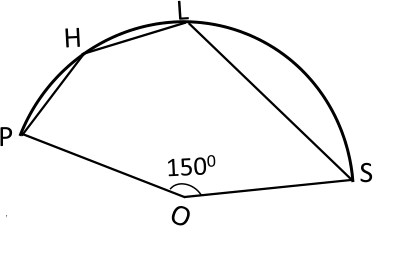
In the circular sector below, PH, HL and LS are straight lines. Points P, H, L, and S lie on the circumference of circle O. $PH=HL$ and $\angle LSO=35^\circ$. Find $\angle HLS$.
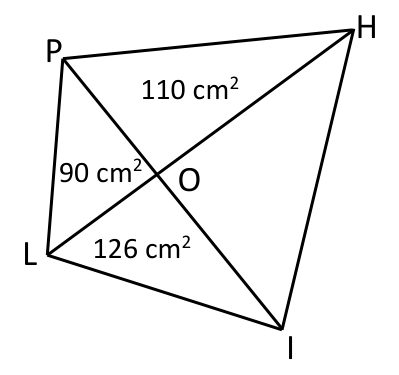
The quadrilateral PHIL is divided into four regions as shown below. If the areas of $\triangle POH$, $\triangle POL$, and $\triangle LOI$ are 110 cm², 90 cm², and 126 cm², respectively, find the area of $\triangle HOI$.
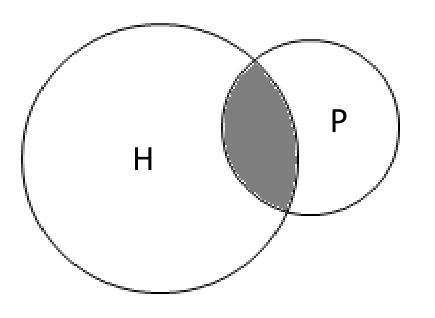
Two circles P and H overlap as shown below. $\dfrac16$ of circle P and $\dfrac18$ of circle H are shaded. If the shaded region is 5 cm², find the area of the unshaded portion of the figure.