AIMO 2021 Senior secondary — Preliminary (Open Trial 1) How many positive divisors does 2020 have?
10
12
14
16
Using $\tan(A-B)=\frac{\tan A-\tan B}{1+\tan A\tan B}$, express $\tan15^\circ$ in surd form.
$2-\sqrt3$
$2+\sqrt3$
$\sqrt3$
$1+\sqrt3$
With $\sum_{i=a}^{b}f(i)=f(a)+f(a+1)+\cdots+f(b)$, evaluate $\sum_{i=1}^{10}\frac1{(2i-1)(2i+1)}$.
$1/3$
$9/21$
$10/21$
$4/5$
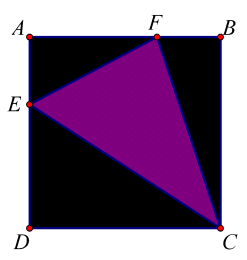
ABCD is a square. E lies on AD and F lies on AB, with $DE=2AE$ and $AF=2BF$. Find the ratio of the area of triangle CEF to the area of square ABCD.
$1/5$
$1/3$
$1/4$
$7/18$
How many committees consisting of one man and three women can be formed from three men and four women?
12
7
9
10
The four consecutive side lengths of a rectangle are $2x-3,3x+2,y-1,2y+3$, respectively. Find its area.
30
33
24
26
It is given that 1812 can be written as the difference of the cubes of two consecutive positive integers. Find their sum. The source prints “1812” on one baseline.
200
218
209
208
Positive integers $x,y$ satisfy $11x-29y=1$. Find the least value of $x+y$.
10
11
12
13
Let $x=\arctan(1/2)+\arctan(1/3)$, where $0<x<\pi$. Express x in radians.
$2\pi/3$
$\pi/2$
$\pi/3$
$\pi/4$
In the cryptarithm TEN+TEN+FORTY=SIXTY, find Y. Use the standard cryptarithm convention: different letters denote different decimal digits, and leading digits are nonzero.
6
7
8
24
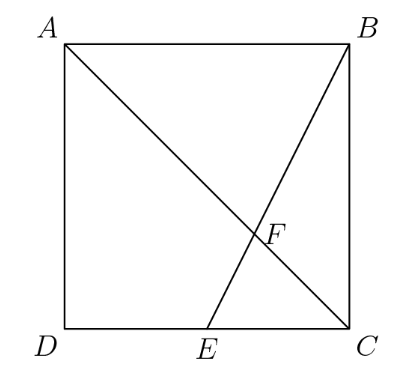
E is the midpoint of CD in square ABCD. BE meets diagonal AC at F. If quadrilateral AFED has area 45, find the area of the square.
100
108
120
135
For real $x,y$, find the minimum of $2x^2+4xy+3y^2+6y+4$.
-3
-5
5
3
Let $[x]$ denote the greatest integer not exceeding x. Evaluate $[1^2/2]+[2^2/2]+[3^2/2]+\cdots+[20^2/2]$.
A bag contains three red and four blue marbles. Two are drawn without replacement. Given that the first is blue, what is the probability that the second is also blue?
$1/2$
$3/7$
$4/7$
$2/3$
Given $a_1=2,a_2=-1$ and $a_{n+2}=a_n+2a_{n-1}$ for natural numbers $n\ge1$, find $a_7$.
23
22
20
18
The parabola $y=(x-20)^2-16$ meets the x-axis at A and B and the line $x+y=10$ at C and D. Find the area of the quadrilateral with these four vertices.
46
52
60
63
An integer n satisfies $0\le n<9$ and $9\mid n^2-3n+5$. Find the sum of all positive possible values of n.
Given $\cos(2\pi/7)+\cos(4\pi/7)+\cos(6\pi/7)=-0.5$, find $\sum_{k=1}^{6}\cos^2(k\pi/7)$.
Evaluate the infinite continued fraction $5+\frac{15}{5+\frac{15}{5+\frac{15}{5+\cdots}}}$.
Find the sum of all four-digit numbers formed by the digits 1,2,5,6. Editorial convention: use each of the four listed digits exactly once.