A large tray in the bakery’s display case has an equal number of three types of croissants: plain, chocolate and cheese. Norm rushes into the bakery and buys two croissants at random without looking. The probability that Norm does not have a chocolate croissant is closest to
Oaklands and Brighton are two busy train stations on the same train line. On one particular day:
- One-fifth of the trains do not stop at Oaklands.
- 45 trains do not stop at Brighton.
- 60 trains stop at both Brighton and Oaklands.
- 60 trains stop at only Brighton or Oaklands (not both).
How many trains do not stop at either of these stations on that day?
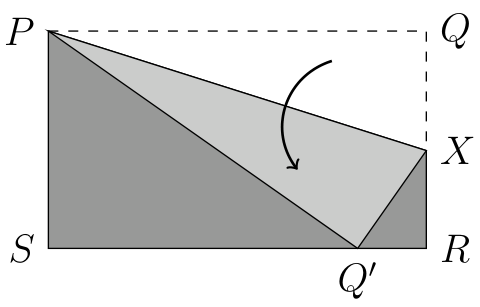
A rectangular sheet of paper $PQRS$ has width $PQ$ twice the height $QR$. The paper is folded along a line $PX$ such that $Q$ lies on top of $Q^{\prime}$, a point on $RS$. Angle $SPX$ is
Ten students sit a test consisting of 20 questions. Two students get 8 questions correct and one student gets 9 questions correct. The remaining seven students all get at least 10 questions correct and the average number of questions answered correctly by these seven students is an integer. If the average number of questions answered correctly by all ten students is also an integer, then that integer is
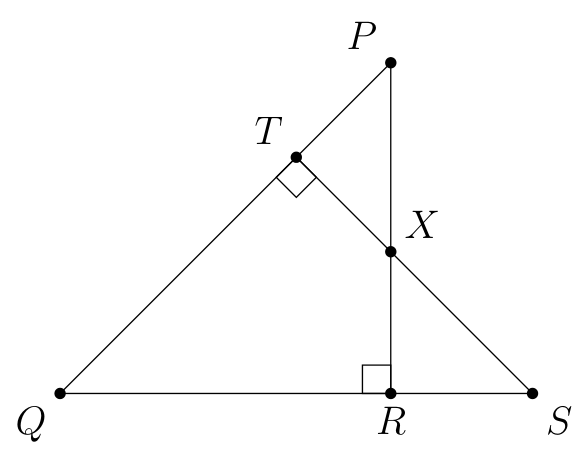
In the diagram, $QR=QT=4$ cm and $PQR$ and $QST$ are both isosceles right-angled triangles. In square centimetres, what is the area of the quadrilateral $QRXT$?
Ten identical solid gold spheres will be melted down and recast into a number of smaller identical spheres whose diameter is 80% of the original ones. Ignoring any excess gold which may be left over, how many smaller spheres will be made?
A regular decagon has 10 sides of length 1. Four vertices are chosen to make a convex quadrilateral that has all side lengths greater than 1. How many non-congruent quadrilaterals can be formed this way?
The increasing sequence of positive integers $1,2,4,\ldots$ has the property that each term from the third onwards is the next positive integer which is not equal to the sum of any two previous terms of the sequence. How many terms of the sequence are less than 2016?