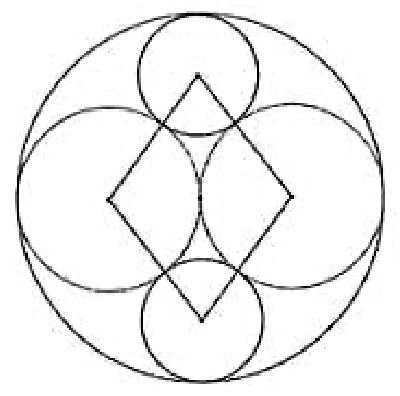
In the diagram below, five circles are arranged so that each inner circle is tangent to its adjacent inner circles and to the largest circle. The vertices of the shaded quadrilateral are the centres of the four circles inside the largest circle. If the diameter of the largest circle is $x$ cm, what is the area of the shaded quadrilateral in $\mathrm{cm}^2$ in terms of $x$?
Car $A$ left Village $X$ for Village $Y$ at the same time as Car $B$ which left Village $Y$ for Village $X$. Both cars travelled at constant speed. $5$ hours later the two cars passed each other. Another $3$ hours later, Car $A$ reached Village $Y$ but Car $B$ was still $90$ km away from Village $X$. Find the distance (in km) between the two villages.
Given four integers $a,b,c,d$, form another four new numbers, where each new number is obtained by adding to each of $a,b,c,d$ the average of the other three integers. In other words, add to $a$ the average of $b,c,d$ to form a new number; add to $b$ the average of $a,c,d$ to form another new number, and so on. If the four new numbers formed are $28,37,46,$ and $57$, find the average of $a,b,c,d$.
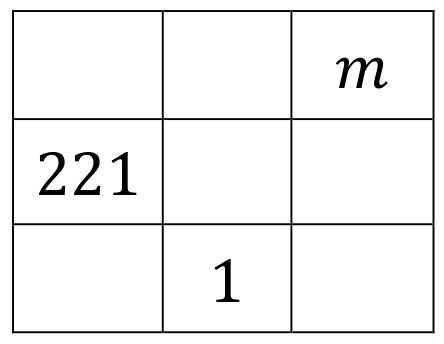
The following is a $3\times3$ grid with three cells filled in with three positive integers $1,221$ and $m$. Find the value of $m$ such that it is possible to fill in the remaining six empty cells with six distinct positive integers different from $1,221$ and $m$ such that the sums of the positive integers in every row, every column and every diagonal are the same.
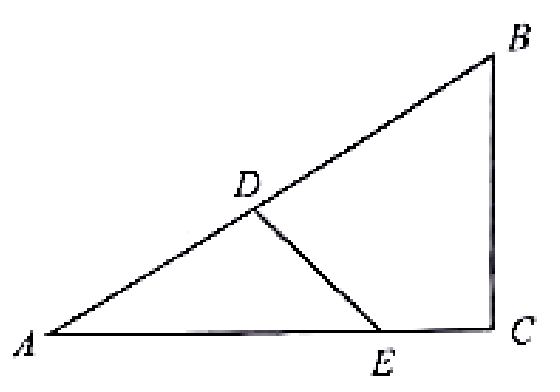
In the diagram below, $ABC$ is a triangle with $AB=13$, $BC=5$ and $AC=12$. Points $D$ and $E$ lie on $AB$ and $AC$ respectively such that $DE$ divides the triangle $ABC$ into two regions with equal area. If the least possible length of $DE$ is $m$, find the value of $m^2$.
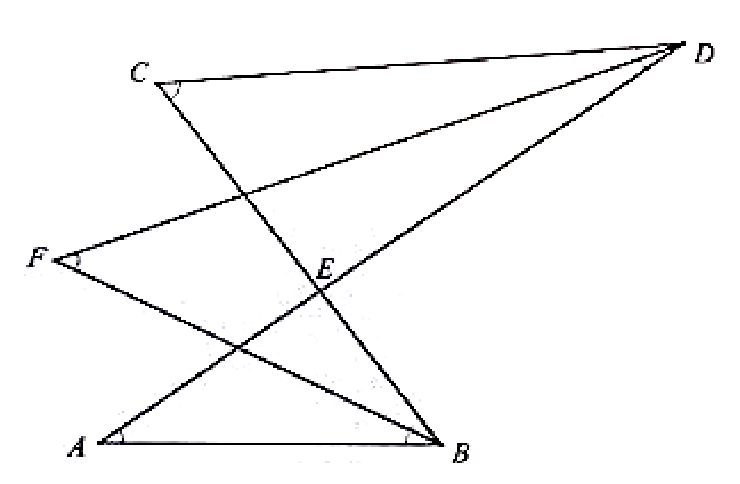
In the diagram below, $BF$ is an angle bisector of $\angle ABC$ and $DF$ is an angle bisector of $\angle ADC$. If $\angle A=36^\circ$, $\angle C=58^\circ$ and $\angle F=x^\circ$, find the value of $x$.
Find the sum of all 3-digit whole numbers $\overline{abc}$ for which the 6-digit number $\overline{123abc}$ is divisible by all the four numbers $2,3,5,$ and $7$.
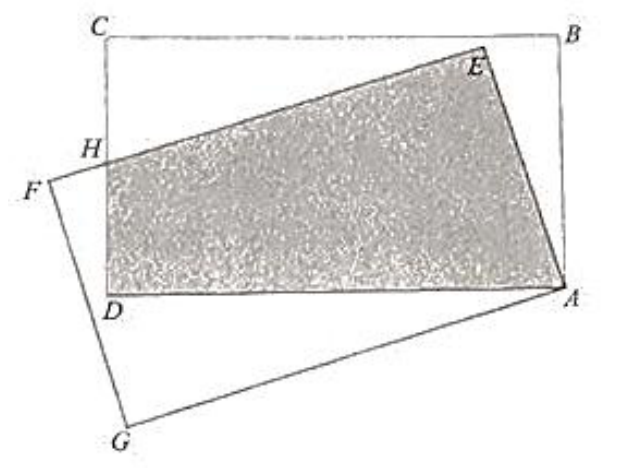
The diagram below shows two overlapping congruent rectangles $ABCD$ and $AEFG$. If $AB=8$, $HD=4$ and $HF=2$, find the total area of the unshaded regions of the two rectangles.
If $a$ and $b$ are positive real numbers such that $\frac1a+\frac1b=\frac1{a-b}$, find the value of $\left\lceil\frac ba\right\rceil$. Here $\lceil x\rceil$ denotes the smallest integer greatest than or equal to $x$. For example, $\lceil3.1\rceil=4$.