The diagram below shows six points, $A,B,C,M,N$ and $O$ on the real number line. $M$ is the midpoint of the line segment $AB$, $N$ is the midpoint of the line segment $BC$ and $O$ the midpoint of the line segment $AC$.
Let $p=\frac{7a}{15}-1$ and $q=a^2-\frac{8a}{15}$, where $a$ is a real number. Which is the following statements is correct for any given value of $a$?
A fair dice with numbers 1, 2, 3, 4, 5 and 6 on its six faces respectively was rolled twice. In the first and second rolls, the dice landed on numbers $a$ and $b$ respectively. What is the probability that the equation $x^2+ax+b=0$ has two distinct real roots?
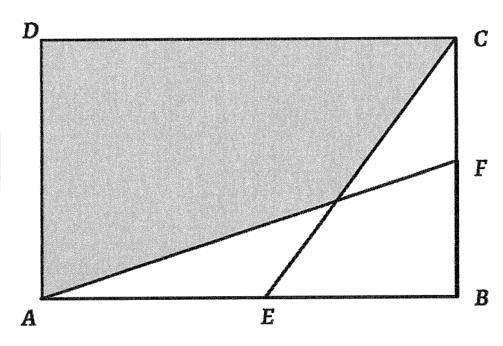
In the diagram below, $ABCD$ is a rectangle. $E$ and $F$ are the midpoints of the sides $AB$ and $BC$ respectively and $AF$ and $CE$ are line segments. If the area of the rectangle is 24 $cm^2$, find the area of the shaded region in $cm^2$.
In a fund-raising campaign of a school, 11 girls and $b$ boys of Class 2A raised the same total amount as that of Class 2B which has 9 boys and $g$ girls, where $b>0$ and $g>0$. The total amount that each class raised is $\$(bg+9b+11g+145)$. Given that the average amount raised by each of the two classes is $\$x$ and $x$ is an integer value more than 30, find the value of $x$.
The number of sides of two regular polygons differs by 25. If $\alpha$ and $\beta$ are interior angles of the two regular polygons respectively and $|\alpha-\beta|=15^\circ$, find the sum of the number of sides of the two regular polygons.
Suppose that $x$ is a positive real number such that
$$27^x=1/x.$$
It is given that the above equation has a unique positive solution. Find the value of $2025x$.
The four-digit whole number $\overline{abcd}$ is a perfect square. The two-digit whole numbers $\overline{pq}$ and $\overline{rs}$ are formed by adding 17 to $\overline{ab}$ and $\overline{cd}$ respectively. If the four-digit whole number $\overline{pqrs}$ is a perfect square, find the sum of the two perfect squares $\overline{abcd}$ and $\overline{pqrs}$.
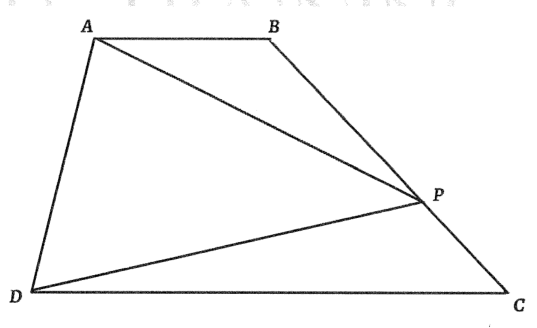
In the diagram below, ABCD is a trapezium in which AB // DC and AB = 10 cm. P is a point on BC such that BP = 4PC. Given that
$$\frac{\text{Area of }\triangle APD}{\text{Area of }\triangle APB}=\frac{15}{4},$$
find the length of DC in cm.
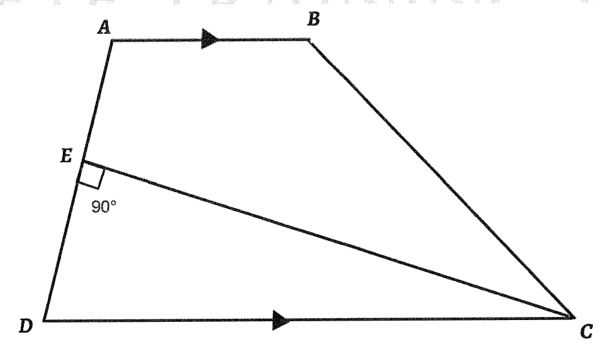
In the diagram below, $ABCD$ is a trapezium and $AB$ is parallel to $DC$. The angle bisector of $\angle BCD$ is perpendicular to $AD$ and intersects $AD$ at $E$ such that $DE=2AE$. If the area of the triangle $CED$ is 16 $cm^2$, find the area of the trapezium $ABCD$ in $cm^2$.