Skip to content / Đến nội dung
ThichHocToan.com

SMO 2010 Junior Round 1

Question 1

Among the five real numbers below, which one is the smallest?
  1. $\sqrt[2009]{2010}$
  2. $\sqrt[2010]{2009}$
  3. $2010$
  4. $\frac{2010}{2009}$
  5. $\frac{2009}{2010}$

Question 2

Among the five integers below, which one is the largest?
  1. $2009^{2010}$
  2. $20092010^2$
  3. $2010^{2009}$
  4. $3^{3^{3^3}}$
  5. $2^{10}+4^{10}+\cdots+2010^{10}$

Question 3

Among the four statements on real numbers below, how many are correct?
1. If $a\lt b$ and $a,b\ne0$, then $1/b\lt 1/a$.
2. If $a\lt b$, then $ac\lt bc$.
3. If $a\lt b$, then $a+c\lt b+c$.
4. If $a^2\lt b^2$, then $a\lt b$.
  1. $0$
  2. $1$
  3. $2$
  4. $3$
  5. $4$

Question 4

What is the largest integer less than or equal to $\sqrt[3]{2010^3+3\times2010^2+4\times2010+1}$?
  1. $2009$
  2. $2010$
  3. $2011$
  4. $2012$
  5. None of the above.

Question 5

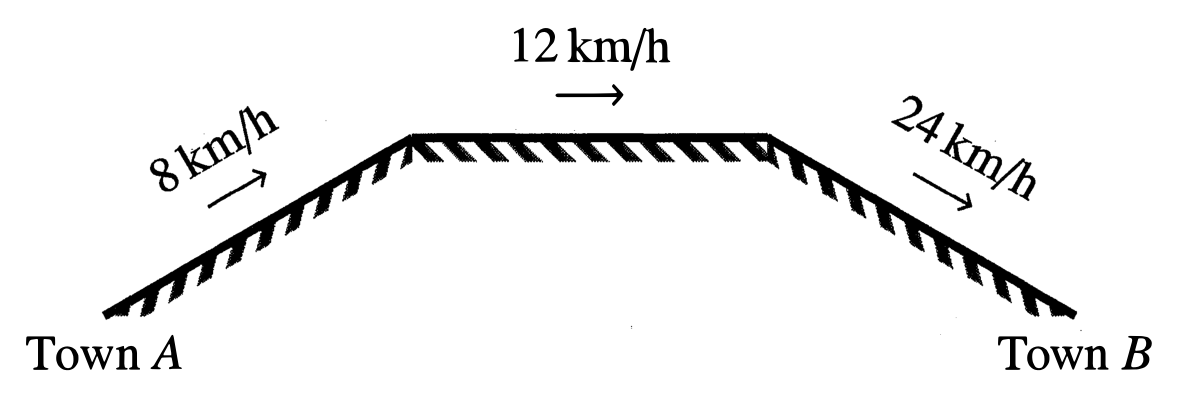
The conditions of the road between Town $A$ and Town $B$ can be classified as up slope, horizontal or down slope, and the total length of each type of road is the same. A cyclist travels from Town $A$ to Town $B$ with uniform speeds $8$ km/h, $12$ km/h and $24$ km/h on the up slope, horizontal and down slope road respectively. What is the average speed of his journey?

Question illustration
  1. $12\text{ km/h}$
  2. $\frac{44}3\text{ km/h}$
  3. $16\text{ km/h}$
  4. $17\text{ km/h}$
  5. $18\text{ km/h}$

Question 6

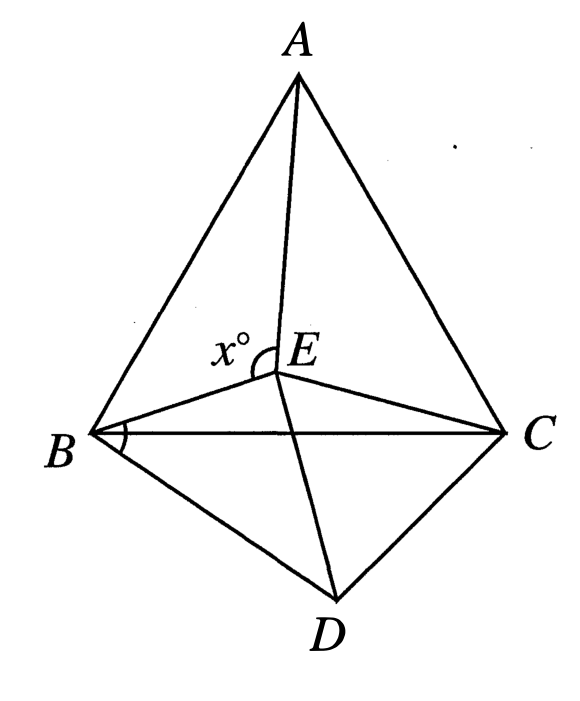
In the diagram, $ABC$ and $CDE$ are equilateral triangles. Given $\angle EBD=62^\circ$ and $\angle AEB=x^\circ$, what is $x$?

Question illustration
  1. $100$
  2. $118$
  3. $120$
  4. $122$
  5. $135$

Question 7

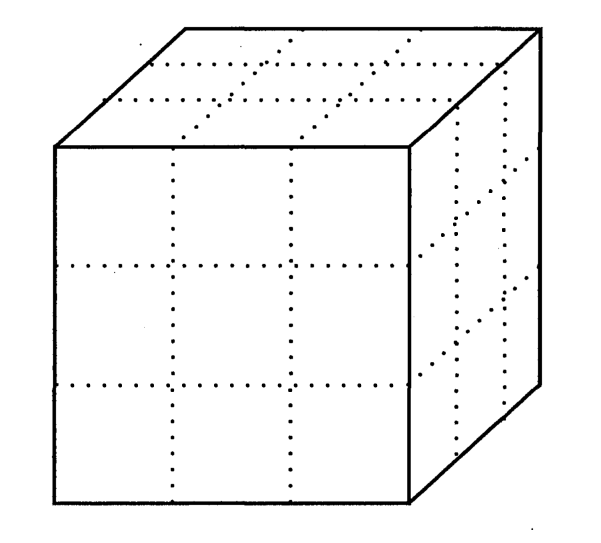
A carpenter wishes to cut a wooden $3\times3\times3$ cube into twenty-seven $1\times1\times1$ cubes. He can do this easily by making $6$ cuts through the cube, keeping the pieces together in the cube shape as shown.

Question illustration

What is the minimum number of cuts needed if he is allowed to rearrange the pieces after each cut?
  1. $2$
  2. $3$
  3. $4$
  4. $5$
  5. $6$

Question 8

What is the last digit of $7^{7^7}$?
  1. $1$
  2. $3$
  3. $5$
  4. $7$
  5. $9$

Question 9

Given that $n$ is an odd integer less than $1000$ and the product of all its digits is $252$, how many such integers are there?
  1. $3$
  2. $4$
  3. $5$
  4. $6$
  5. $7$

Question 10

What is the value of $(\sqrt{11}+\sqrt5)^8+(\sqrt{11}-\sqrt5)^8$?
  1. $451856$
  2. $691962$
  3. $903712$
  4. $1276392$
  5. $1576392$

Question 11

Let $x,y$ be real numbers satisfying
$$y=\sqrt{\frac{2008x+2009}{2010x-2011}}+\sqrt{\frac{2008x+2009}{2011-2010x}}+2010.$$
Find $y$.

Question 12

For integers $a_1,\ldots,a_n\in\{1,2,3,\ldots,9\}$, the notation $\overline{a_1a_2\cdots a_n}$ denotes $10^{n-1}a_1+10^{n-2}a_2+\cdots+10a_{n-1}+a_n$. For example, when $a=2,b=0$, $\overline{ab}$ denotes $20$. Given $\overline{ab}=b^2$ and $\overline{acbc}=(\overline{ba})^2$, find $\overline{abc}$.

Question 13

Given that $m-2$ is a positive integer and is also a factor of $3m^2-2m+10$, find the sum of all such values of $m$.

Question 14

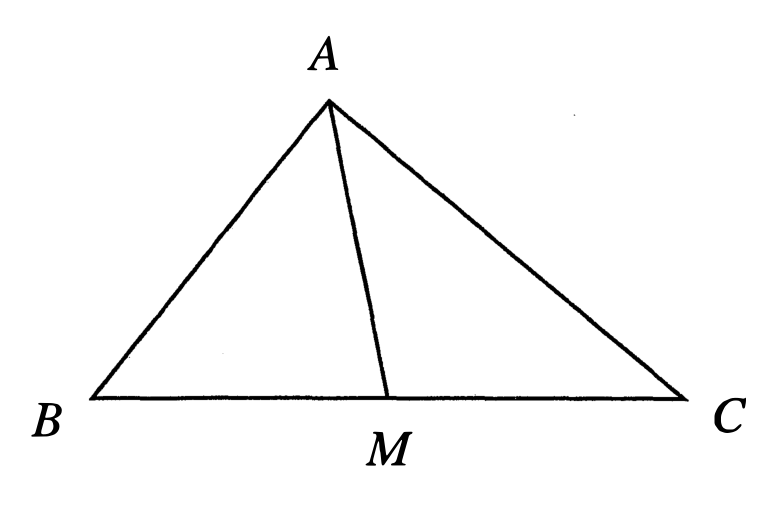
In triangle $ABC$, $AB=32$ cm, $AC=36$ cm and $BC=44$ cm. If $M$ is the midpoint of $BC$, find $AM$ in cm.

Question illustration

Question 15

Evaluate $\dfrac{678+690+702+714+\cdots+1998+2010}{3+9+15+21+\cdots+327+333}$.

Question 16

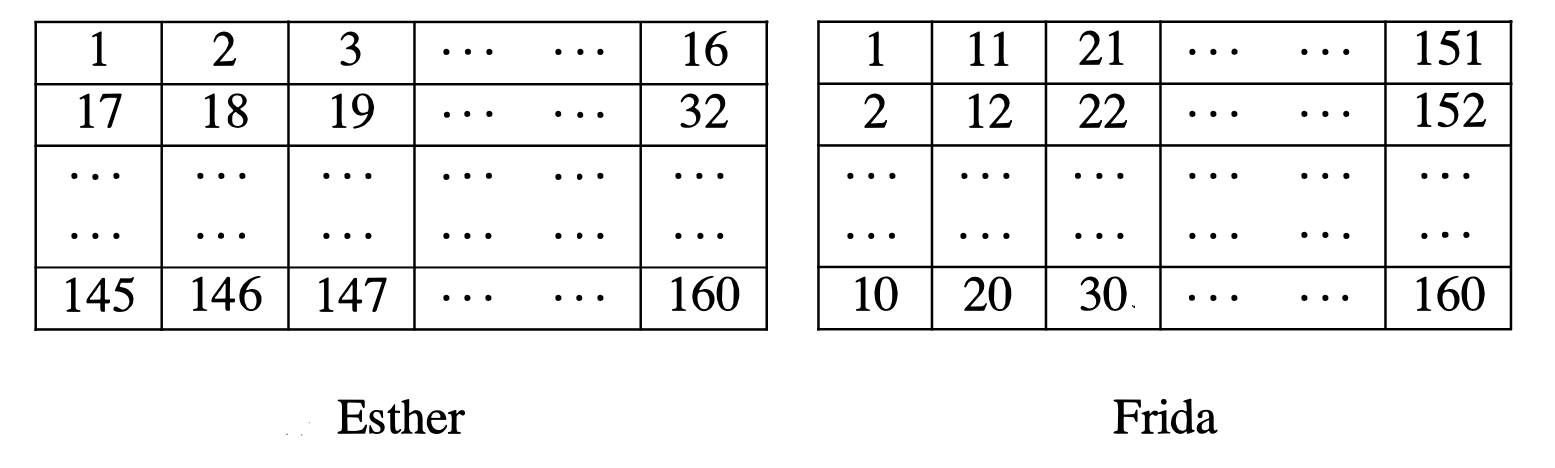
Esther and Frida are supposed to fill a rectangular array of $16$ columns and $10$ rows with the numbers $1$ to $160$. Esther does it row-wise: the first row is $1,2,\ldots,16$, the second is $17,18,\ldots,32$, and so on. Frida does it column-wise: the first column is $1,2,\ldots,10$, the second is $11,12,\ldots,20$, and so on. Some numbers occupy the same position in both arrays. Find the sum of the numbers in these positions.

Question illustration

Question 17

The sum of two integers $A,B$ is $2010$. If their lowest common multiple is $14807$, write down the larger integer.

Question 18

A sequence of polynomials $a_n(x)$ is defined recursively by
$$a_0(x)=1,\qquad a_1(x)=x^2+x+1,$$
$$a_n(x)=(x^n+1)a_{n-1}(x)-a_{n-2}(x)\quad(n\ge2).$$
For example,
$$a_2(x)=(x^2+1)(x^2+x+1)-1=x^4+x^3+2x^2+x,$$
$$a_3(x)=(x^3+1)(x^4+x^3+2x^2+x)-(x^2+x+1)$$
$$=x^7+x^6+2x^5+2x^4+x^3+x^2-1.$$
Evaluate $a_{2010}(1)$.
Question 19

A triangle $ABC$ is inscribed in a semicircle of radius $5$. If $AB=10$, find the maximum value of $s^2$, where $s=AC+BC$.

Question 20

Find the last two digits of $2011^{2010^{2009}}$.