Jane has 9 boxes with 9 accompanying keys. Each box can only be opened by its accompanying key. If the 9 keys have been mixed up, find the maximum number of attempts Jane must make before she can open all the boxes.
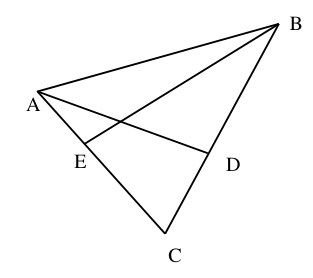
The diagram shows triangle $ABC$ with $AC=18$ cm and $BC=24$ cm. $D$ lies on $BC$ such that $AD\perp BC$, and $E$ lies on $AC$ such that $BE\perp AC$. Given $BE=20$ cm and $AD=x$ cm, find $x$.
A language school has 100 pupils. 69% study French, 79% study German, 89% study Japanese and 99% study English. Given that at least $x\%$ of the students study all four languages, find $x$.
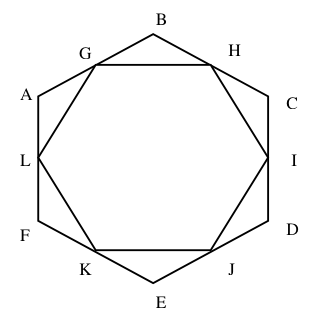
The diagram shows a regular hexagon $ABCDEF$. $G,H,I,J,K,L$ are the midpoints of $AB,BC,CD,DE,EF,FA$, respectively. Given $[ABCDEF]=100$ cm$^2$ and $[GHIJKL]=x$ cm$^2$, find $x$.
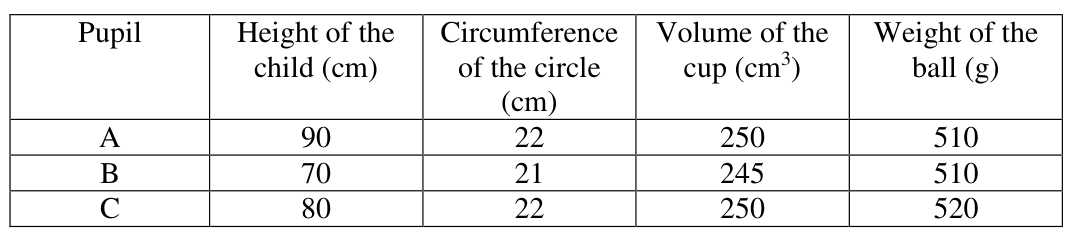
Three pupils $A,B,C$ write down the height of a child, circumference of a circle, volume of a cup and weight of a ball. Their responses (in cm, cm, cm$^3$, g respectively) are: $A:(90,22,250,510)$; $B:(70,21,245,510)$; $C:(80,22,250,520)$. Each pupil has exactly two correct responses. If the child is $x$ cm tall, find $x$.
The diagram shows a square grid comprising 25 dots. A circle is attached to the grid. Find the largest possible number of dots the circle can pass through.
Jane and Peter competed in a 100 m race. When Peter finished, Jane had just crossed the 90 m mark. If Peter were to start 10 m behind the starting line, the distance between them when one of them reaches the finish is $x$ m. Find $x$.
A $5\times5\times5$ cube is assembled using only $1\times1\times1$ cubes and $1\times1\times2$ cuboids. Find the maximum possible number of $1\times1\times2$ cuboids.
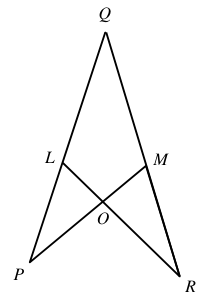
As shown, $L$ and $M$ lie on $PQ$ and $QR$, respectively. $O$ is the intersection of $LR$ and $PM$. Given $MP=MQ$, $LQ=LR$, $PL=PO$ and $\angle POR=x^\circ$, find $x$.
Jane has nine 1 cm sticks, six 2 cm sticks and three 4 cm sticks. She must use all the sticks to make a single rectangle. How many rectangles with different dimensions can she make?
Peter wants to cut a 63 cm string into segments so that one or more segments can add up to every whole-number length from 1 cm to 63 cm. Find the least number of cuts.