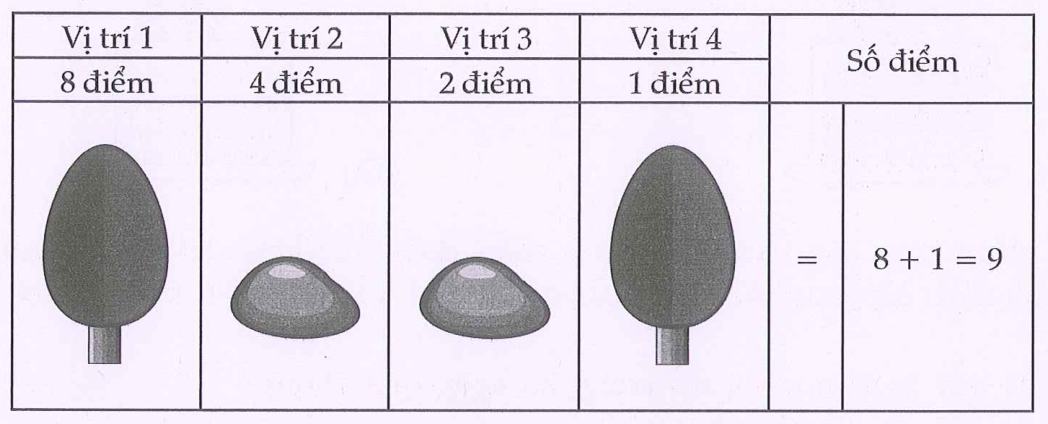
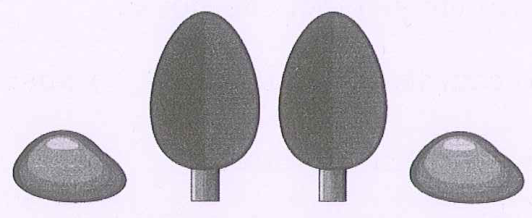
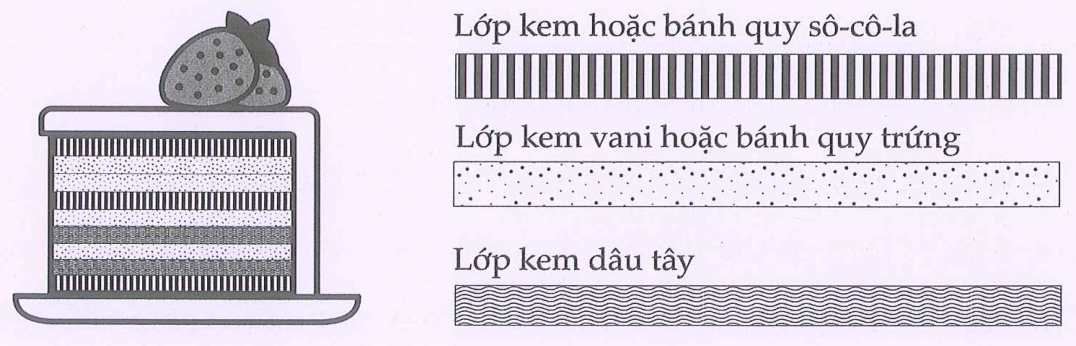
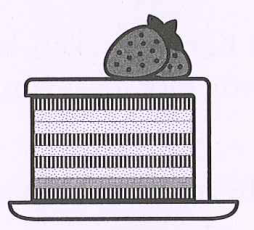
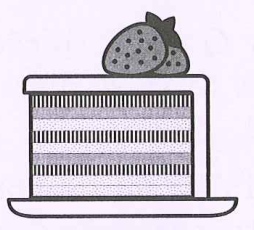
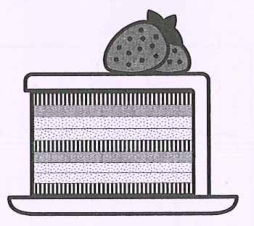
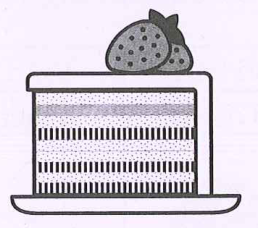
Mr Quantik records test scores in a special way. The maximum score is 15, and each score is represented by a sequence of trees and stones.
The table shows an example of how to calculate the score. We count only the values at positions occupied by trees.
| Position | Position 1 | Position 2 | Position 3 | Position 4 | Score |
|---|---|---|---|---|---|
| Value | 8 points | 4 points | 2 points | 1 point | |
| Symbol | Tree | Stone | Stone | Tree | $8+1=9$ |
Alex visits an automatic health-diagnosis website. He receives a list of questions, starts with question 1 and follows the instructions.
- Question 1: Have you had a fever in the past three days?
- If YES, go to question 2.
- If NO, go to question 4.
- Question 2: Do you feel pain in any part of your body?
- If YES, go to instruction 3.
- If NO, go to question 5.
- Instruction 3: See a doctor at the nearest medical center.
- Question 4: Can you count backward from 20 to 1?
- If YES, go to instruction 7.
- If NO, go to instruction 8.
- Question 5: Are you feeling dizzy?
- If YES, go to instruction 6.
- If NO, go to question 4.
- Instruction 6: You need to rest immediately.
- Instruction 7: You may continue working, but should let your body rest.
- Instruction 8: You are having trouble concentrating; ask someone else for help.
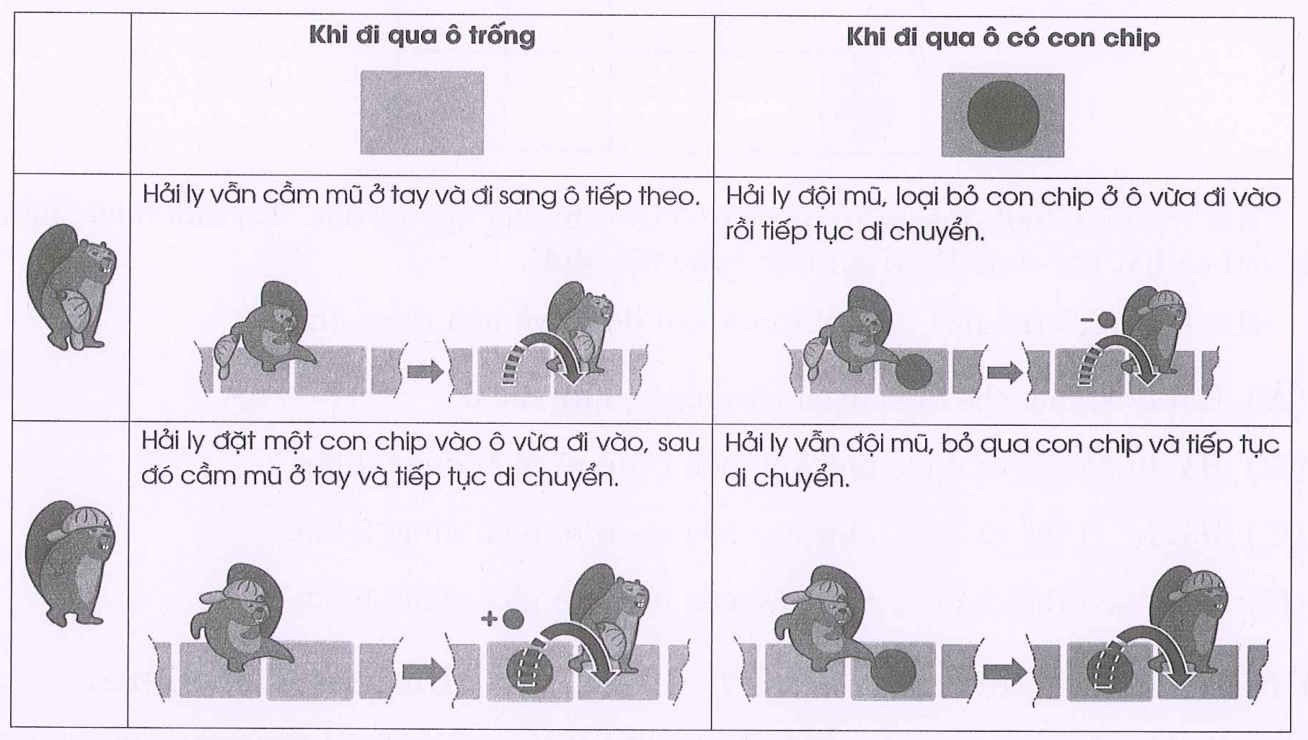
In a game on a row of tiles containing chips, a beaver visits each cell from left to right. How the chips change depends on whether the beaver is holding or wearing its hat, as described below.
| Beaver state | Entering an empty cell | Entering a cell with a chip |
|---|---|---|
| Holding the hat | The beaver keeps holding the hat and moves to the next cell. | The beaver puts on the hat, removes the chip from the cell just entered and continues. |
| Wearing the hat | The beaver places a chip in the cell just entered, takes the hat in its hand and continues. | The beaver keeps wearing the hat, leaves the chip and continues. |
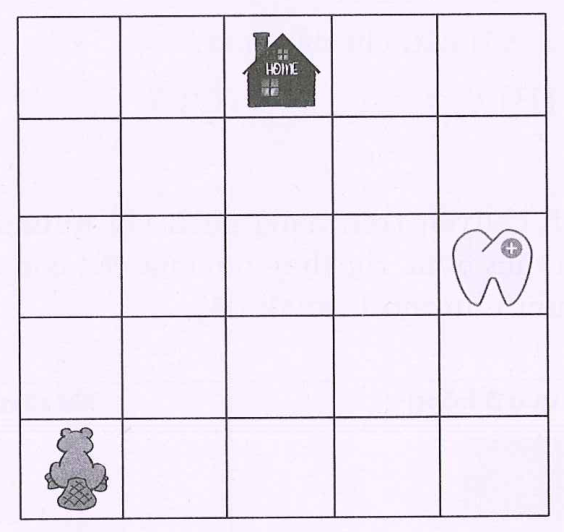
For the cells shown below, if the beaver is initially holding its hat, what arrangement of chips will remain at the end?
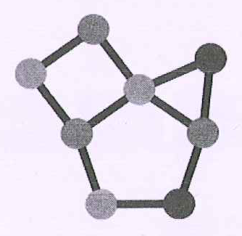
A class has 8 students. Alice usually divides the class into groups for exercises. For various reasons, some pairs of students do not like being in the same group. In the figure, each circle represents a student. Two circles are joined when the corresponding students do not like being in the same group.
Alice therefore needs at least 3 groups to keep everyone happy. However, she notices that she could persuade two students to agree to work together and then divide the class into just two groups. How many choices are there for the pair of students she should persuade?
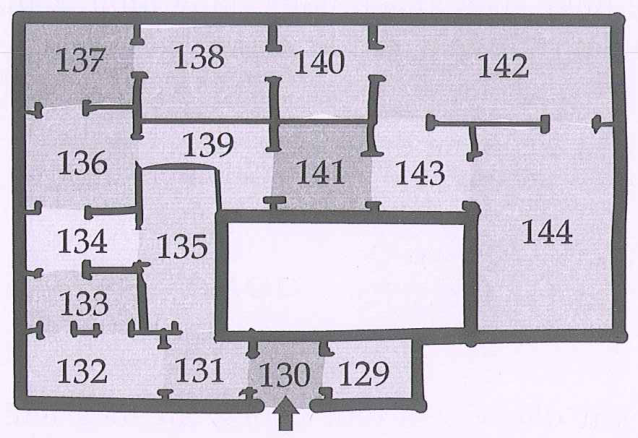
The figure below is a map of the Hermitage Museum in Saint Petersburg, Russia.
Victor the beaver enters through the door marked by an arrow. He wants to tour the rooms according to these rules:
- Every time he enters a room, he checks its adjacent rooms, sharing a door, to see whether there is a room he has not yet reached.
- If there is, he moves to the adjacent room with the smallest number that he has not yet toured.
- If not, he tours the current room.
- After finishing a room (A), he returns to the room in which he stood immediately before entering (A).
Simply passing through a room does not count as touring it.
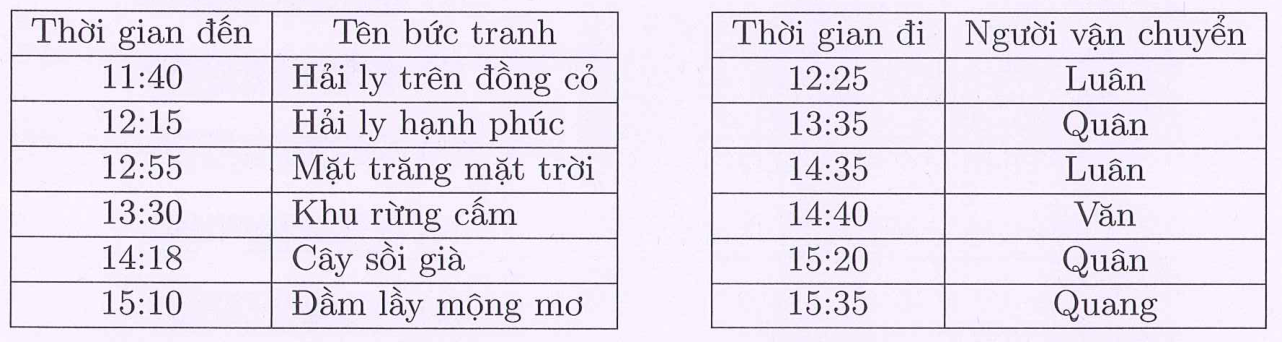
TransArt is a painting-delivery company. Paintings arrive at a warehouse and are stacked on top of one another. Couriers arrive and take the painting currently on top. For security, TransArt records the arrivals and departures.
| Arrival time | Painting title |
|---|---|
| 11:40 | Beaver in the Meadow |
| 12:15 | Happy Beaver |
| 12:55 | Moon and Sun |
| 13:30 | The Forbidden Forest |
| 14:18 | The Old Oak |
| 15:10 | The Dreamy Swamp |
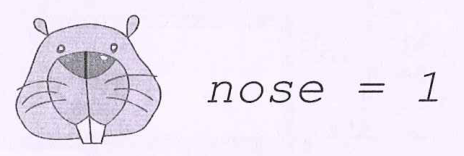
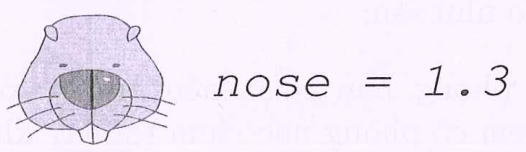
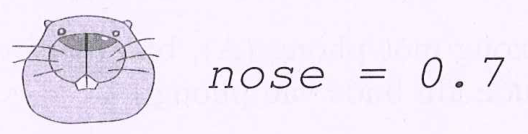
A shop uses computer vision to recognize customers' actions. It can identify looking straight ahead, lowering the head or raising the head from the apparent length of the bridge of the nose, called nose.
- If $nose=1$, the customer is looking straight ahead.
- When the customer nods and lowers the head, the bridge of the nose appears longer, so $nose>1$.
- When the customer tilts the head upward, $nose<1$.
To buy $n$ tickets, the customer must nod $n$ times and then tilt the head upward. The control program starts when the customer stands in front of the machine looking straight ahead.
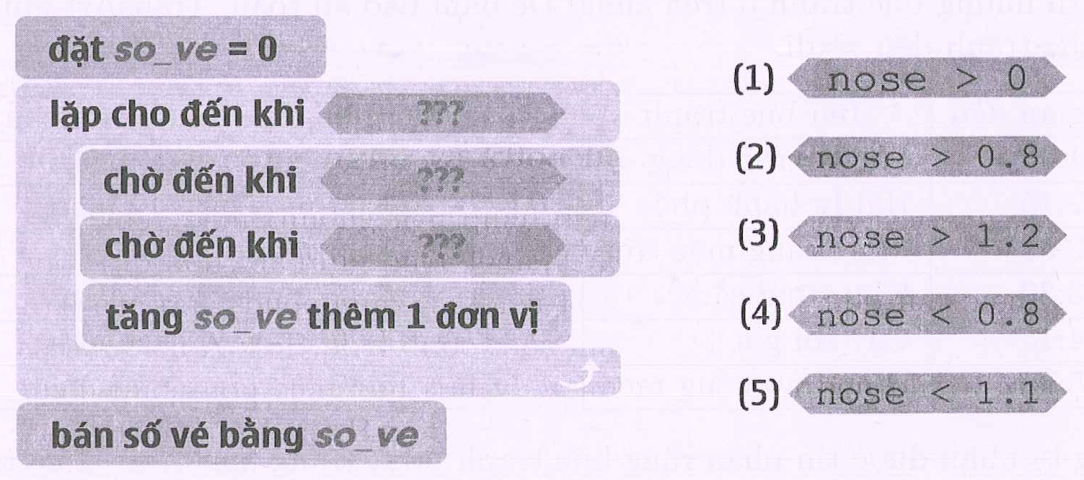
Which comparison blocks should be inserted, from top to bottom, into the program below so it works as required?
Editable program transcription:
set so_ve = 0
repeat until ???:
- wait until ???
- wait until ???
- increase so_ve by 1
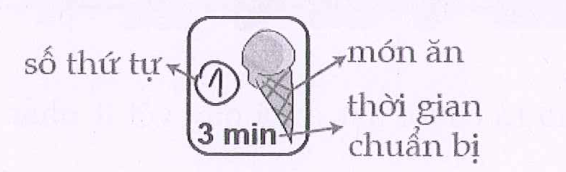
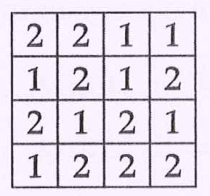
A shop sells three foods: ice cream, requiring 3 minutes to prepare; sandwiches, requiring 8 minutes; and pizza, requiring 12 minutes. Orders are numbered consecutively starting from 1. The figure illustrates the first order.
Label translations: order number, food item, preparation time.
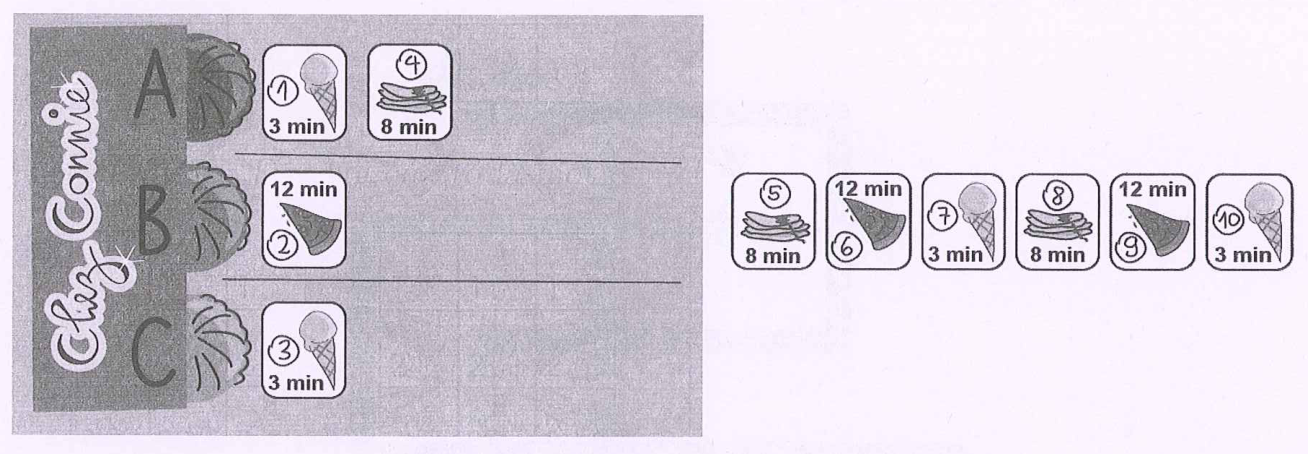
The shop has three counters. Customers queue, and a staff member directs them in order to the counter with the shortest waiting time. If several counters tie, priority is $A\to B\to C$.
The following figure shows the orders received by the shop.
Which counter will serve for the longest total time?
Beavers use beads to make decorations. To communicate conveniently, they describe these shapes with symbols: S represents a star, T a triangle, R a rectangle and L a line segment.
They have three rules for shortening a description:
- Consecutive identical beads can be shortened by putting their number first. For example, 4S means four consecutive star beads.
- If a group of beads repeats, write the repetition count followed by a description of the group in parentheses.
- Otherwise, simply write the letter representing the bead.
For example, the bead string below can be written as S 3(TR) 3S L. It has 9 characters, ignoring spaces.
What is the smallest number of characters needed to describe the following bead string?
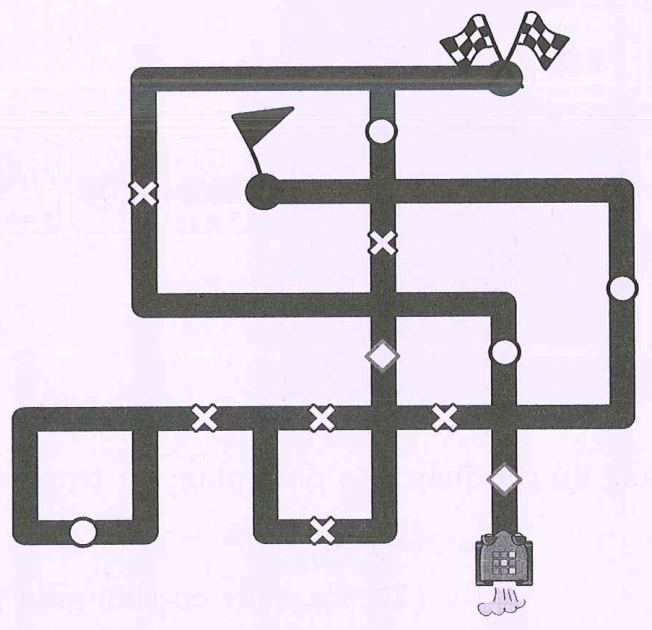
A robot is about to drive autonomously along the roads shown below.
The road segments contain symbols ◇, ○ and × that tell it which direction to take at the next junction. One symbol means “go straight”, one means “turn right”, and the remaining one means “turn left”.
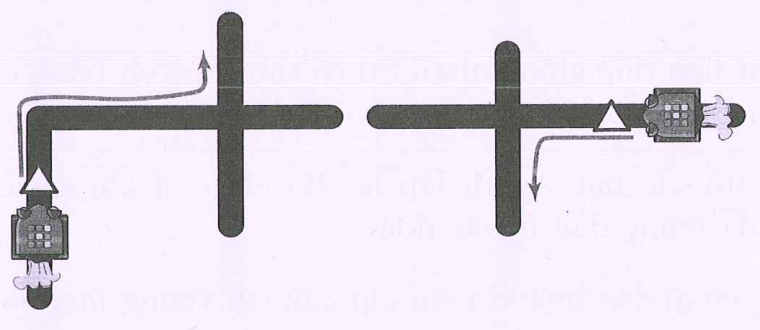
These instructions do not depend on the robot's absolute direction of travel: a symbol keeps the same meaning whichever way the robot is facing. For example, a “turn left” instruction makes the robot move as follows:
The robot must avoid the triangular flag and reach the checkered flags. What meanings should be assigned to the symbols?
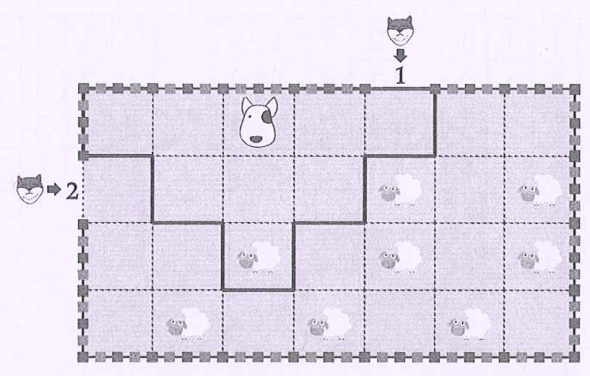
To keep wolves from sneaking into the garden and taking the sheep, the beavers place dogs to guard the gates. One dog can guard an area as shown below.
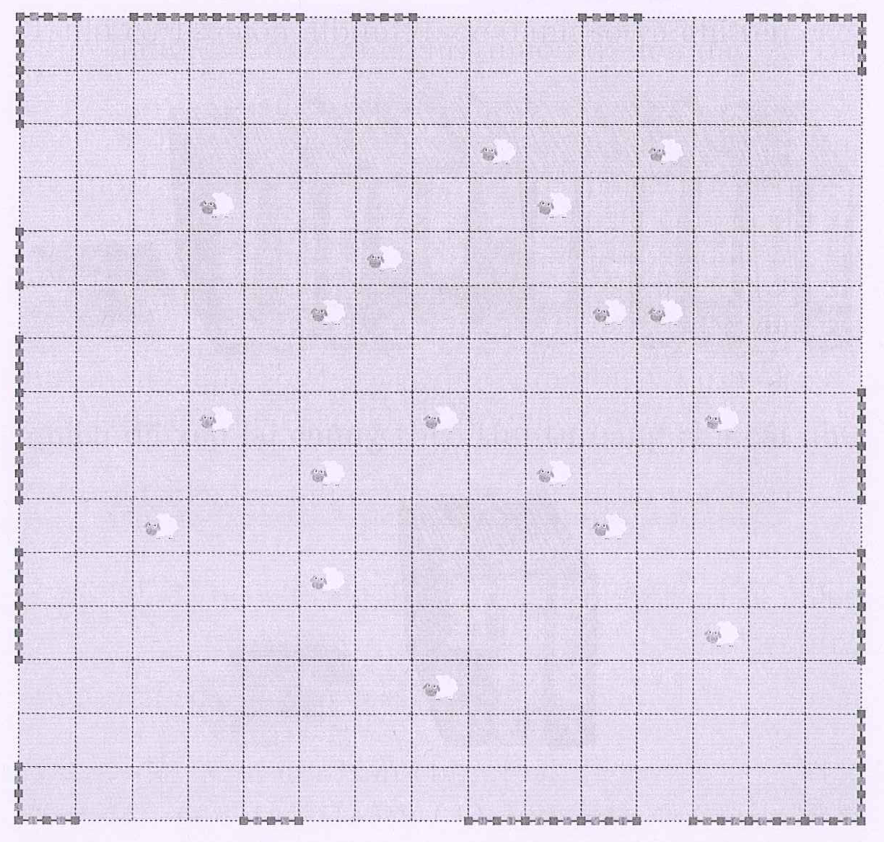
The wolf cannot enter through gate 1 but can enter through gate 2. For the following garden, what is the smallest number of dogs needed to guard all the gates?