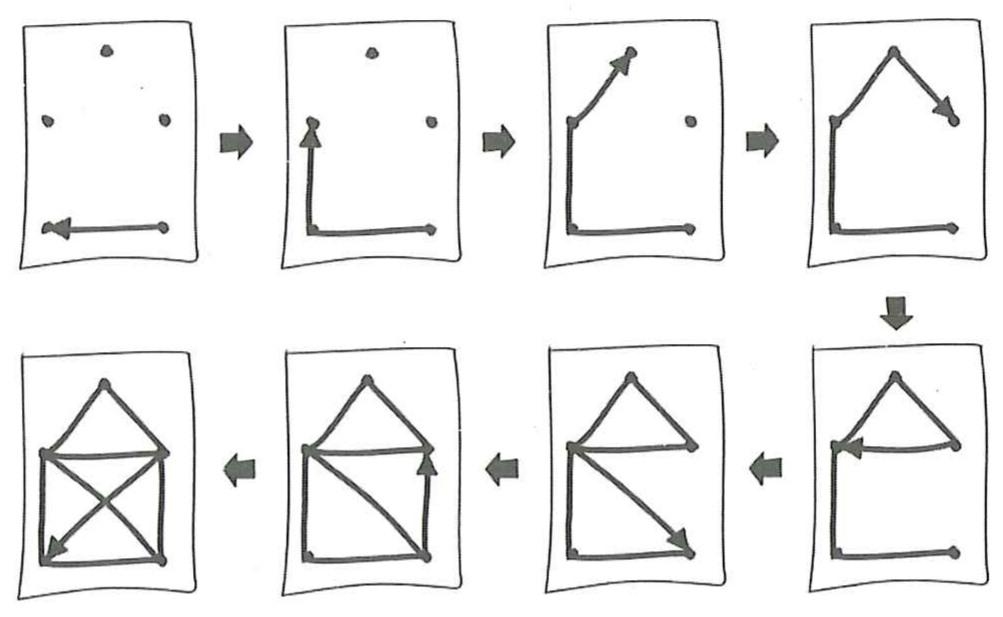
We know that some figures can be drawn with a single stroke (that is, without lifting the pen throughout the drawing) and without drawing any segment more than once (without retracing any strokes). For example, the illustration below shows the steps for drawing a house with a single stroke.
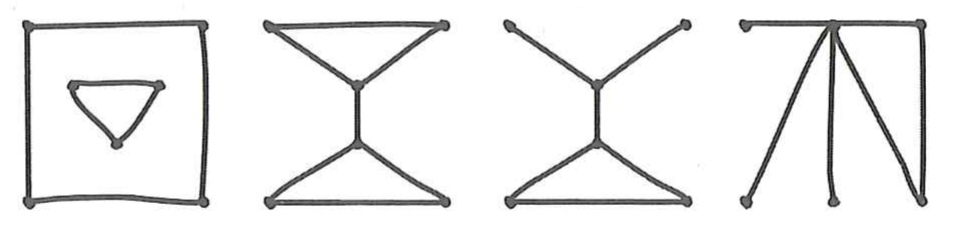
How many of the four figures below can be drawn with just one stroke?
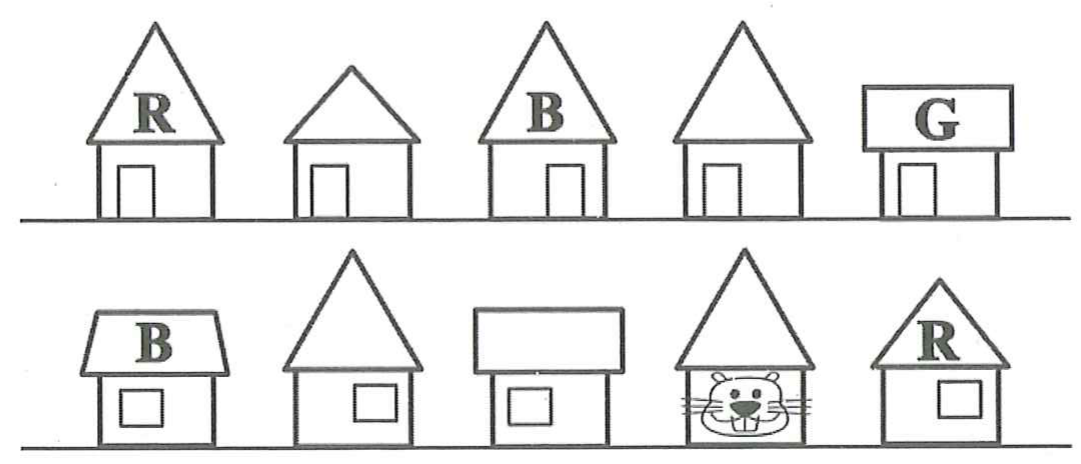
With the colour festival approaching, the residents of Colour City decide to repaint their houses in one of three colours: blue (B), red (R) and green (G). They agree on a rule: no house may have the same colour as a neighbouring house or the house directly opposite it across the street. The picture below shows some houses that have already been painted.
Which colours can the beaver’s house be painted to satisfy these conditions?
On Sunday, Bob wants to play games and borrows his mother’s computer. However, her computer is password-protected. The password consists of his mother’s name, Emily, with exactly one capital letter, and her age (a two-digit number), placed before or after her name. Of course, Bob knows his mother’s name and age, but he still has to make some attempts to find the correct password.
What is the minimum number of attempts Bob needs to guarantee that he can unlock his mother’s computer?
In the beaver village, Anna, Ben and Lisa live in three houses painted blue, red and yellow (not necessarily in that order). Each owns a different kind of pet: a cat, a parrot or a dog. We know that:
- Anna lives in the yellow house.
- The red house has a cat.
- Ben’s house is next to Lisa’s house.
- Lisa has a parrot.
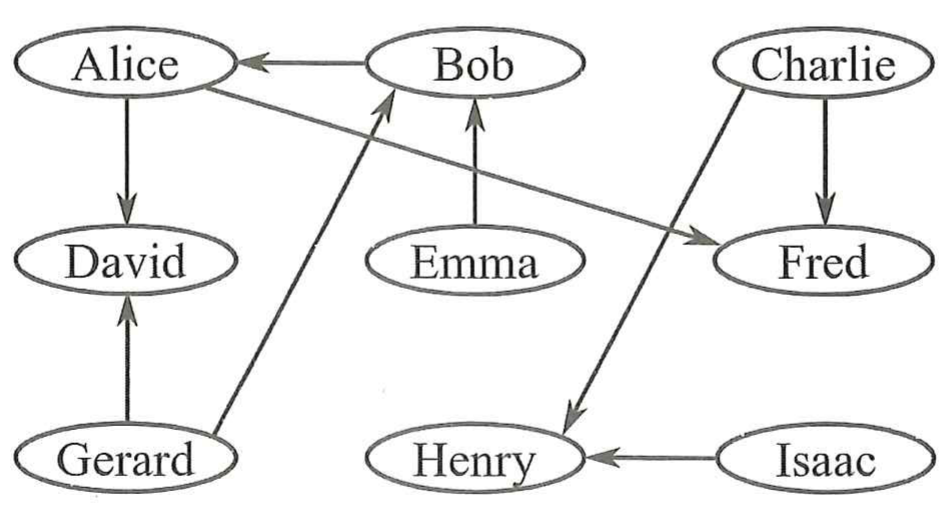
The beavers are organising a chess tournament. In the picture below, arrows connect players who have played each other, in the direction **Winner → Loser.** For example, Emma beat Bob and Isaac beat Henry.
There is not enough time for every pair to play, so they agree to use the transitive rule. For example, if Bob beats Alice and Alice beats David, Bob is also considered to have beaten David without playing him. The champion is the player who beats every other beaver under these rules. Before finding the champion, the beavers play four more games, with the results shown below.
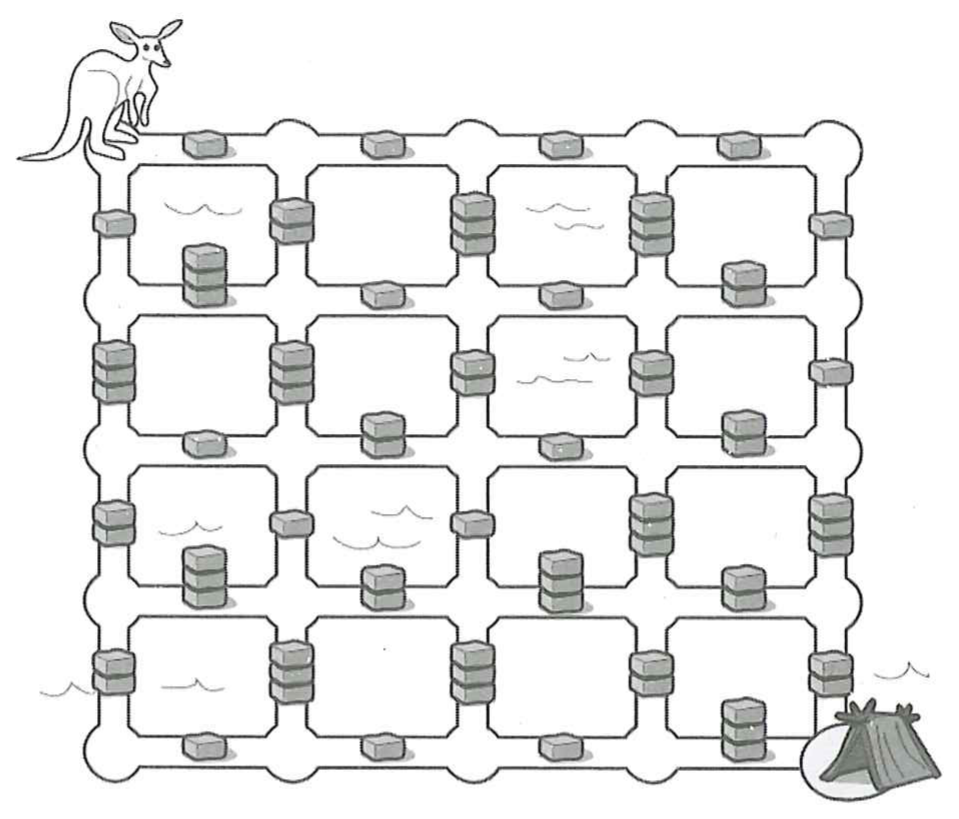
Kangaroo wants to get home by jumping along the roads shown below. Kangaroo can jump only horizontally (left or right) or vertically (up or down). Furthermore, Kangaroo can jump over a pile of stones only if it contains no more than two stones.
Call the distance between two adjacent intersections one road segment. What is the fewest road segments Kangaroo must jump along to reach home in the bottom-right corner?
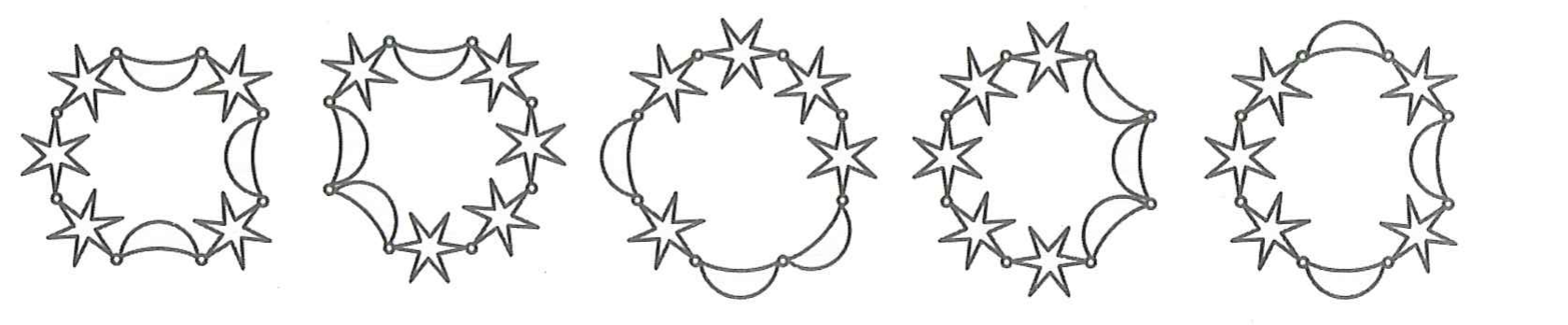
The beavers usually make bracelets using these steps:
- Join a star-shaped bead () and a moon-shaped bead ().
- Repeat this operation twice more.
- Join the pieces together into a chain.
- Add two more stars to the chain. Then join its ends to make a bracelet.
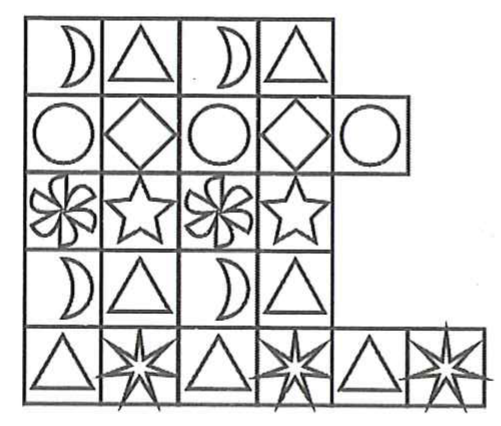
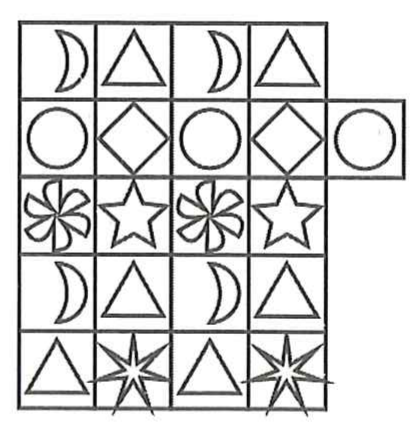
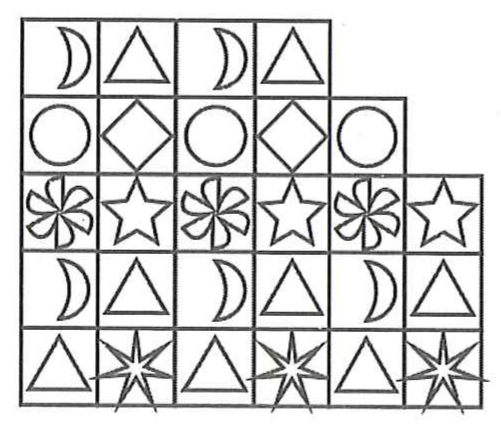
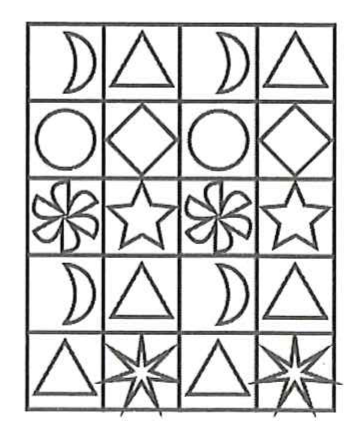
How many of the bracelets below definitely cannot be made this way?
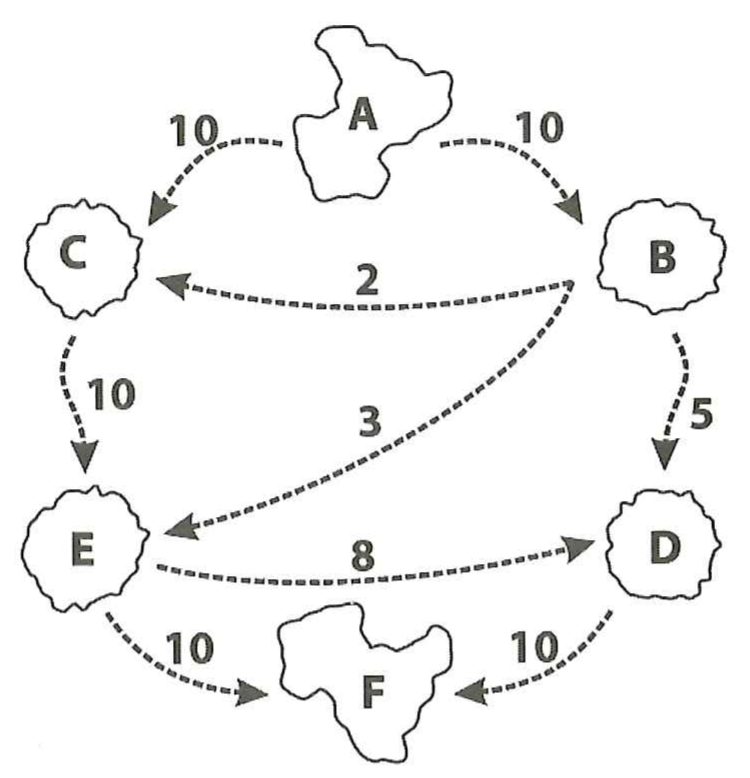
The beaver kingdom consists of six islands: A, B, C, D, E and F. A strange disease has appeared on island F, and the king needs to send experts from island A to help island F. To prevent the disease from spreading, however, the king also restricts travel between the islands as shown below.
Travel must follow the arrows. Furthermore, the number of people allowed on each route is limited. Each number in the diagram is the maximum number of people permitted to travel along that route in one day.
What is the maximum number of experts who can reach island F on the first day?
The beaver wants a pine tree and a bundle of grass to build a house, but has only two carrots. Luckily, there is a market at Grandson Castle today. The following trades are available in its rooms:
- Room A: exchange a carrot for a fish, or a coin for grass.
- Room B: exchange a fish for a bowl of rice, or a ring for ice cream.
- Room C: exchange ice cream for a coin, or a ring for grass.
- Room D: exchange a carrot for a bowl of rice, or a carrot for ice cream.
- Room E: exchange a carrot for a coin, or a ring for a pine tree.
- Room F: exchange a ring for a coin, or ice cream for a fish.
- Room G: exchange ice cream for a ring, or a carrot for grass.
- Room H: exchange a carrot for grass, or a bowl of rice for a fish.
What is the minimum number of rooms the beaver must enter to obtain a pine tree and a bundle of grass to take home for building?
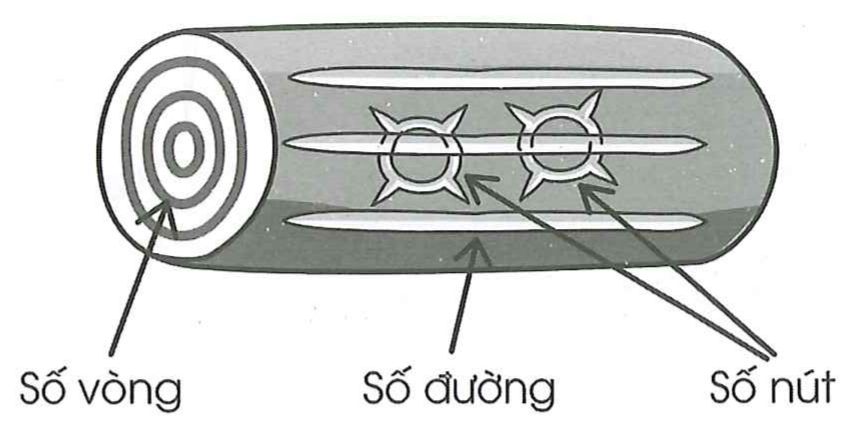
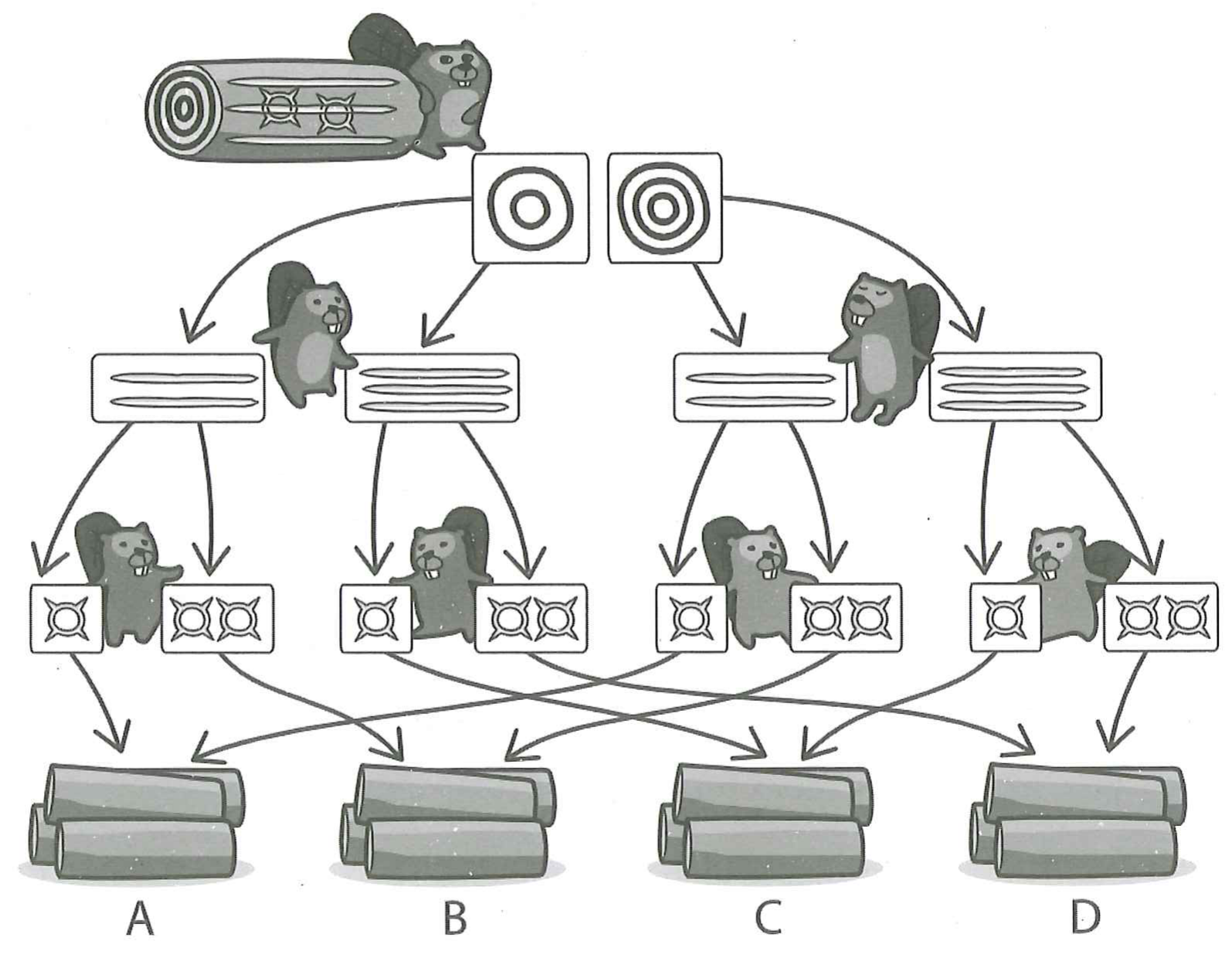
The beavers hide secret information in logs. The place where a log is stored depends on three attributes: its number of rings, number of lines and number of knots, as illustrated below.
Diagram labels: “Số vòng” = number of rings; “Số đường” = number of lines; “Số nút” = number of knots.
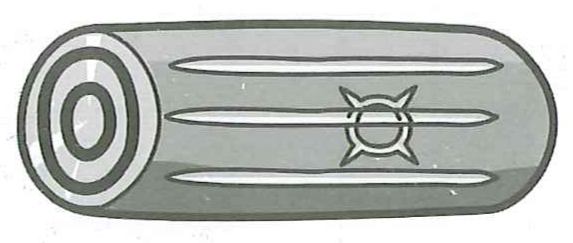
The rules for assigning logs to storage areas according to these attributes are shown below. We can see that the log above will be placed in area D.
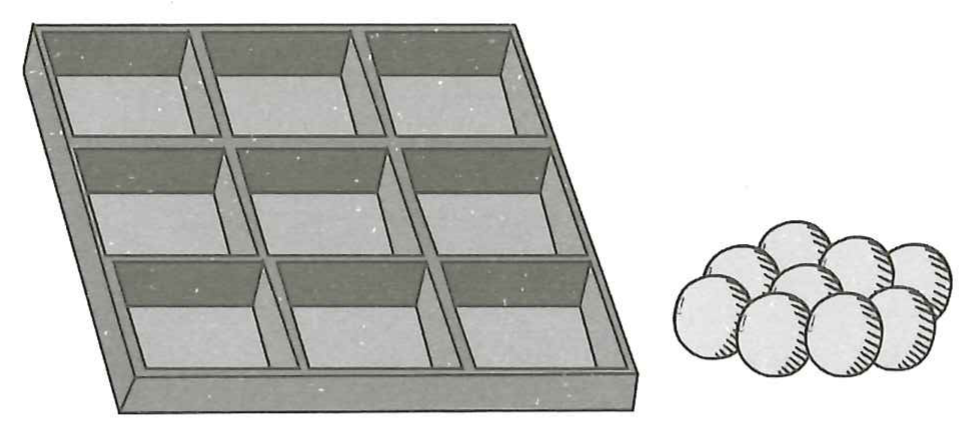
Alex the beaver is asked to place balls in a wooden box with nine compartments, as illustrated below.
There are nine balls in total, but Alex may choose how many to put in the box. The arrangement must also satisfy all these conditions:
- Every ball in the box is placed neatly in one of the nine compartments (all nine compartments are large enough to hold a ball).
- Each compartment contains at most one ball.
- The total number of balls in every row and every column is odd.
How many different arrangements satisfy these conditions?
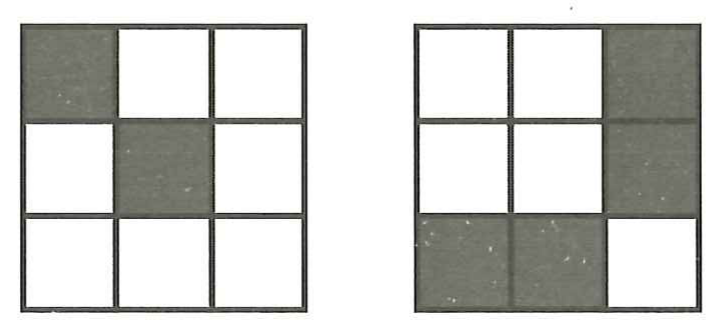
The beavers like using Bomino tiles. These tiles are decorated by colouring cells grey on a $3\times3$ grid according to these rules:
- Every grey cell must share an edge or a vertex with at least one other grey cell.
- Every grey cell shares an edge with at most one other grey cell.
- A tile with $n$ grey cells is called an $n$-Bomino.
- Two tiles are considered the same if one can be rotated or flipped to obtain the other.
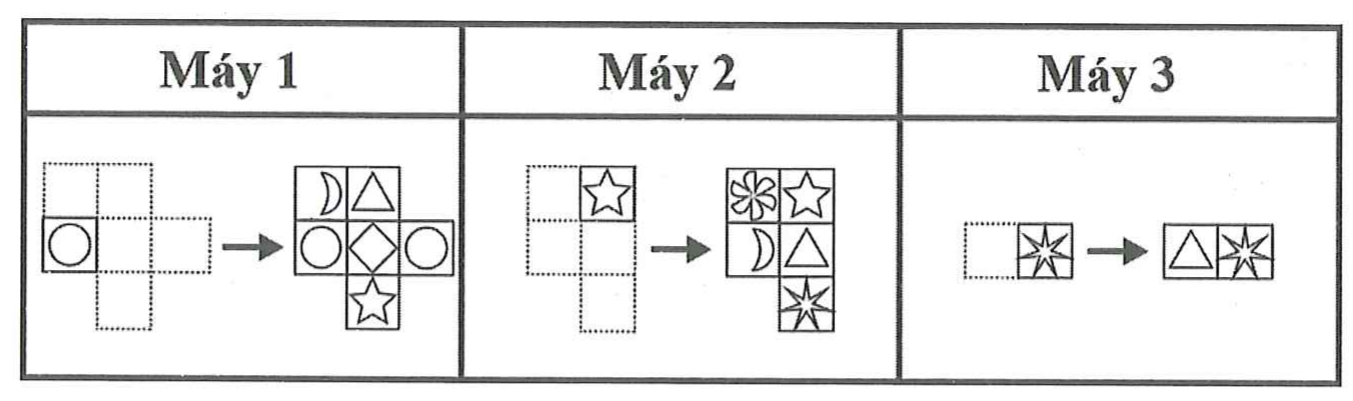
The beavers have three carving machines. Each machine takes a block bearing a given shape and adds other shapes according to its own rule, as shown below.
Diagram labels: “Máy 1”, “Máy 2”, “Máy 3” mean Machine 1, Machine 2 and Machine 3.
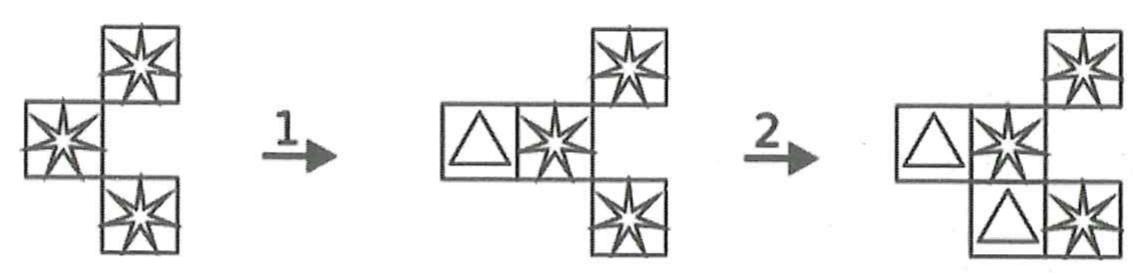
For example, the diagram below shows how Machine 3 can be used twice to obtain a new carving.
Starting with the block and using these three machines, which of the following carvings can the beavers produce?
Hansel and Gretel are playing a game with 10 stones: 3 blue stones and 7 red stones. They take turns removing stones. On each turn a player may take 1 or 2 blue stones, or 1, 2 or 3 red stones. The player who takes the last stone wins.
If Gretel is allowed to move first, which stones should she take on her first turn to guarantee a win? Assume both players play very well.
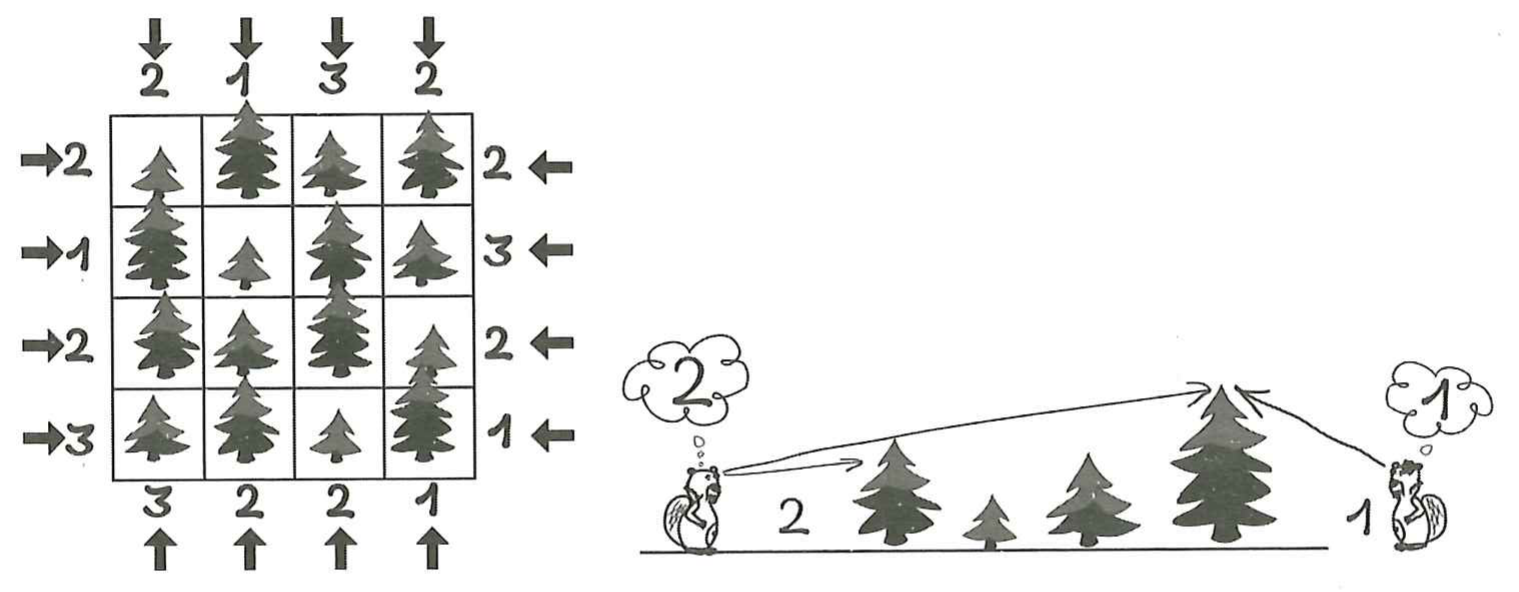
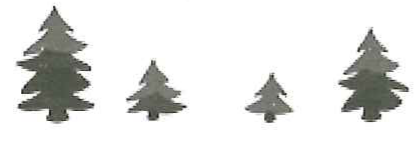
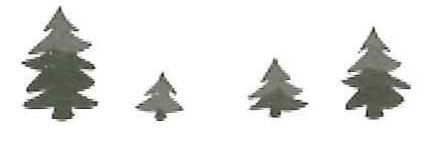
The beaver has 16 pine trees of four types (), four of each type. Trees of the same type have the same height, and different types have different heights. The beaver plants the 16 trees in a $4\times4$ garden so that each type appears exactly once in every row and every column. At each position around the garden, the beaver puts a sign showing the number of trees visible in that row or column from that position. Note that shorter trees behind taller trees are hidden. The illustration below gives an example of the numbers on the signs for the planting arrangement shown.
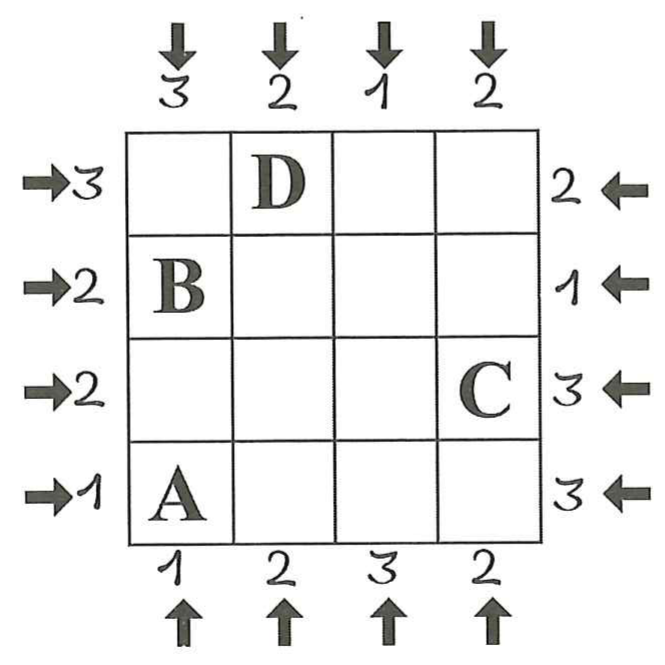
The following picture shows some signs that have been placed around the garden.
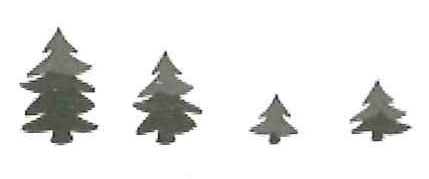
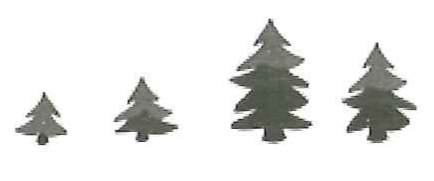
Which four trees below could be planted at A, B, C and D, respectively?

 ) and a moon-shaped bead (
 ).
 and using these three machines, which of the following carvings can the beavers produce?
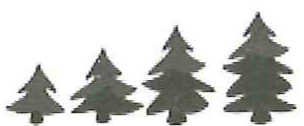 ), four of each type. Trees of the same type have the same height, and different types have different heights. The beaver plants the 16 trees in a $4\times4$ garden so that each type appears exactly once in every row and every column. At each position around the garden, the beaver puts a sign showing the number of trees visible in that row or column from that position. Note that shorter trees behind taller trees are hidden. The illustration below gives an example of the numbers on the signs for the planting arrangement shown.