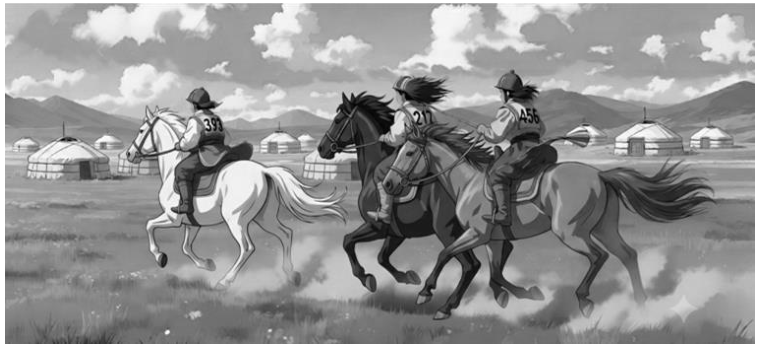
During the Naadam festival, three warriors namely Andy, Ben and Charlie, competed in a $1$ km horse race across the vast Mongolian grasslands. Each of their horses ran at a constant speed throughout the race. When Andy crossed the finish line, Ben was $40$ meters behind him. When Ben crossed the finish line, Charlie was $25$ meters behind him. How many meters behind Andy was Charlie at the exact moment Andy crossed the finish line?
At a party, there are $200$ people, each of whom is either a liar (a person who always tells a lie) or a truth teller (a person who always tells the truth). During the party, some of them shake hands with each other. However, the room is too dark, so it is impossible to determine which pairs of people shook hands.
After the party, each person was asked:
“How many truth tellers did you shake hands with?”
The answer the $n$th person gives is $n-1$, where $n=1,2,3,\ldots,200$.
Given that
$$A=\frac{4051\times4051}{2026\times2025}-\frac{2025\times2025}{2026\times4051}-\frac{2026\times2026}{2025\times4051}.$$
What is the numerical value of $A$?
There are $20$ students at the MIMC Cultural Night, where all the boys shake hands exactly once with each student. If all the girls don't shake hands with each other and there are exactly $145$ handshakes in total, how many girls are attending this Cultural Night?
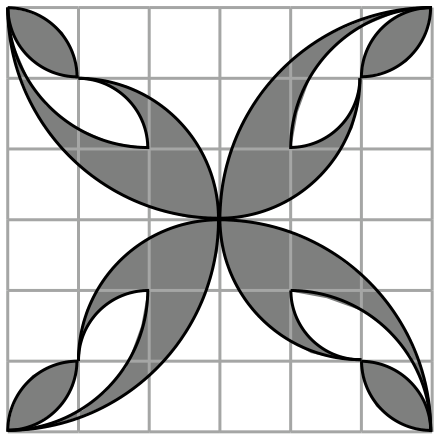
A $6$ by $6$ grid is shown in the diagram below, where each unit square has a side length of $7$ cm. Each curve is a quarter of a circle, where the radius of this circle is equal to one or more side lengths of a unit square. What is the area, in cm², of the shaded region? (Note: Take $\pi=\frac{22}{7}$.)
The $2026$ FIFA World Cup consists of $48$ teams divided into $12$ groups of $4$ teams each. In every group, each team plays every other team exactly once. A win earns $3$ points, a draw earns $1$ point, and a loss earns $0$ points. After all group matches have been played, exactly $k$ teams finish with $6$ points. What is the largest possible value of $k$?
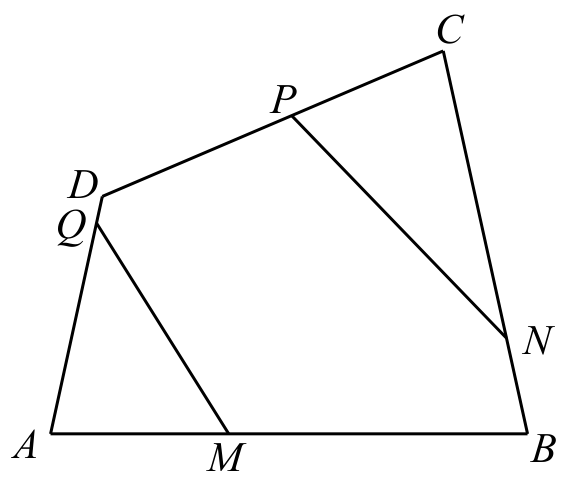
As shown in the diagram below, $ABCD$ is a convex quadrilateral where points $M,N,P,Q$ lie on sides $AB,BC,CD,AD$, respectively, such that
$$\frac{AM}{MB}=\frac35,\qquad\frac{BN}{NC}=\frac13,\qquad\frac{CP}{PD}=\frac45,\qquad\frac{DQ}{QA}=\frac18.$$
If the area of $ABCD$ is $45$ cm², what is the area, in cm², of hexagon $MBNPDQ$?
At the beginning, there are $5051$ jars, each containing exactly one candy. In each turn, one candy is removed from each non-empty jar, then a new empty jar is added, and all the candies collected during this turn are placed into the newly added jar. After $5051$ turns, what is the largest number of candies in any jar?
During a $40$-day period, Andy saved money every day except on $4$ skipped days. On day $n$, where $1\le n\le40$, if he did not skip that day, he saved $n$ dollars. Otherwise, he saved nothing. The four skipped days formed two disjoint pairs of consecutive days, with at least one day between the two pairs. Andy never skipped more than two consecutive days. If Andy's total savings over the forty days were $766$ dollars, how many possible patterns of skipped days are there?
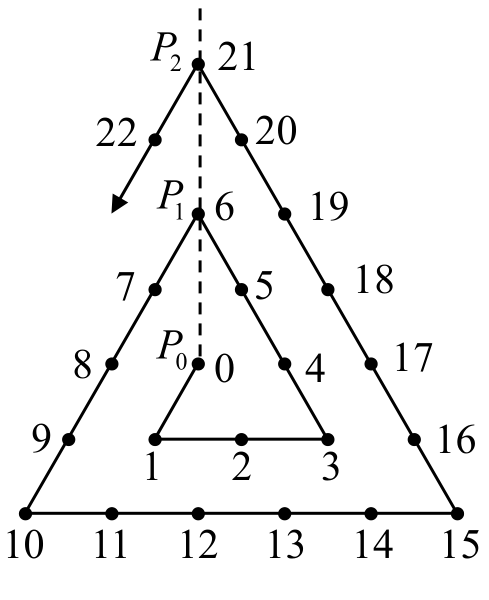
As shown in the diagram below, a frog jumps along a triangular spiral path, starting at point $P_0$ (which represents the number $0$). The path consists of straight segments whose lengths increase by one unit after each turn: the first segment has length $1$, the second has length $2$, the third has length $3$, and so on.
Each jump moves the frog by exactly one unit along the path to the next numbered point. (For example, jump $1$ lands on $1$, jump $2$ lands on $2$, jump $3$ lands on $3$, and so on.) Following this pattern, the frog reaches point $P_1$ (position $6$) after $6$ jumps and point $P_2$ (position $21$) after $21$ jumps.
Let $P_n$ denote the $n$th point along the vertical line shown. How many jumps must the frog make to travel starting from $P_0$ to point $P_{14}$?
Consider all five-digit palindromic numbers, $\overline{abcba}$, where $a\ne0$, which are divisible by $99$. Let $M$ and $m$ be the largest and the smallest of these numbers. What is the value of $M+m$?
Three four-digit positive integers are written on a board. If every digit $2$ written in the three numbers is replaced with $3$, then the sum of the resulting numbers is $15301$. If every digit $4$ in the three original numbers is replaced with $7$, then the sum of the resulting numbers is $16176$. What is the sum of the three original numbers?
Let $x_1,x_2,\ldots,x_{10}$ be a permutation of the numbers $1,2,3,4,5,6,7,8,9,10$. How many different permutations satisfy the following conditions?
$$x_1<x_2<x_3<x_4<x_5,$$
$$x_6<x_7<x_8<x_9<x_{10},$$
$$x_1+x_2+x_3+x_4+x_5<x_6+x_7+x_8+x_9+x_{10}.$$