There are some closed boxes, each box containing either a silver coin or a gold coin. It is known that $\frac25$ of all the coins inside the boxes are silver and the rest are gold. After opening $\frac14$ of the closed boxes, we observed that $\frac13$ of them contain silver coins. What fraction of the remaining closed boxes contain silver coins?
A number is called **primalistic** if it can be expressed in the form of $pqr+1$, where $p$, $q$ and $r$ are three different prime numbers. What is the **primalistic** number that is closest to 360?
A box contains a sufficient amount of red, blue and yellow balls, each of which has a value of 3, 5 and 6 points, respectively. Larry draws some balls from the box such that the number of yellow balls he draws is less than both the number of red balls drawn and the number of blue balls drawn.
If Larry draws the smallest possible number of balls from the box, such that at least one ball of each colour is drawn and the total value of the drawn balls is 66 points, what is the number of red balls drawn by Larry?
When a positive integer is divided by a positive integer divisor, the remainder is 26. When the same positive integer is doubled and then is divided by the same divisor, the remainder is 7. What is the value of the divisor?
What is the value of $x$ in the following equation:
$$\frac{x}{4\times9}+\frac{x}{9\times14}+\frac{x}{14\times19}+\cdots+\frac{x}{2019\times2024}=\frac{5^2\times101}{5+10+15+\cdots+200}\ ?$$
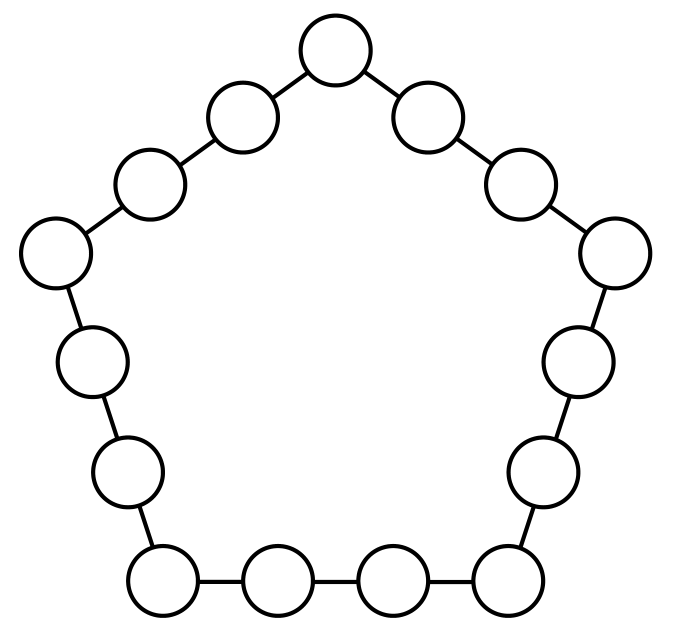
Fill in each of the fifteen circles with the numbers from 1 to 15, where each number can be used exactly once, so that the sums of all the numbers on each side of the pentagon are all equal. Let $S$ be the greatest possible sum of each side and $T$ be the least possible sum of each side. What is the value of $S+T$?
Let $a$, $b$ and $c$ be three different digits such that
$$\frac1{\overline{ab}\times\overline{bc}}+\frac1{\overline{bc}\times\overline{ca}}+\frac1{\overline{ca}\times\overline{ab}}=\frac{11}{3321}.$$
What is the numerical value of $\overline{ab}+\overline{bc}+\overline{ca}$?
Let $A$, $B$, $C$ and $D$ be four positive two-digit integers: $A=\square5$, $B=\square3$, $C=7\square$ and $D=2\square$, where the $\square$ symbol does not necessarily represent the same digit in each of the numbers.
Given that:
- The sum of $A$, $B$, $C$ and $D$ is 180.
- The unit digits of $A$, $B$, $C$ and $D$ are all distinct.
- The unit digit of $D$ is greater than the unit digit of $C$.
- $D<A<B<C$.
What is the largest possible value of $A\times B$?
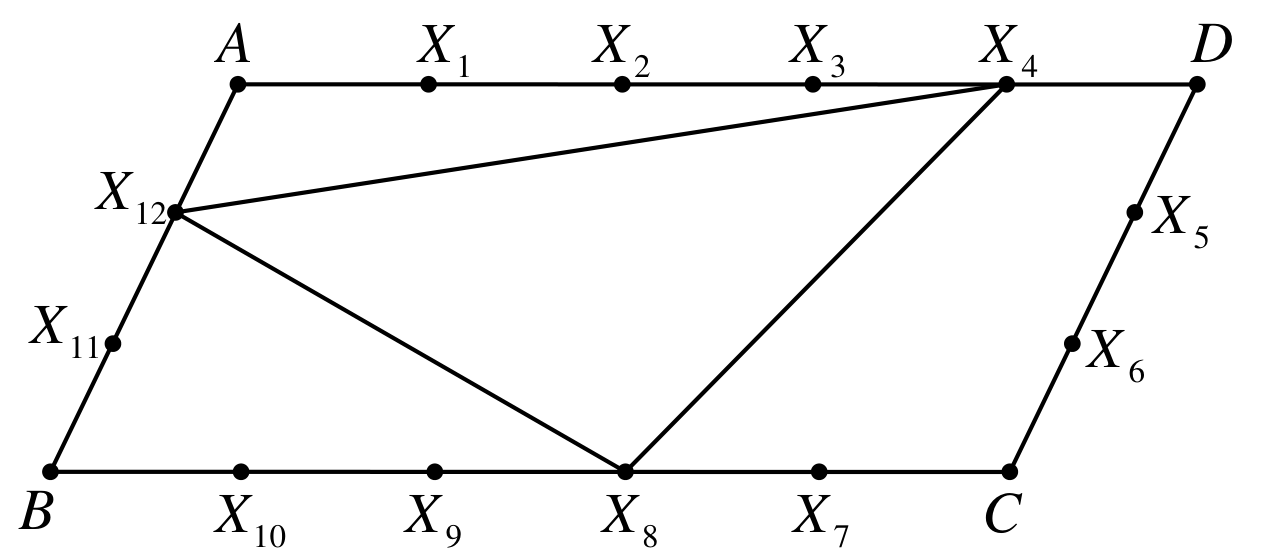
In the diagram below, $ABCD$ is a parallelogram of area 60 cm² and $X_j$ are points on the sides such that
$$\begin{aligned}AX_1&=X_1X_2=X_2X_3=X_3X_4=X_4D=DX_5=X_5X_6=X_6C\\&=CX_7=X_7X_8=X_8X_9=X_9X_{10}=X_{10}B=BX_{11}=X_{11}X_{12}=X_{12}A.\end{aligned}$$
What is the area, in cm², of triangle $X_4X_8X_{12}$?
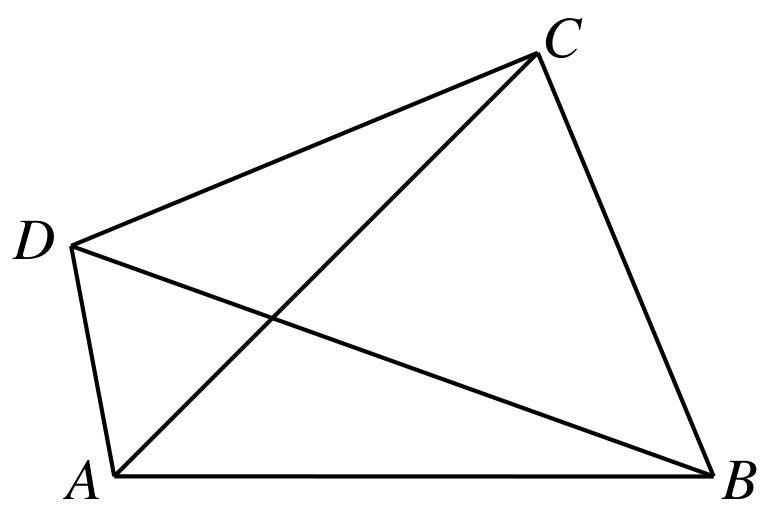
In the diagram below, $ABCD$ is a quadrilateral, where $AB=AC$ and $CD\perp BC$. The area of $ABCD$ is 54 cm² and the area of triangle $ACD$ is 17 cm². What is the area, in cm², of triangle $ABD$?
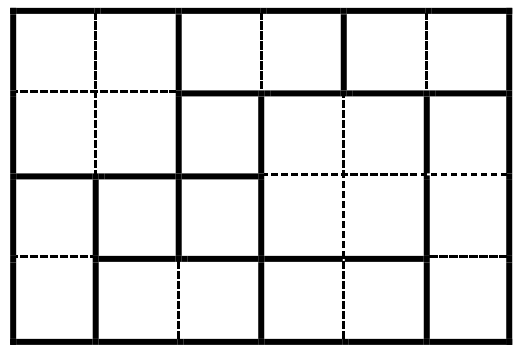
The $4\times6$ rectangle is formed by using 3 pieces of $1\times1$ square tiles, 2 pieces of $2\times2$ square tiles, 1 piece of $2\times1$ rectangle tile, 4 pieces of $1\times2$ rectangle tiles and 1 piece of $3\times1$ rectangle tile as shown in the diagram below.
In how many different ways can we paint one or more pieces of tile so that the total area of the painted tile(s) is 4 units?
(Note: when painting a piece of tile(s) – all of its tiles must be fully painted.)
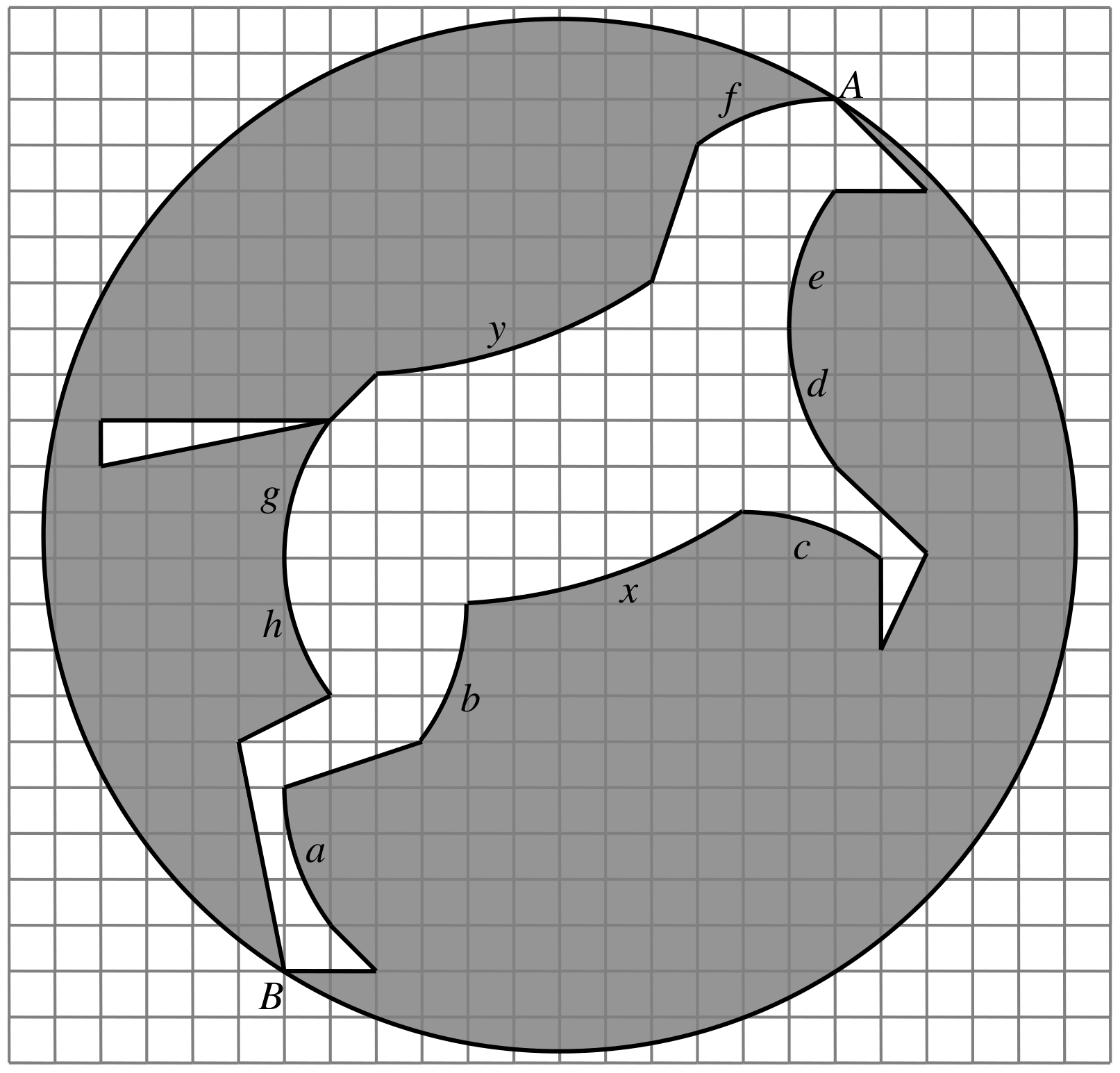
A horse-shaped diagram is drawn inside a circle on a grid composed of unit squares, where $A$ and $B$ lie on grid points situated on the diameter of the big circle, as shown below.
What is the area, in cm², of the shaded region, given that the arcs $a,b,c,d,e,f,g,h$ are all identical and each is contained in a $1\times3$ region, and the arcs $x$ and $y$ are identical, and each is contained in a $2\times6$ region? (Take $\pi=\frac{22}{7}$)
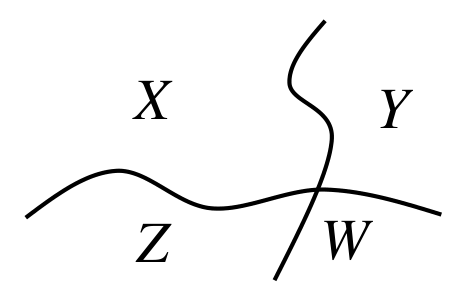
We define one village as bordering another village if they share a common border, not just a common point. For example, in the diagram below, village $X$ borders villages $Y$ and $Z$, but it does not border village $W$.
Meghan resides in town $A$, which comprises several villages. Each village borders exactly three other villages in town $A$.
Consider the situations when the number of villages in town $A$ is either 4, 5, 6, 7, 8, 9 or 10. List down all situations that can possibly fit our condition.
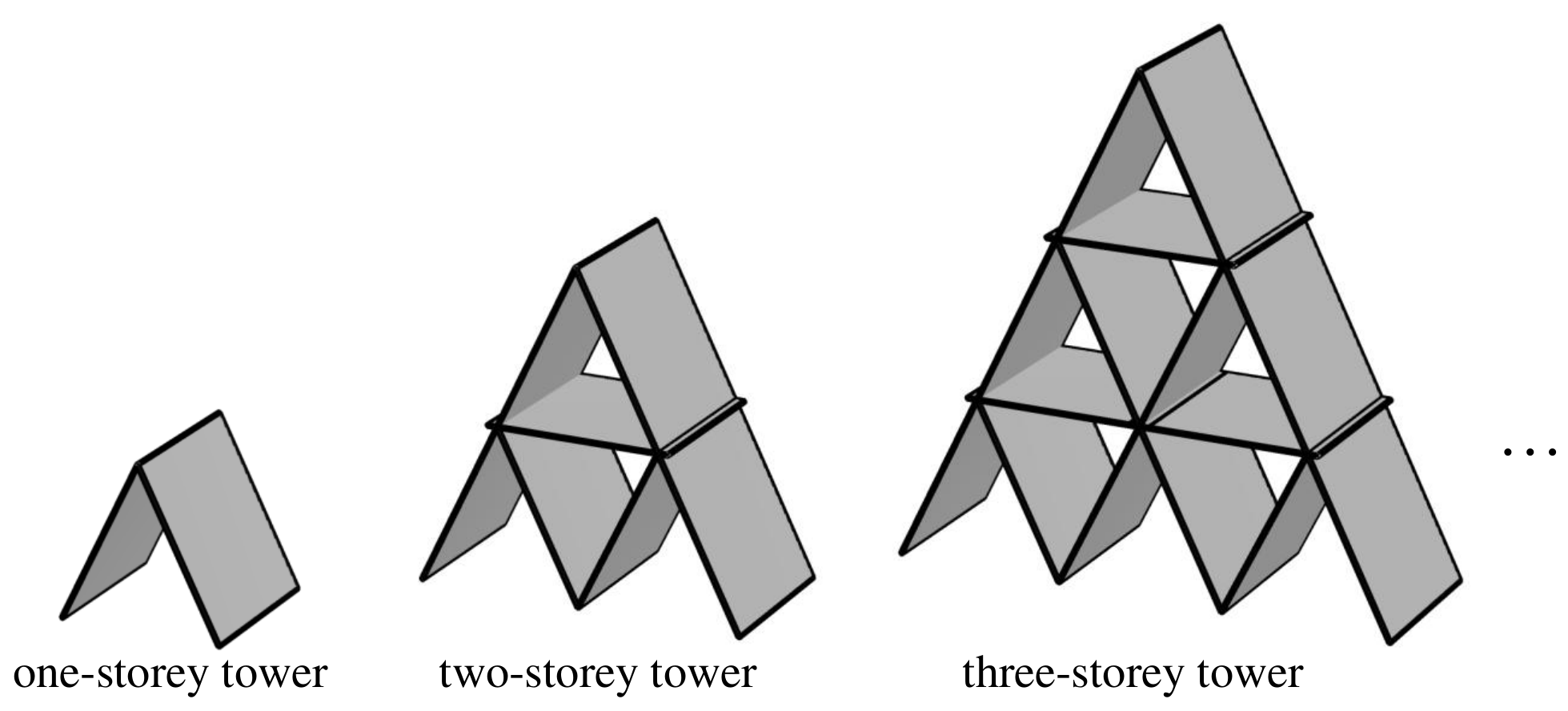
The diagram below shows three towers made by using different numbers of cards. The one-storey tower uses 2 cards, the two-storey tower uses 7 cards, and the three-storey tower uses 15 cards. If 2024 cards are available, what is the number of storeys on the tallest tower that can be constructed?
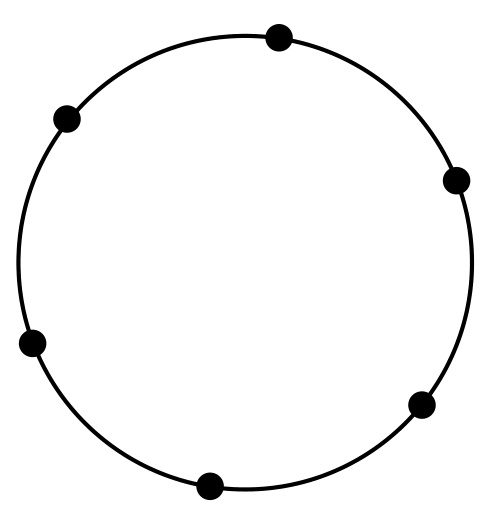
In the diagram below, there are 6 points on a circle, where the distances between adjacent points are not necessarily the same. In how many different ways can we draw at least one segment using these 6 points as its endpoints so that each point is the endpoint of at most one segment and that all the segments drawn do not intersect each other?