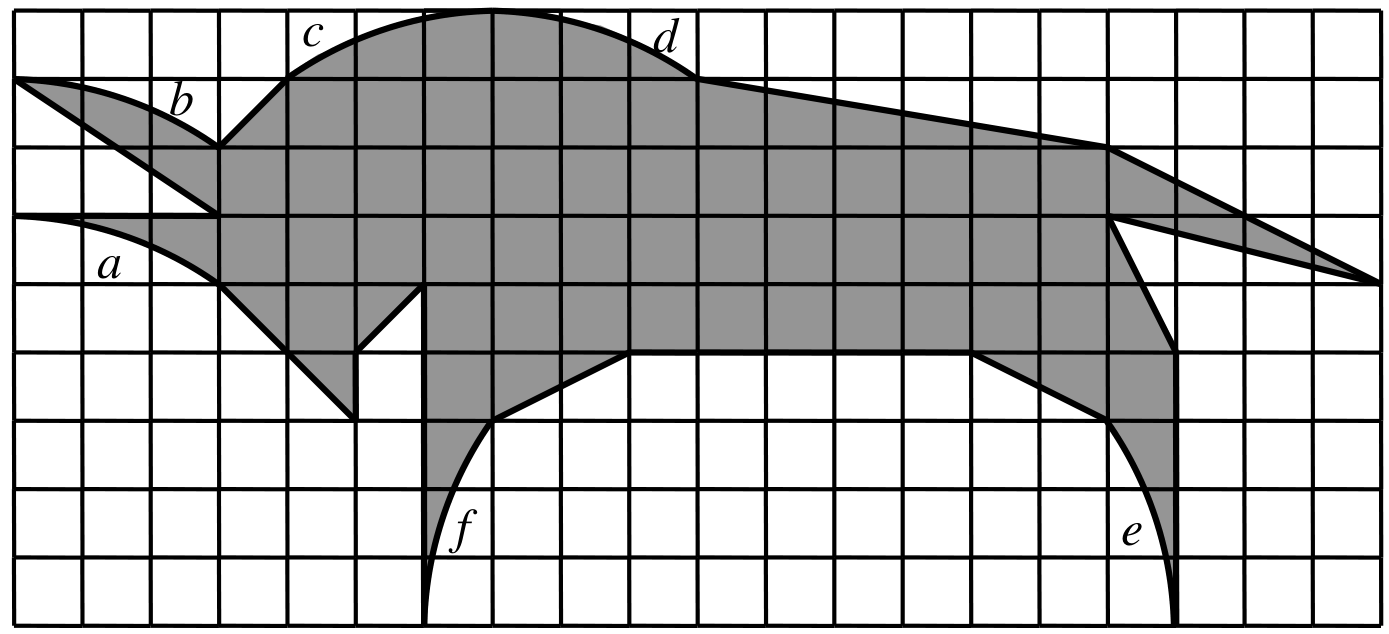
What is the area, in cm$^2$, of the shaded diagram (Bull shape) formed by six identical arcs (namely $a,b,c,d,e,f$) and fifteen segments, given that the side length of each unit square is $1$ cm and all six arcs are in $1\times3$ or $3\times1$ rectangles?
Thirty students from five classes in one school decided to join the “Donate a book” initiative and brought a total of $40$ books for the library. Students from the same class brought the same number of books, and students from different classes brought different numbers of books. If every student donated at least one book, how many students donated exactly one book?
The product of five consecutive positive integers is $120$ times greater than $\overline{ABABAB}$, where $A$ and $B$ are non-zero digits. What is the largest of those five numbers?
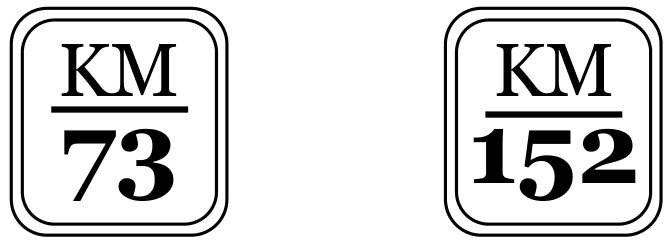
Mr. Sun was traveling in an old bus that was moving at a constant speed on a road with kilometre markers, which indicate the distance in kilometres from the road’s start. Two examples of such kilometre markers are given below. A moment before falling asleep, he saw that the bus was passing a kilometre marker labelled with a two-digit number. After exactly one hour, Mr. Sun opened his eyes and saw the bus passing a kilometre marker labelled with a three-digit number, and he remembered that: its first digit was equal to the second digit of the number he saw before falling asleep, the second digit of the three-digit number was $0$, and the third digit of the three-digit number was equal to the first digit of the number he saw before falling asleep. Mr. Sun then slept for exactly two more hours before waking up, when he saw the bus passing a kilometre marker with a number that was almost the same as the second number, except that the second digit had been replaced by another digit. What was the speed, in km/h, of the bus?
Alex has a large piece of paper of width $6$ cm and length $94$ cm. He wants to cut as many rectangles as possible from this paper such that each rectangle has integer side lengths in cm and perimeter $20$ cm. What is the largest possible number of rectangles he can get?
**User-approved clarification (added condition, not official source wording):**
Every side of each cut rectangle must be parallel to an edge of the original sheet.
Allen, Bob and Cindy are walking around a circular lake trail. They start walking from the same location at the same time. Bob is walking clockwise, while Cindy and Allen are walking counterclockwise. They all walk at constant speeds. After a while, Bob meets Cindy for the first time. Then $3$ minutes later, Bob meets Allen. Finally, another $14$ minutes later, Bob meets Cindy for the second time. It is known that Cindy’s speed is $\frac34$ of Bob’s speed and the lake trail is $2023$ metres long. How many minutes after Bob meets Cindy for the first time will Bob meet Allen for the second time?
**User-approved clarification (added condition, not official source wording):**
The Bob–Allen encounter described as occurring 3 minutes after Bob first meets Cindy is Bob and Allen's first meeting after they start.
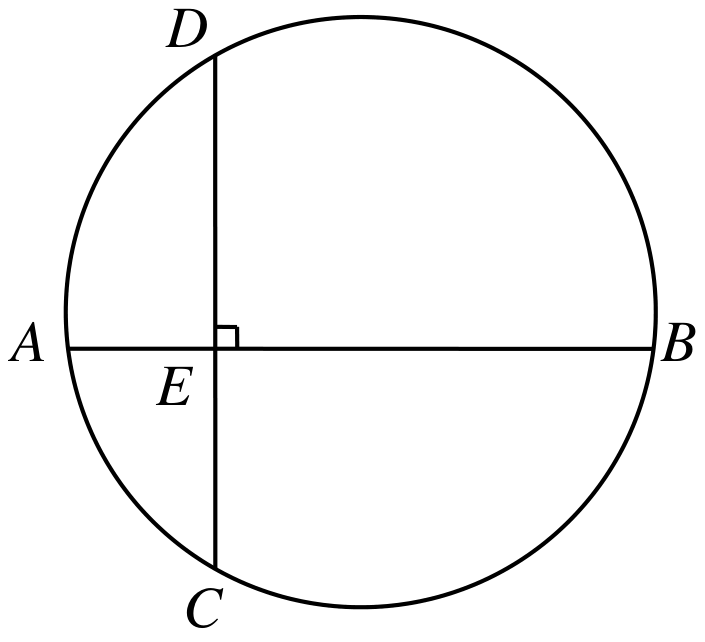
Two perpendicular chords of a circle, $AB$ and $CD$, intersect each other at point $E$, as shown in the diagram below. If $AE=28$ cm, $EB=84$ cm and $CE=42$ cm, what is the area, in cm$^2$, of the circle? (Take $\pi=\frac{22}{7}$.)
Each passenger on the train has a ticket. The tickets are numbered with consecutive $6$-digit numbers, starting from some number greater than or equal to $100000$. It is known that the number of passengers whose ticket number ends with $23$ is exactly $\frac{1}{108}$ of the number of all passengers. What is the largest possible number of passengers on the train?
There is a sequence of positive integers. The first term of the sequence is $1$, the second term is $2$, the third term is $3$ and the square of each number starting from the second one equals the sum of the two neighbouring terms. For example, for the second term we have that: $2^2=1+3$. What is the remainder when the $2023$rd term is divided by $11$?
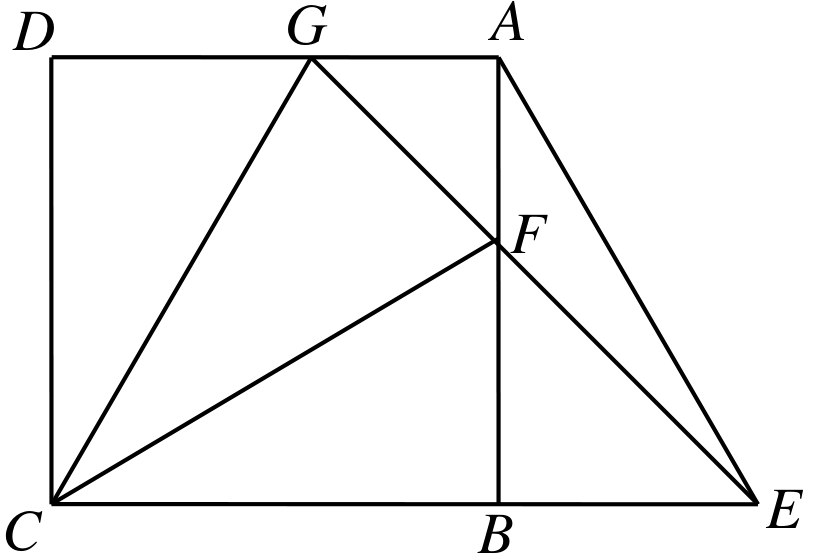
Let $ABCD$ be a square, where point $E$ lies on the extension of $CB$ such that $\angle BAE=30^\circ$, and point $G$ lies on $AD$ such that $\angle BCG=60^\circ$, as shown in the diagram below. If the area of triangle $CGF$ is $X$ and the area of triangle $BEF$ is $Y$, what is the ratio of $X:Y$?
Each cell of a $100\times100$ grid is painted in one of $20$ colours. A cell is said to be lonely if its colour is different from the colour of every other cell in the same row and different from the colour of every other cell in the same column. What is the largest possible number of lonely cells in the grid?
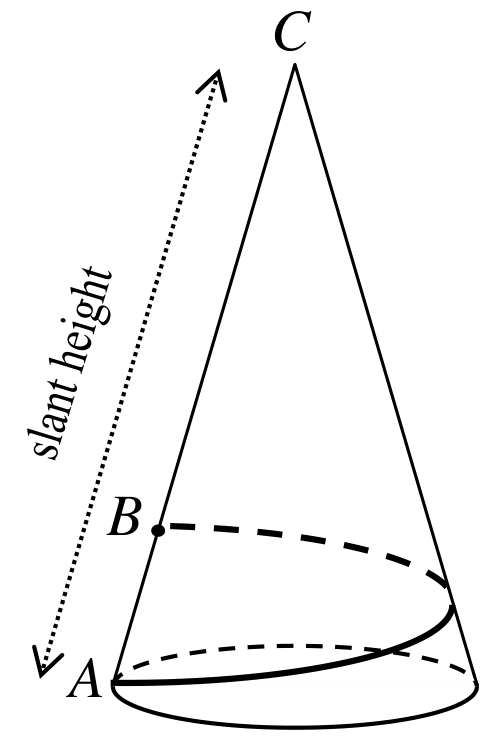
A circular cone with vertex $C$ has point $A$ on the circumference of its base and point $B$ on the segment $AC$, as shown in the diagram below. The shortest possible rope is wrapped once around the cone such that it starts at point $A$ and ends at point $B$. Assume that the base diameter and the slant height of this cone are $6$ cm and $12$ cm, respectively. If $AB=3$ cm and $D$ is the point on the rope that is closest to $C$, what is the length, in cm, of $CD$?