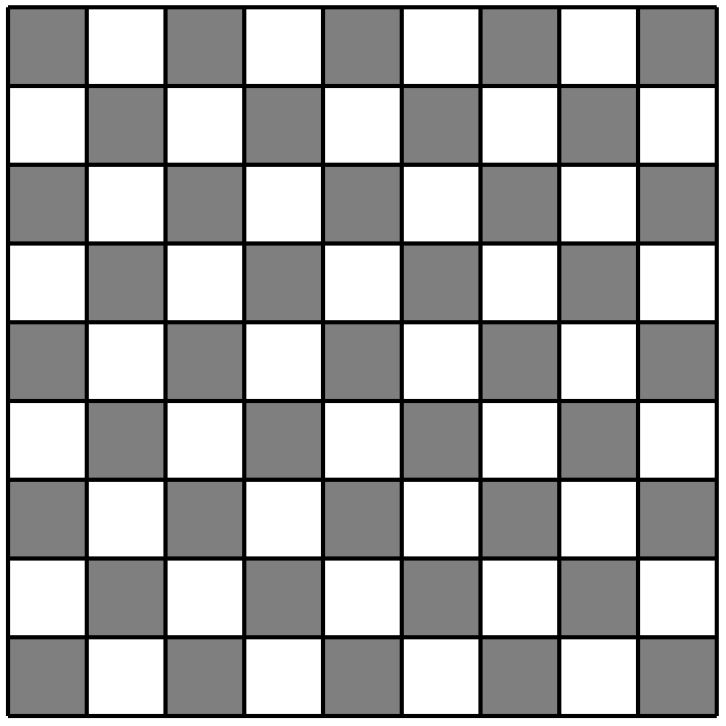
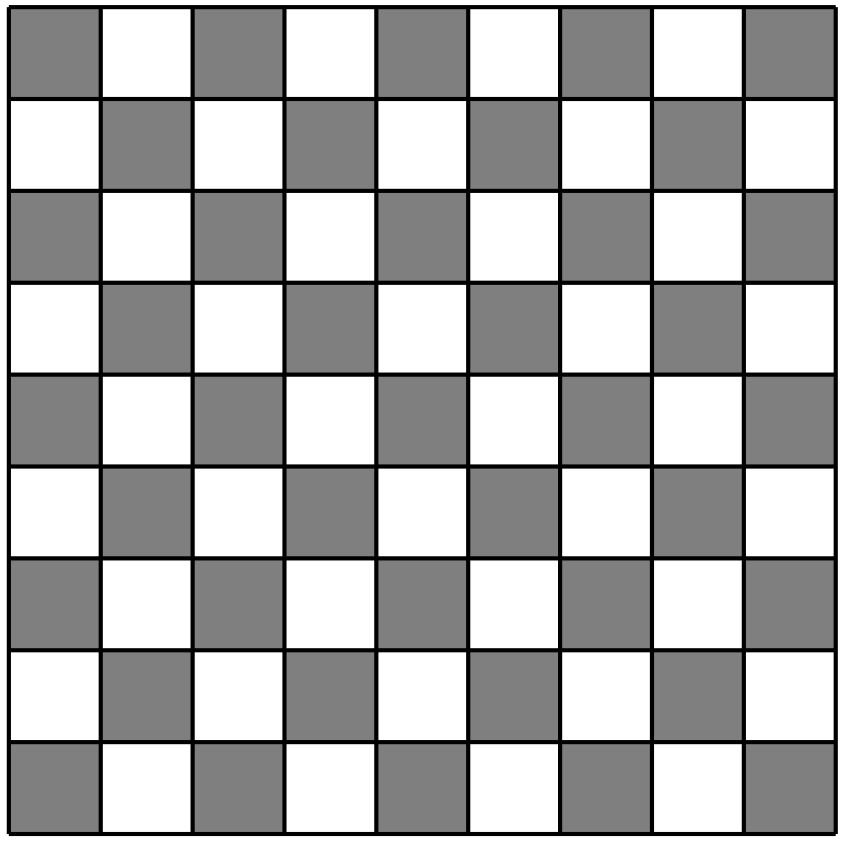
In the diagram below, a $9\times9$ chessboard is shown where each unit square is alternately coloured in black or white and each of its four corners are all coloured in black. Now, a lame bishop starts on any black square. If in each move, it can go to any diagonally adjacent black square without visiting any white squares, what is the minimum number of moves required to be able to visit all the black squares, not necessarily returning to its starting square? Draw the path.
Answer: ___ moves. Draw the path on the original answer board.
A $1\times2021$ plank is to be cut into $2021$ unit squares. In each move, we can either cut through a single plank, dividing it into two (not necessarily equal), or through a stack of planks of equal length, dividing each of them into two in the same way. Your task is to achieve this goal using as few cuts as you can. How many cuts do you need? Describe your process in full detail.
The first few positive integers starting from “$1$” were written on a board. If one of the numbers was erased, then the average of the remaining numbers becomes $\frac{45}{4}$. Which number was erased?
A thin plastic triangle that is lying on a flat surface may be flipped over any of its edges repeatedly. Whenever its new position shares an interior point with its initial position after several flips, the two triangles must coincide perfectly.
If triangles with equal angles are viewed as the same triangle, find the angles of all possible triangles with this property.
(Note: The number of correct answers minus the number of incorrect answers is the net correct answer, $3$ marks for each net correct answer. Finding all correct answers without any incorrect answer gives $40$ marks.)
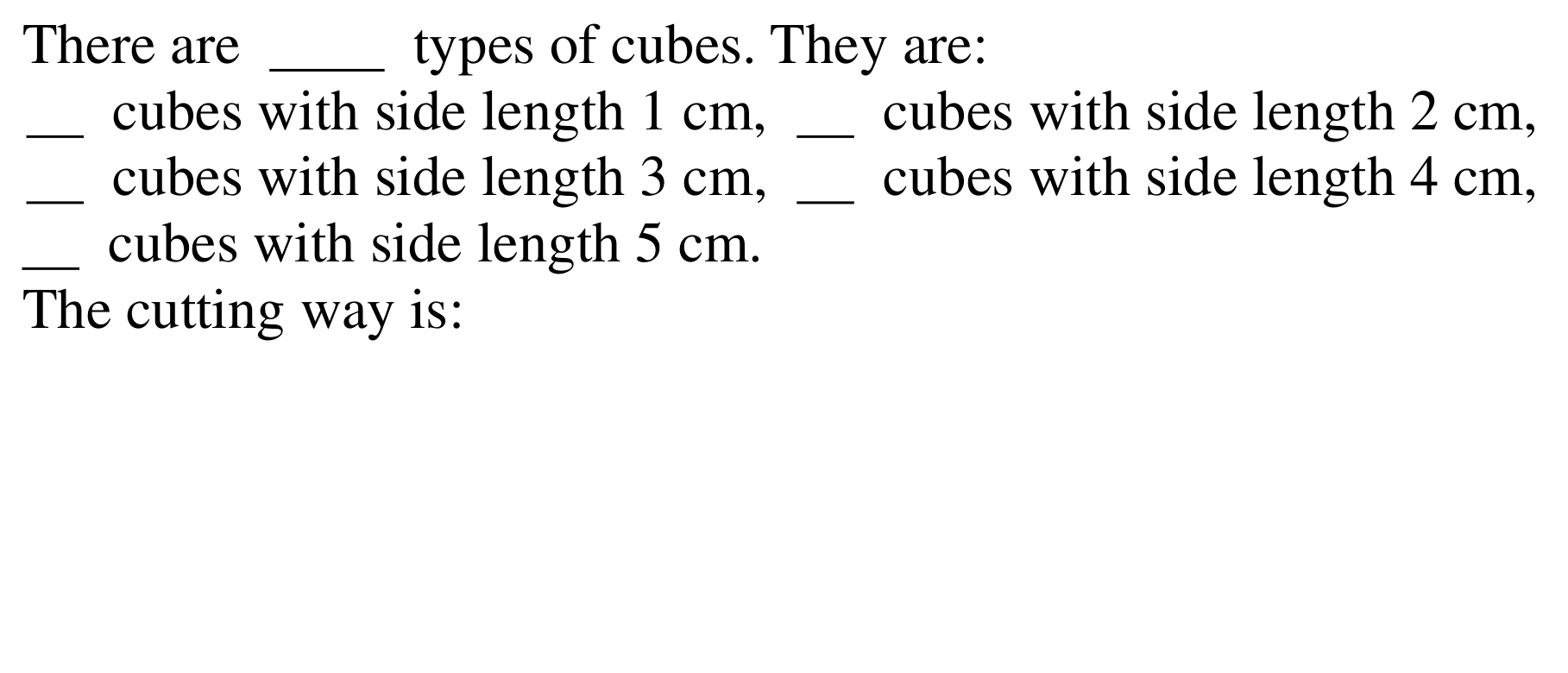
A cube, with side length $6$ cm, is to be dissected into $49$ smaller cubes. If the size of the smaller cubes does not need to be all the same but the side length, in cm, of each smaller cube must all be integers, then how many types of cubes of different sizes do we have? What is the number of cubes of each type?
Answer form: ___ types; ___ cubes of side 1 cm, ___ of side 2 cm, ___ of side 3 cm, ___ of side 4 cm, and ___ of side 5 cm.
Satya has some number of apples and oranges. It is known that the total number of those fruits that he has initially is between $100$ to $300$ and the ratio between the number of apples to the number of oranges is $7:4$. Then, each day, he randomly eats two of them, but not necessarily of the same kind. On the $10$th day, after he eats two of them, the ratio becomes $8:5$. How many apples and oranges in total does Satya initially have?
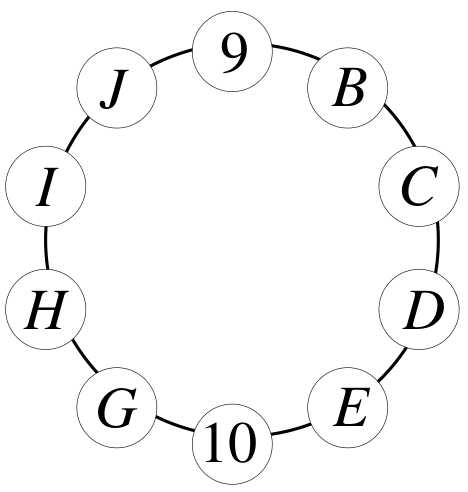
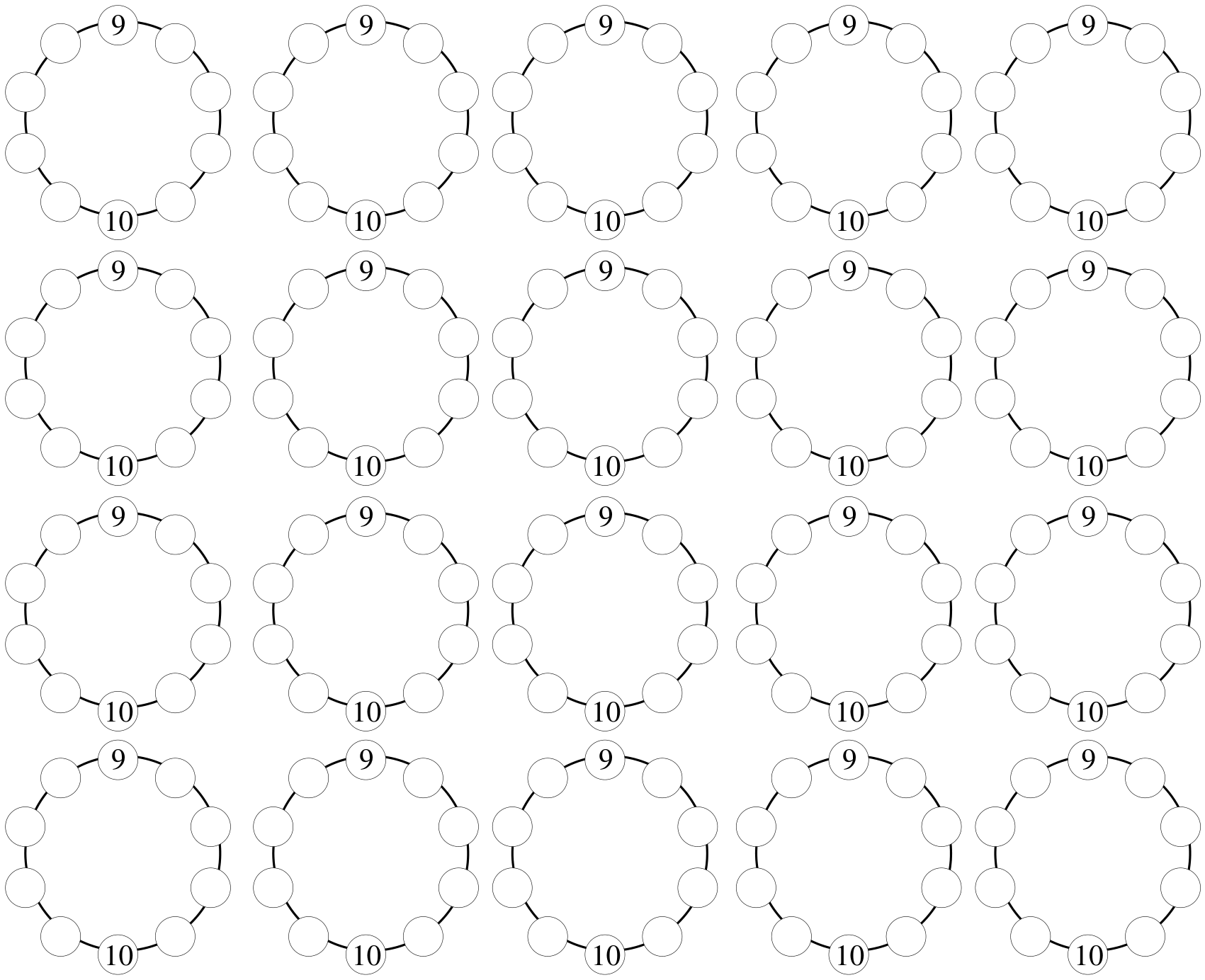
In the diagram below, ten beads labelled as $A,B,C,D,E,F,G,H,I,J$ are arranged in clockwise order on a circle, where bead $A$ is labelled $9$ and bead $F$ is labelled $10$. The remaining eight beads are to be labelled with the numbers $1,2,3,4,5,6,7,8$, using each number exactly once. If the number on $G$ must be greater than the number on $E$ and the sum of the numbers of any two adjacent beads must be a prime number, list down all different possible labellings.
(Note: The number of correct answers minus the number of incorrect answers is the net correct answer, $2$ marks for each net correct answer. Finding all correct answers without any incorrect answer gives $40$ marks.)
The road between Town $M$ and Town $S$ is $15$ km long. Anna and Boris both leave Town $M$ at noon, where Anna walks and Boris is riding a bike. Meanwhile, their friend Olga walks starting from Town $S$ to Town $M$ and all three of them are travelling on the same road. When Boris meets Olga, he gives Olga the bike and walks the rest of the way, while Olga travelled by bike until she meets Anna and gives Anna the bike. Anna then bikes the rest of the way, arriving in Town $S$ at the same time as Boris. If the walking speed of each person is $6$ km/h and their biking speed is $15$ km/h, how many hours before noon did Olga leave Town $S$?