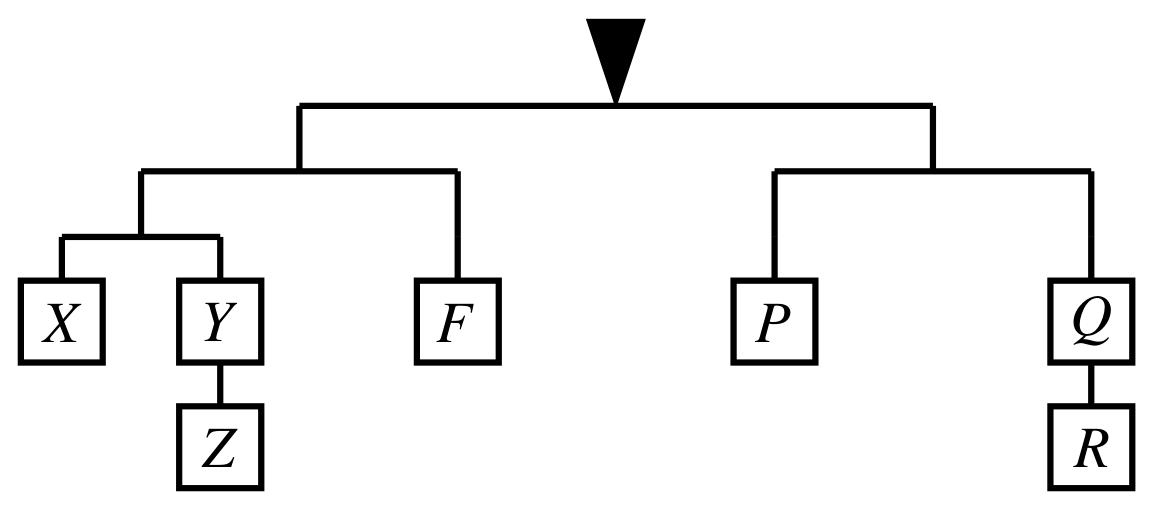
In the figure below, the balance is in equilibrium and each of the weights is an integer greater than zero grams. If the sum of all weights is the largest possible integer not greater than $2019$ grams, find the largest possible value, in gram, of $X$.
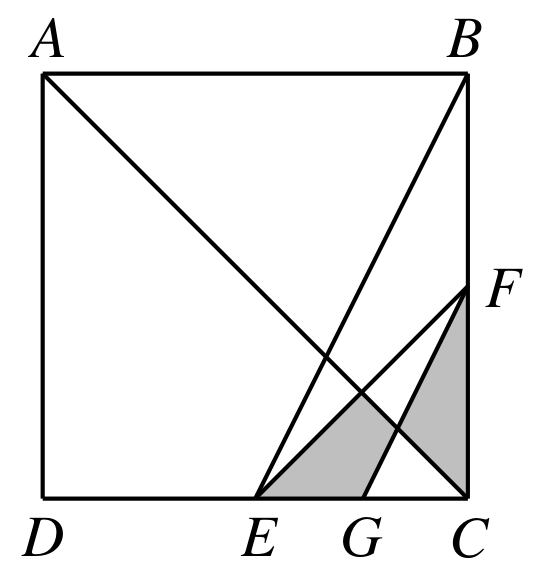
In the figure below, $ABCD$ is a square and points $E$, $G$ and $F$ are the midpoints of $CD$, $CE$ and $BC$ respectively. What is the ratio of the total area of the shaded regions to the area of $ABCD$?
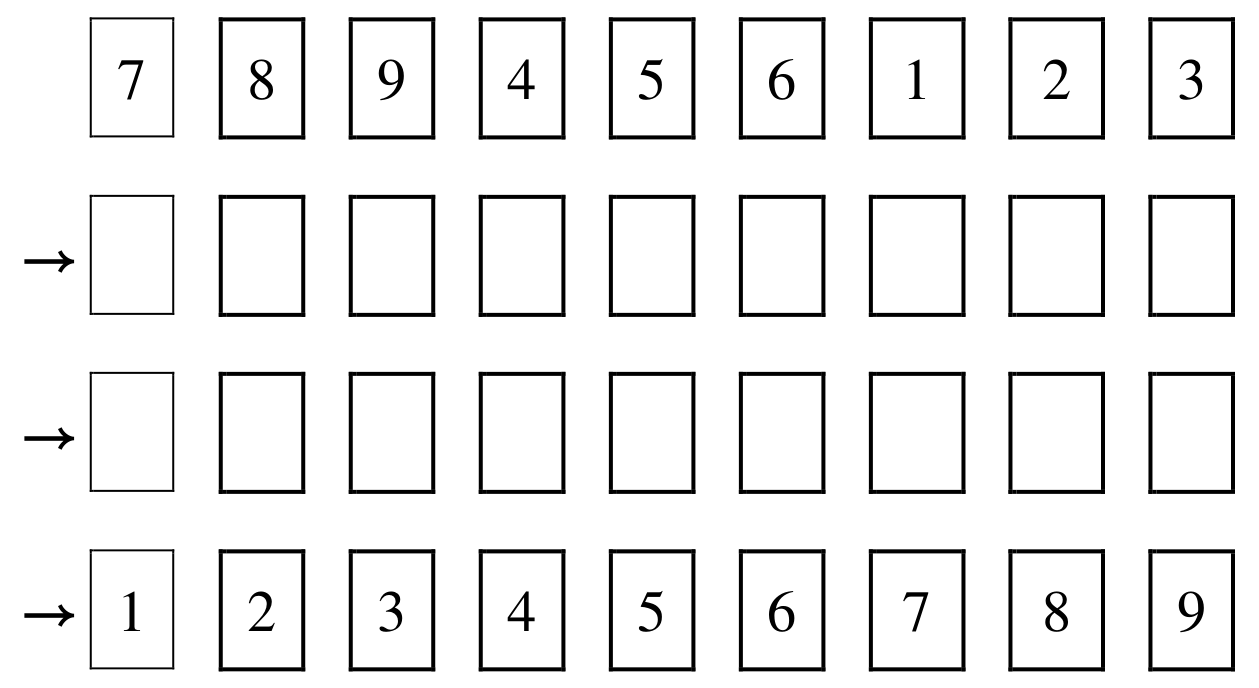
There are nine cards that are arranged in a sequence $7,8,9,4,5,6,1,2,3$ in this order as shown below. On each turn, we may remove any number of consecutive cards, reverse their order and put them back anywhere in the row. After three turns the cards are in the sequence $1,2,3,4,5,6,7,8,9$. What are the three turns? Show your steps.
Peter and Jack went to a store to buy some pens. In the store, they are selling different pen packs such that each pack has exactly $1,2,4,8,16,\ldots$ pens. For example, if Peter wants to buy $14$ pens, then he needs to buy packs with $8$, $4$ and $2$ pens. It is known that Peter bought $n$ pens and Jack bought $n+1$ pens, where $n\le2019$. If Peter and Jack bought the minimum number of packs of pens and Peter has $4$ packs more than Jack, then find the number of different values of $n$.
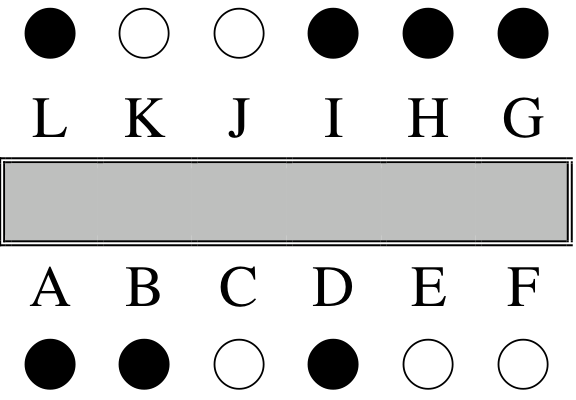
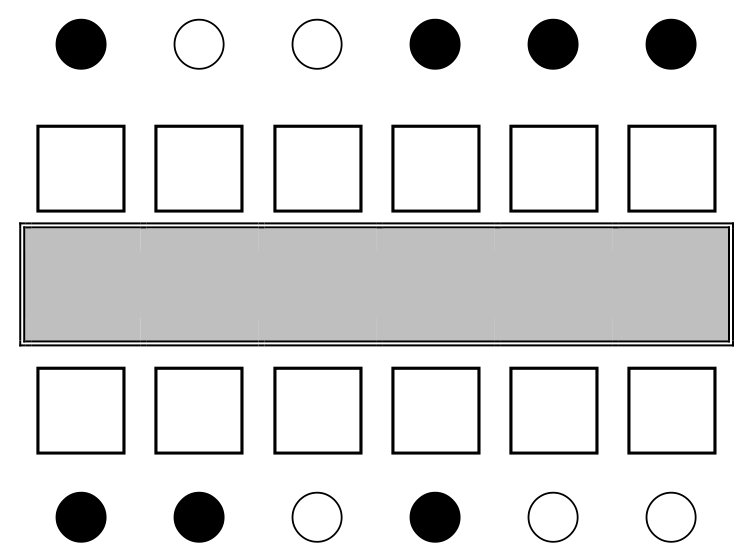
Twelve children, $A,B,C,D,E,F,G,H,I,J,K,L$, sit at a long table with chairs on each side, forming six opposite pairs. Six of them are boys and the other six are girls. The party host stipulates two rules. First, each boy must have a girl on the seat opposite him. Second, if a girl is not in a seat at either end of the table, then there must be a boy on each side of her. However, not every child observed these rules. In the diagram below, those children observing the rules are represented by white circles and those not observing the rules are represented by black circles. Since neither rule applies to a girl sitting on a seat at either end, such a girl may be represented by a white circle or a black circle. What is the gender of each child, represent a girl as “g”, a boy as “b”?
Original response template:
Answer entry: give the twelve letters in the order $A,B,C,D,E,F,G,H,I,J,K,L$.
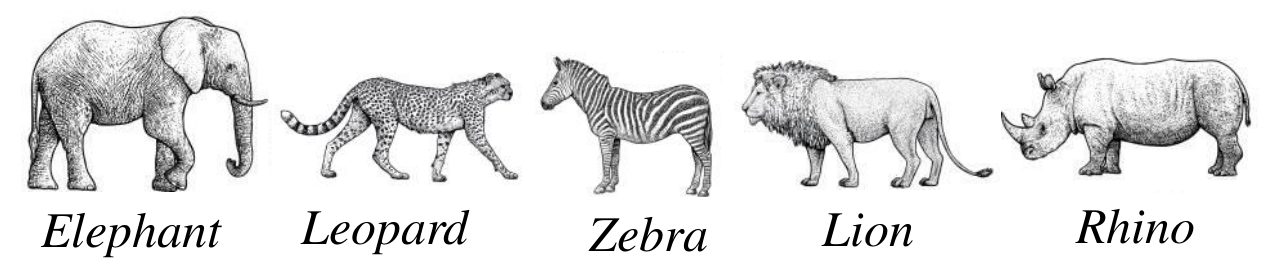
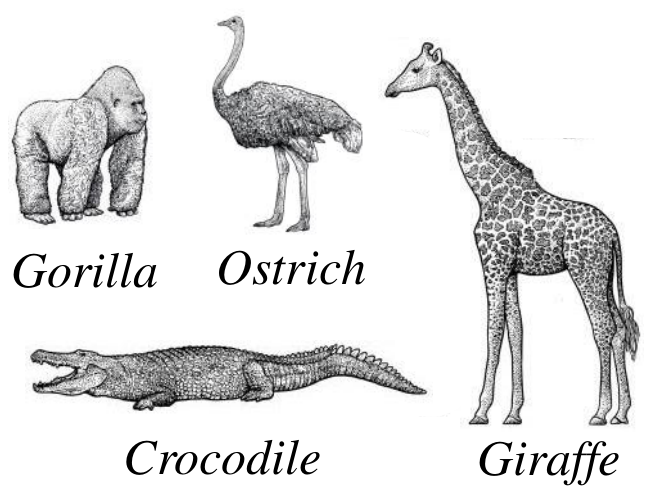
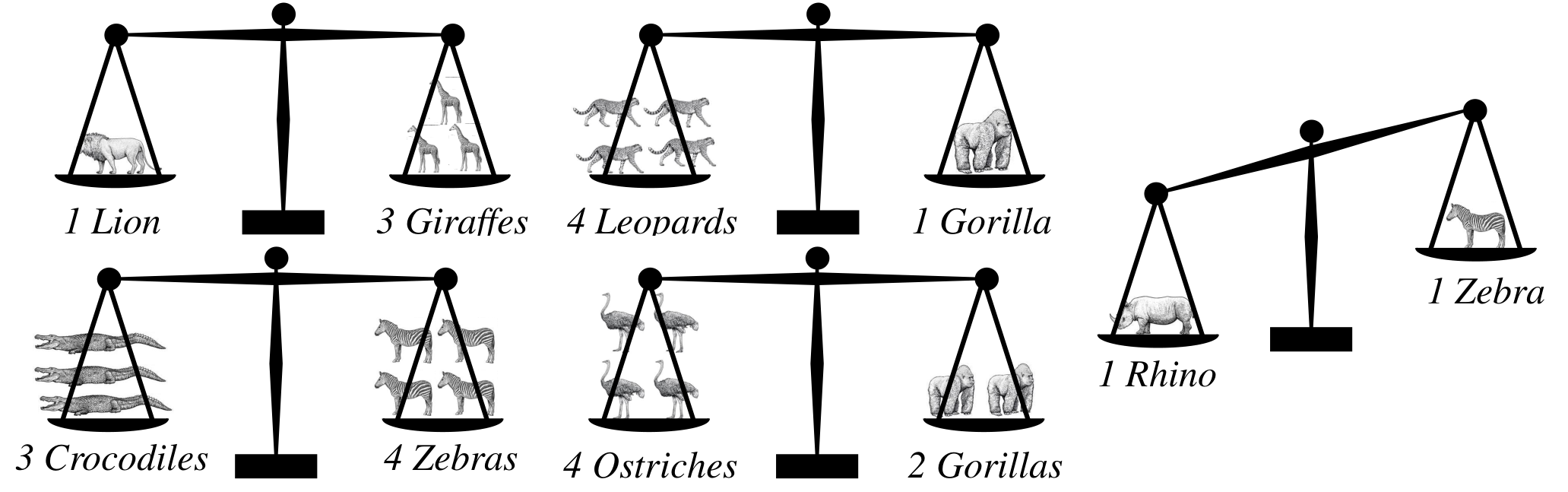
The weights of these animal figurines are $1$ kg, $2$ kg, $3$ kg, $4$ kg, $5$ kg, $6$ kg, $7$ kg, $8$ kg or $9$ kg. Different kinds of animal figurines have different weights and the same kind of animal figurines have the same weight. I put some figurines on a balance scale and get the following result:
What is the weight, in kg, of each kind of animal figurine?
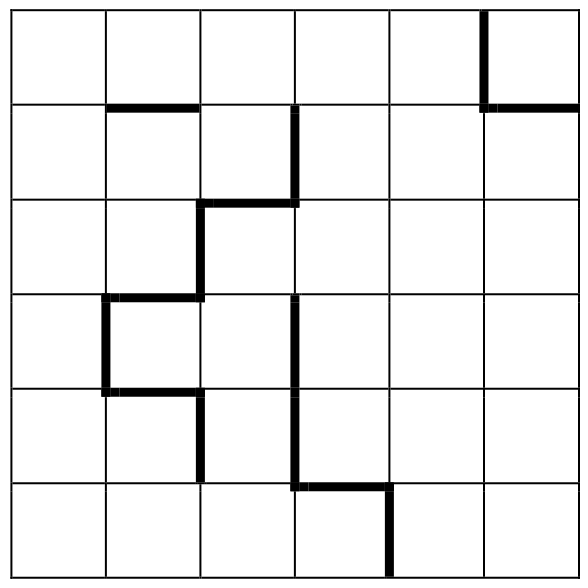
In the $6\times6$ grid below, each row and column contains three kinds of digits: one $1$, two $2$s and three $3$s. A bold line is drawn between two adjacent squares if and only if both contain the same number. Now all the numbers have been erased. Complete the grid.
Original answer grid:
Answer entry: enter the six rows from top to bottom, with the six digits of each row together and a semicolon between rows.
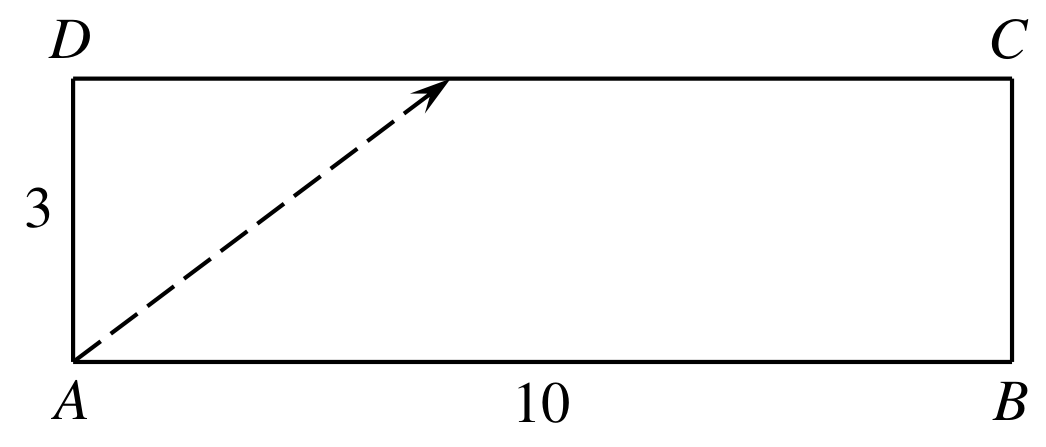
A ball is shot from corner $A$ of a billiard table $ABCD$ so that the first bounce is on the side $CD$. The ball continues to bounce from the sides of the table (by reflection, at a constant speed and without friction). After exactly five bounces (five reflections from the sides of the table), the ball stops in corner $D$. If $AD=3$ m and $AB=10$ m, what is the total length, in m, of the longest path covered by the ball as it moves from $A$ to $D$?
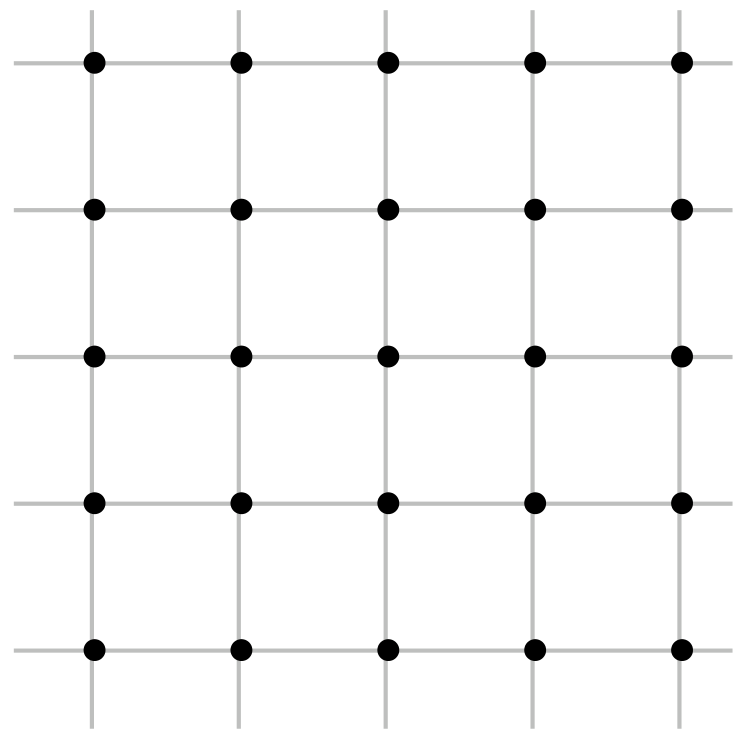
The figure shows $25$ points, all of which are located in a square grid. How many straight lines can you draw, each containing exactly three of the $25$ points?
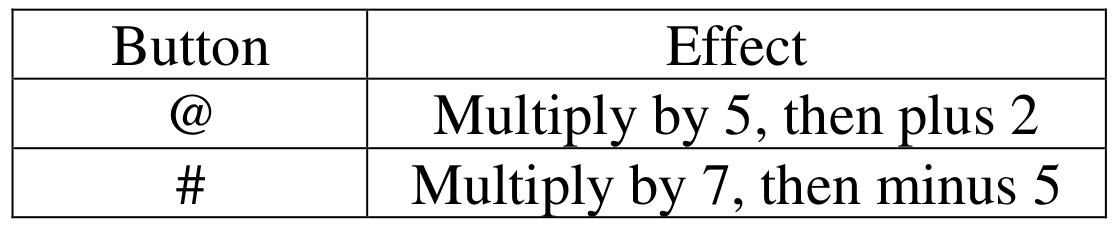
A special calculator displays the number $1$ on its screen when it is switched on and has only two buttons: @ and #. The @ and # buttons work differently:
| Button | Effect |
|---|---|
| @ | Multiply by $5$, then plus $2$ |
| # | Multiply by $7$, then minus $5$ |
Original button table:
For example, if you press @ first, then the calculator displays $1\times5+2=7$. Pressing @ again, it displays $7\times5+2=37$. Next, pressing # will then change the display to $37\times7-5=254$.
How many different three-digit numbers can be displayed by pressing @ and # buttons? (Just pressing one button many times is allowed.)