Mark went to a movie which started at $19:00$. He went to the toilet after watching one-third of the movie. When he came back, the rest of the movie was seven times as long as the time he was in the toilet. At $21:12$, the time from his return from the toilet was six times the rest of the movie. At what time did the movie end?
Peter, Anna and Andria bought three identical cars at the same price. Peter initially paid €$1300$, Anna €$1000$ and Andria €$600$. Every month after that, Peter paid €$180$, Anna €$240$ and Andria €$280$ until the price of each car have been exactly paid by the respective person. What is the lowest possible price, in Euros, of the car?
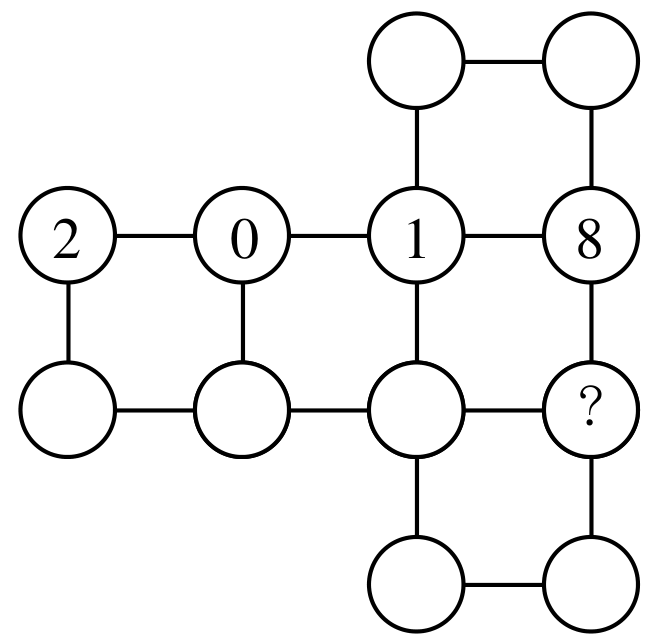
The eight empty circles in the diagram below are to be filled in, using each of the integers $3$, $4$, $5$, $6$, $7$, $9$, $10$ and $11$ exactly once, to make the sums of the four numbers at the corners of each square the same. Find the number inside the circle marked with a “?”.
Using the same two digits, Andrei and Natalie write down different six-digit numbers. For each of these numbers, the three digits in odd places are the same and the three digits in even places are also the same. If $5$ times Andrei's number is equal to $6$ times Natalie's number, what is Andrei's number?
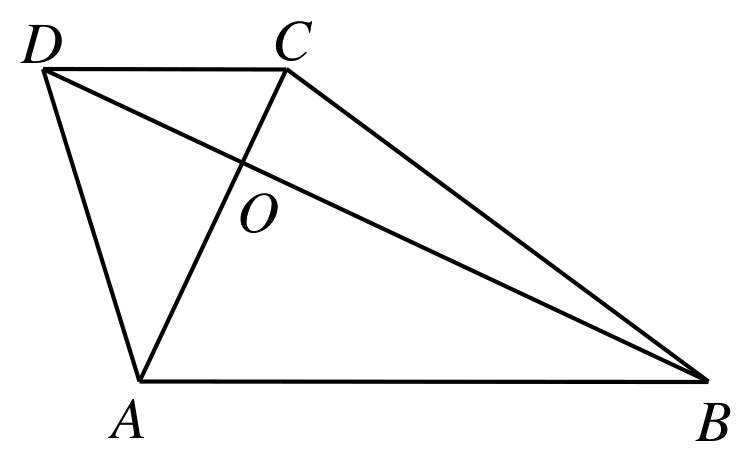
In quadrilateral $ABCD$, $AB$ is parallel to $CD$, and the diagonals $AC$ and $BD$ are perpendicular and intersect at point $O$. If $AO=p$ cm, $CO=q$ cm, $BO=r$ cm, $DO=s$ cm, $AB=7$ cm and $CD=3$ cm, what is the value of $pq+rs$?
The sum of three $3$-digit numbers is $2418$. All nine digits of those numbers are different, and two of those numbers are multiples of nine. What is the smallest possible value of the third number?
Given that $\overline{BIMC}+\overline{BI}+\overline{MC}+B+I+M+C-1=2018$, where $B$, $I$, $M$ and $C$ are distinct digits, what is the largest possible value of the $4$-digit number $\overline{BIMC}$?
Using each of four distinct non-zero digits once, we can construct $24$ different four-digit numbers. The second smallest of the numbers is a multiple of $5$. The second largest is even but not divisible by $4$. The positive difference between the fifth smallest number and the fifth largest number lies between $3000$ and $4000$. What is the maximum value of the largest of the $24$ numbers?
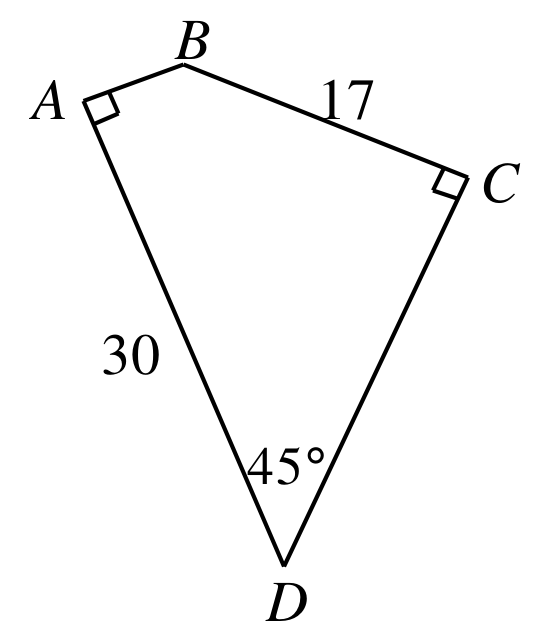
In quadrilateral $ABCD$, $AD=30$ cm, $BC=17$ cm, $\angle ADC=45^\circ$ and $\angle BAD=\angle BCD=90^\circ$. What is the area, in $\mathrm{cm}^2$, of $ABCD$?
The sum of the ages of the three boys in a family is $25$ and the product of the three ages is $360$. This is also true about the ages of the three girls in the same family. The middle boy is older than the middle girl. How much older is the middle boy than the middle girl?
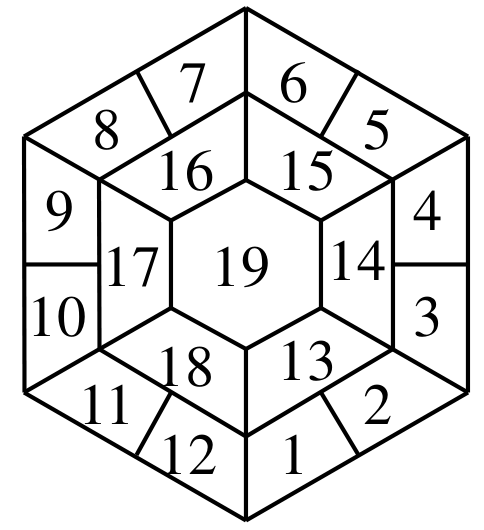
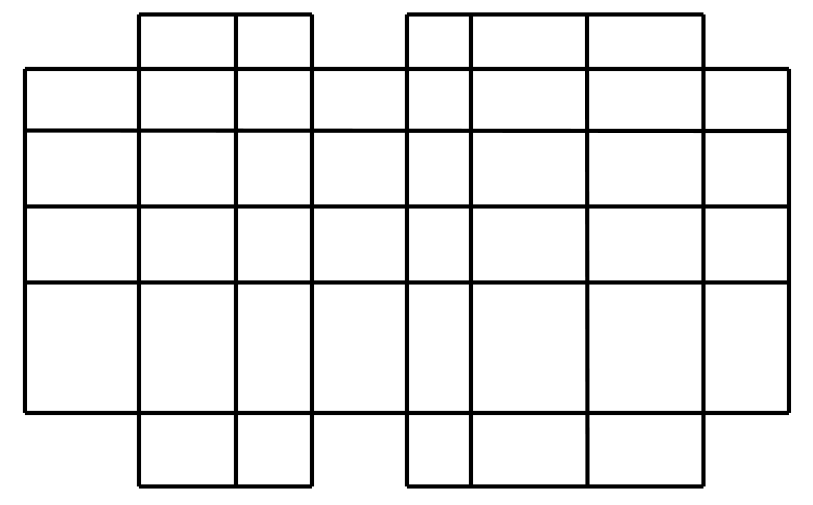
The diagram below shows a hexagonal room. Its floor is covered with $19$ numbered rugs of four different colors. Two rugs with a common segment along their borders must have different colors. Only two colors are used in the middle layer, and at most one rug in the outer layer has the same color as the central rug. Two coloring patterns are different if the color of at least one rug has changed. How many different coloring patterns are there?
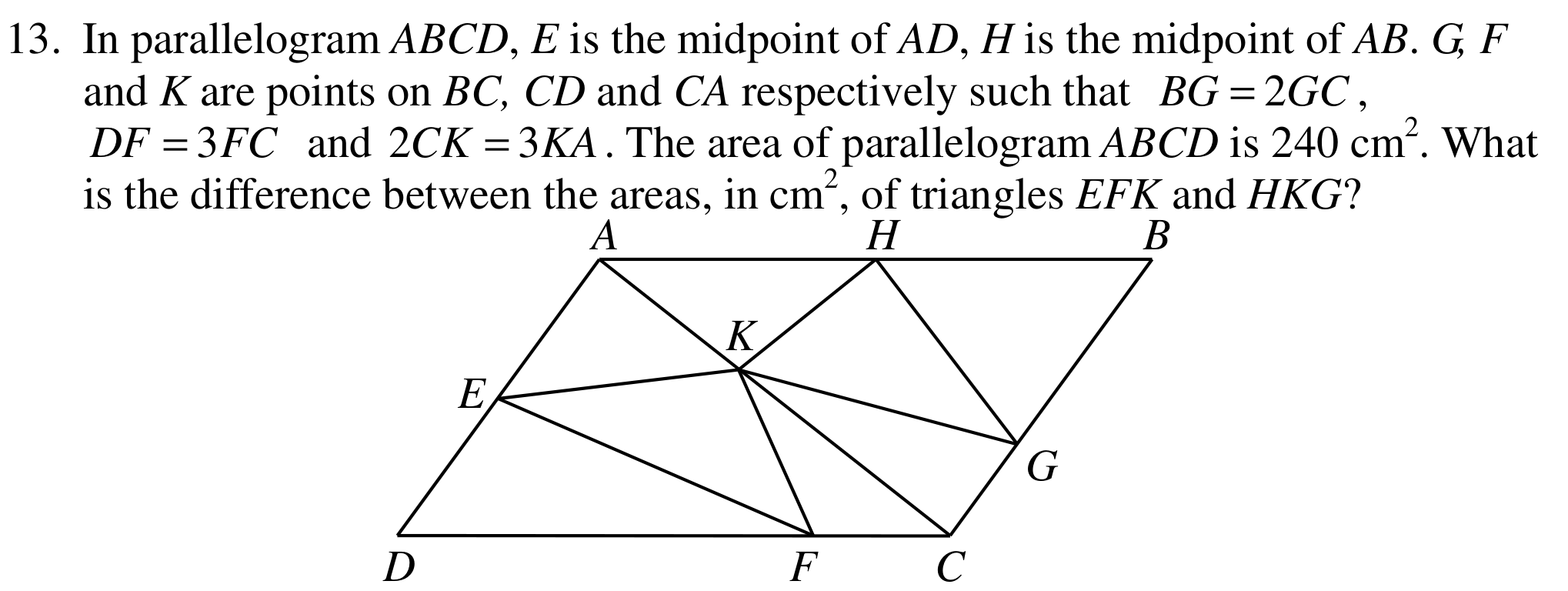
In parallelogram $ABCD$, $E$ is the midpoint of $AD$, $H$ is the midpoint of $AB$. $G$, $F$ and $K$ are points on $BC$, $CD$ and $CA$ respectively such that $BG=2GC$, $DF=3FC$ and $2CK=3KA$. The area of parallelogram $ABCD$ is $240$ $\mathrm{cm}^2$. What is the difference between the areas, in $\mathrm{cm}^2$, of triangles $EFK$ and $HKG$?
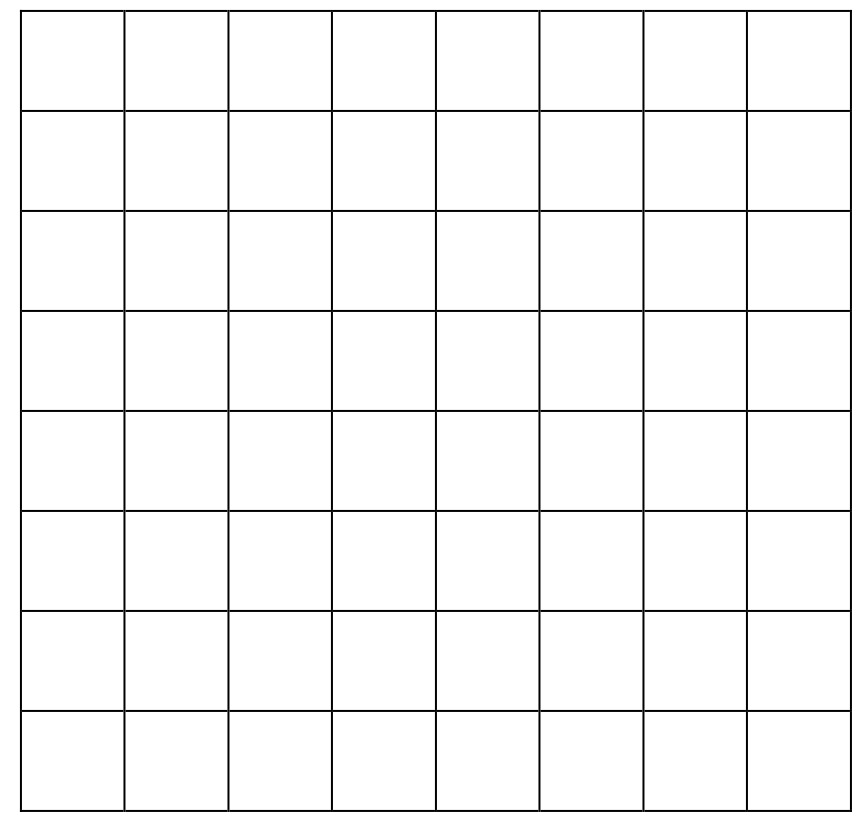
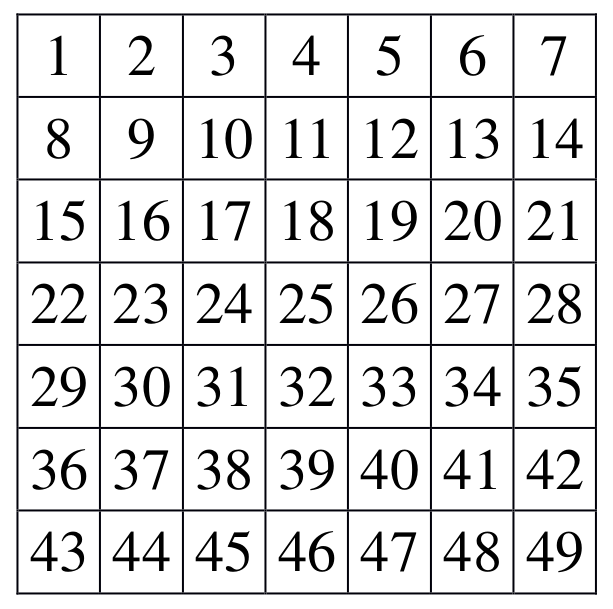
The unit squares of a $8\times8$ table are to be filled in with the integers from $1$ to $64$, using each exactly once. You can choose where to put the number $1$. Then the number $2$ must be in an adjacent square in the same row or the same column as the square containing the number $1$, the number $3$ must be adjacent to the number $2$, and so on. What is the maximum number of prime numbers you can get in the same row?