Eleven coconuts cost as much as fourteen pineapples; twenty-two mangoes as twenty-one pineapples; ten mangoes as three bananas; five oranges as two bananas. How many coconuts cost as much as thirteen oranges?
A girl computes $\frac{1+2}{3}+\frac{4+5}{6}+\cdots+\frac{2011+2012}{2013}$. A boy computes $1+\frac12+\frac13+\cdots+\frac1{671}$. Find the sum of their answers.
Tim and Kim alternately take hazelnuts, starting with Tim taking $5$, then each taking one more than the previous turn. If insufficient remain, take all. Tim finishes with $101$. How many hazelnuts were there initially?
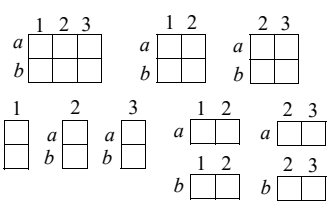
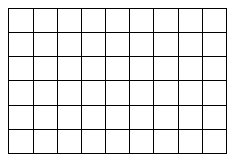
A $2\times3$ table has ten rectangles consisting of an even number of unit squares, as illustrated. How many such rectangles are in a $6\times9$ table?
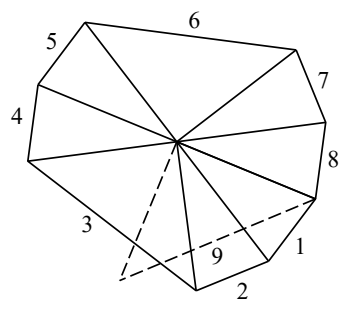
Congruent unit legs form isosceles triangles around a point. Triangle $n$ has central angle $90^\circ$ if $3$ divides $n$, otherwise $30^\circ$. Consecutive triangles share a leg in the forward sequence shown. Find the smallest $n\gt1$ for which triangle $n$ coincides with triangle one.
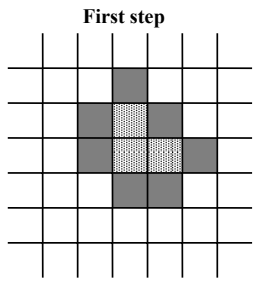
Three initial painted squares form the L shown on an infinite board. Each step paints every square sharing an edge with a painted square. How many squares are painted after $100$ steps?
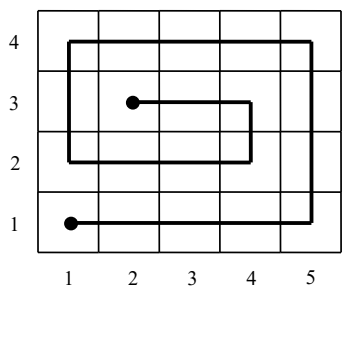
On a board with $2011$ rows and $4024$ columns numbered from bottom left, a snail starts at $(1,1)$ moving right. It turns left before leaving the board or revisiting a cell, making an inward spiral through every cell. Find the sum of the final row and column numbers. The shown $4\times5$ example ends at $(3,2)$.