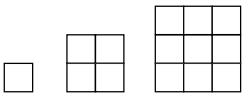
$a,b,c,d,e,f,g$ are seven consecutive positive integers in increasing order. Their sum is a perfect cube, and $c+d+e$ is a perfect square. Find the smallest possible $d$.
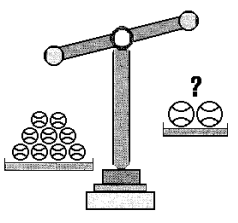
Each large ball weighs $1\frac13$ times a small ball. The original balance has nine small balls on the left and two large balls on the right. Add only small and/or large balls to the right, without removing any. What is the minimum number to add?
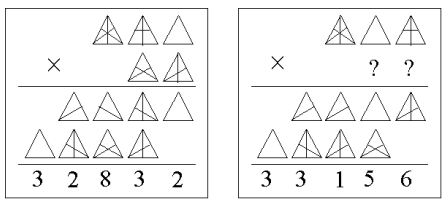
Different triangular symbols represent different digits $1$ to $9$, consistently in both multiplication examples. Find the two-digit number shown as “??”. The printed products are $32832$ and $33156$; the second multiplicand swaps the last two symbols of the first.
Positive integers $a,b$ satisfy $a+b=333$. How many fractions $a/b$ are less than $1$ and irreducible? Irreducible means numerator and denominator share no common factor greater than $1$.
Four friends descend a dusty staircase, stepping by $2,3,4,5$ steps respectively. Only the top and bottom have footprints of all four. How many steps have exactly one person’s footprint?
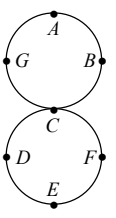
Two touching circles each have radius $2$ cm. An ant repeatedly follows the figure-eight path $ABCDEFCGA$ in this order. After walking $2005\pi$ cm, at which labelled point does it stop?
A basket and $16$ potatoes lie in a straight line $6$ m apart, with the basket at one end. Jose starts at the basket and brings potatoes to it one at a time, running at $3$ m/s. Find the shortest time.
A bicycle travels from X to Y and a car from Y to X at constant speeds, starting together. After they pass, the cyclist takes $25$ times as long as the car to finish. Find bicycle speed : car speed.
Ten whole numbers, possibly repeated, have the ten sums obtained by omitting one number: $82,83,84,85,87,89,90,91,92$, and a repeat of one of these. Find the sum of all ten numbers.
Obet initially has no money. Michael gives him $1/5$ of Michael’s money, Lucky $1/4$ of Lucky’s, and Nelson $1/3$ of Nelson’s. The three gifts are equal. What fraction of the group’s total money does Obet have afterwards?
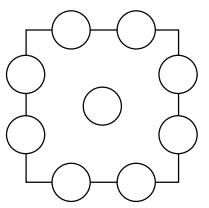
Place $1$ through $9$, one per circle, in the original pattern. Each side contains two outer circles and the four side sums are equal. How many different digits may occupy the central circle?