Put the numbers $1$ to $16$ on the vertices of two cubes, one number per vertex without repetition, so that the four vertices of every face have the same sum.
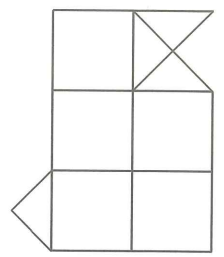
The figure below is a $2\times3$ rectangle with one quarter of its top-right square cut away and attached to its bottom-left square. Cut the figure along a polygonal line into two identical pieces.
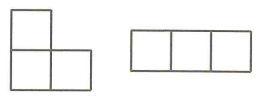
A $1\times1$ cell is removable if deleting it from an $8\times8$ square leaves a figure that can be tiled by $21$ copies of each of the two figures below. How many removable cells are there?
The four-digit number $3025$ is the square of the sum of the number formed by its first two digits and that formed by its last two digits: $(30+25)^2=3025$. Find all other four-digit numbers with this property.
The fraction $\frac14$ has this property: appending the digit $6$ to its numerator $n$ times and prefixing that digit to its denominator $n$ times gives $\frac{166\cdots6}{66\cdots64}=\frac14$ for all $n\ge1$. Its numerator and denominator are single digits, the denominator larger. Find all other such fractions; the repeated digit need not be $6$.
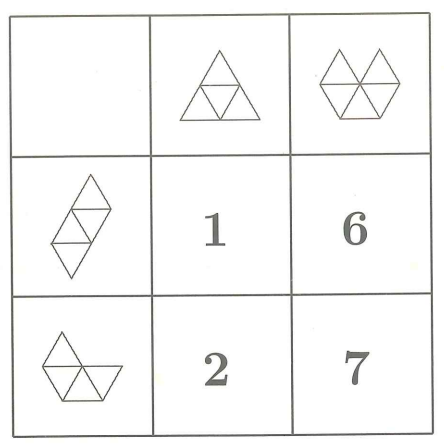
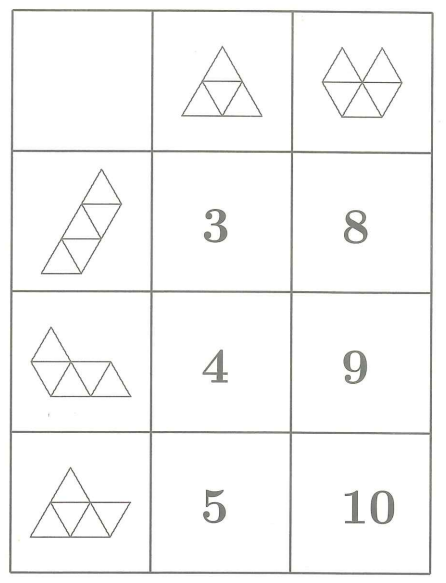
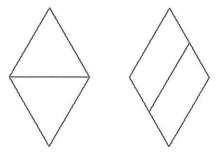
Seven shapes made from three or four equilateral triangles joined edge to edge are shown in the $2\times5$ chart below. For every numbered space, find a figure that can be formed both from copies of its row-header shape and from copies of its column-header shape. Pieces may be rotated or reflected. Space one is solved below as an example.