Question 36
Consider the following sequence of boards. The original organizer's diagram shows the 1-board, 2-board and 3-board, from left to right.
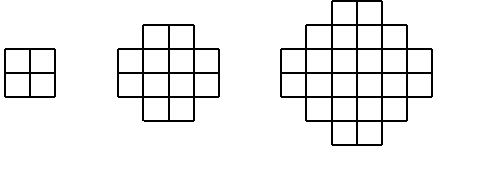
Each cell of a $k$-board contains a switch and a bulb. Initially all bulbs are off. Pressing a switch changes the state, from off to on or from on to off, only of the bulbs in neighbouring cells. Two cells are neighbours if they share a side. For each $k$, determine the largest number of bulbs that can be on after some switches are pressed.
Each cell of a $k$-board contains a switch and a bulb. Initially all bulbs are off. Pressing a switch changes the state, from off to on or from on to off, only of the bulbs in neighbouring cells. Two cells are neighbours if they share a side. For each $k$, determine the largest number of bulbs that can be on after some switches are pressed.