Question 16
Original source text (the exact panel preserves diagram labels, tables and choices):
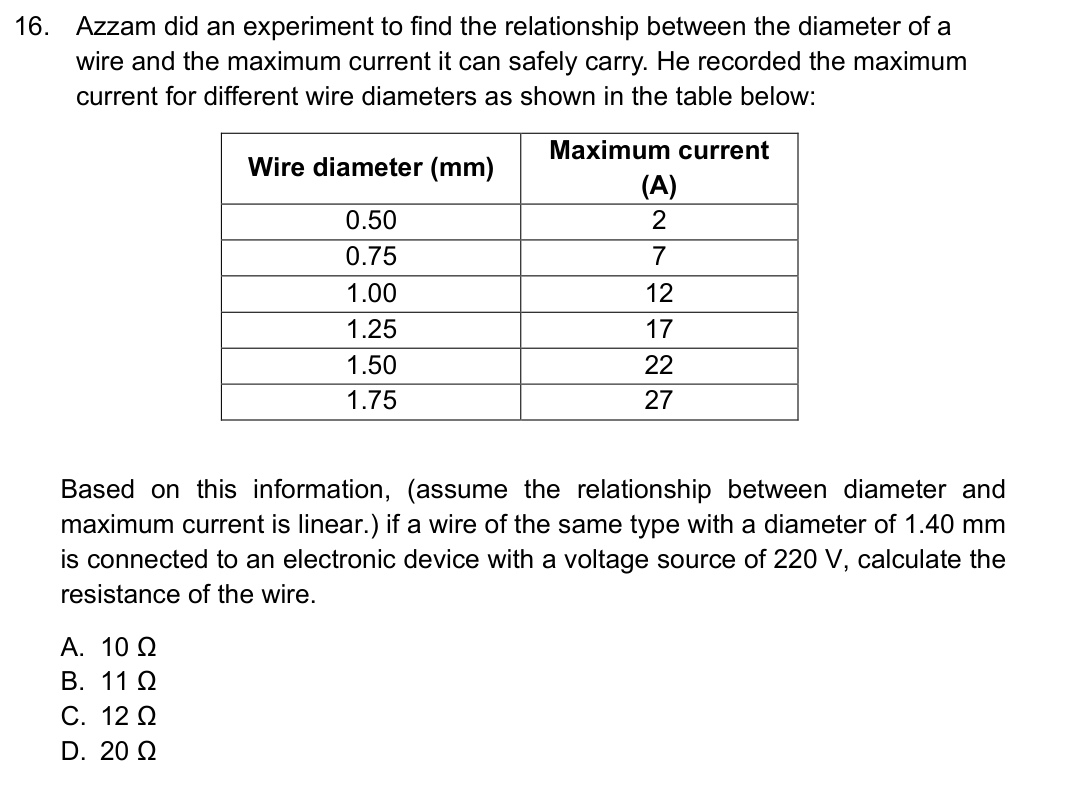
Azzam did an experiment to find the relationship between the diameter of a
wire and the maximum current it can safely carry. He recorded the maximum
current for different wire diameters as shown in the table below:
Maximum current
Wire diameter (mm)
(A)
0.50 2
0.75 7
1.00 12
1.25 17
1.50 22
1.75 27
Based on this information, (assume the relationship between diameter and
maximum current is linear.) if a wire of the same type with a diameter of 1.40 mm
is connected to an electronic device with a voltage source of 220 V, calculate the
resistance of the wire.
A. 10 Ω
B. 11 Ω
C. 12 Ω
D. 20 Ω
Azzam did an experiment to find the relationship between the diameter of a
wire and the maximum current it can safely carry. He recorded the maximum
current for different wire diameters as shown in the table below:
Maximum current
Wire diameter (mm)
(A)
0.50 2
0.75 7
1.00 12
1.25 17
1.50 22
1.75 27
Based on this information, (assume the relationship between diameter and
maximum current is linear.) if a wire of the same type with a diameter of 1.40 mm
is connected to an electronic device with a voltage source of 220 V, calculate the
resistance of the wire.
A. 10 Ω
B. 11 Ω
C. 12 Ω
D. 20 Ω