Question 1
Original source text (the exact panel preserves diagram labels, tables and choices):
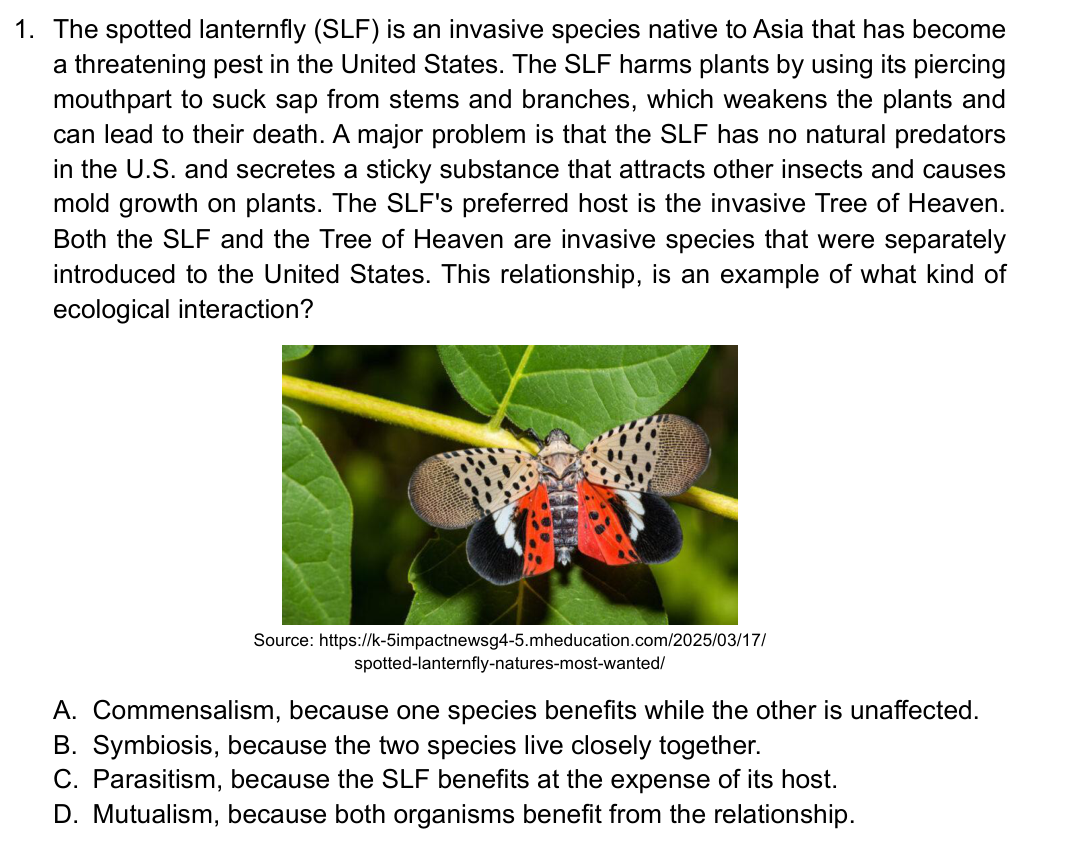
The spotted lanternfly (SLF) is an invasive species native to Asia that has become
a threatening pest in the United States. The SLF harms plants by using its piercing
mouthpart to suck sap from stems and branches, which weakens the plants and
can lead to their death. A major problem is that the SLF has no natural predators
in the U.S. and secretes a sticky substance that attracts other insects and causes
mold growth on plants. The SLF's preferred host is the invasive Tree of Heaven.
Both the SLF and the Tree of Heaven are invasive species that were separately
introduced to the United States. This relationship, is an example of what kind of
ecological interaction?
Source: https://k-5impactnewsg4-5.mheducation.com/2025/03/17/
spotted-lanternfly-natures-most-wanted/
A. Commensalism, because one species benefits while the other is unaffected.
B. Symbiosis, because the two species live closely together.
C. Parasitism, because the SLF benefits at the expense of its host.
D. Mutualism, because both organisms benefit from the relationship.
The spotted lanternfly (SLF) is an invasive species native to Asia that has become
a threatening pest in the United States. The SLF harms plants by using its piercing
mouthpart to suck sap from stems and branches, which weakens the plants and
can lead to their death. A major problem is that the SLF has no natural predators
in the U.S. and secretes a sticky substance that attracts other insects and causes
mold growth on plants. The SLF's preferred host is the invasive Tree of Heaven.
Both the SLF and the Tree of Heaven are invasive species that were separately
introduced to the United States. This relationship, is an example of what kind of
ecological interaction?
Source: https://k-5impactnewsg4-5.mheducation.com/2025/03/17/
spotted-lanternfly-natures-most-wanted/
A. Commensalism, because one species benefits while the other is unaffected.
B. Symbiosis, because the two species live closely together.
C. Parasitism, because the SLF benefits at the expense of its host.
D. Mutualism, because both organisms benefit from the relationship.