Question 3
A student placed Hydrilla leaves of equal length in different beakers, each containing different concentrations of starch solutions, for 15 minutes. Each beaker contained one Hydrilla leaf immersed in starch solution. Figure 3 shows the experimental setup.
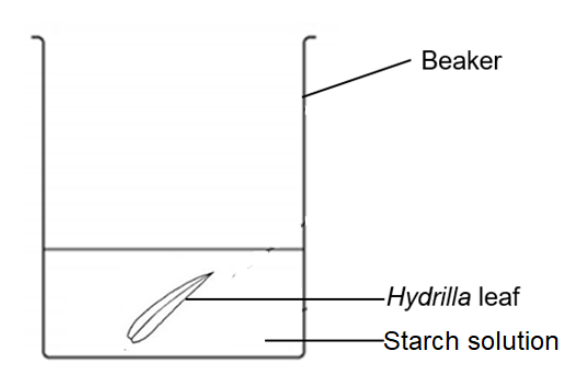
After 15 minutes, a drop of each liquid and the Hydrilla leaf were placed on a glass slide with a coverslip and examined under a light microscope. Table 3 shows the results.
| Type of liquid in each beaker with a Hydrilla leaf | Average length of protoplast (cells without the cell walls) in Hydrilla leaf cells (micrometre) |
|---|---|
|20% starch solution|150|
|50% starch solution|90|
After examining under the microscope, the leaves were placed in distilled water for 15 minutes and examined again. The average length of protoplast in the cells was 225 micrometres.
(a) With reference to Table 3, explain the results for Hydrilla leaf in 50% starch solution. [1.5 marks]
(b) With reference to Table 3, compare and explain the extent of the condition of cells immersed in 20% starch solution and those in 50% starch solution. [1.5 marks]
(c) Explain the results after the Hydrilla leaves were placed in distilled water. [1 mark]
(d) A can of tuna contains very concentrated salt solution. If bacteria cells happen to be present in the can, explain what will happen to the bacteria cells. [1 mark]