Question 1
IMSO 2022 · Indonesia · Science Experiment · 1 December 2022
2 experiments | 25 points | 150 minutes for the whole paper.
EXPERIMENT 1
The eruption of volcanoes and the formation of mountains are only two of the many wonders caused by plate tectonics. These brittle and rigid plates of massive proportions move independently because of the hot and soft solid rock layer beneath them. But, how exactly do they move, and what drives them?
Materials
- room temperature water
- hot water (about 70°C)
- towels for water spills
- food coloring in small containers
- basin or sink for used water
- plastic pan
- pipette or medicine dropper
- four foam cups
- one cup lid
- two sheets of white paper
Procedures
There are eight (8) videos that you can access through our examination portal. Two video clips for each Set-up: Top View and Side View. Download and view them chronologically (Setup A, Setup B, Setup C, and Setup D). Record your observations on the data tables provided.
Editorial availability notice: The supplied archive contains only three PDFs. This PDF has no hyperlinks, embedded video files or portal address. The eight required videos were not supplied or located in the source inventory. The diagrams below are blank observation templates, not video results. Obtain the original authorized videos before completing video-dependent observations; no substitute observations are provided.
Data Tables
Table 1.1 Draw your observation.
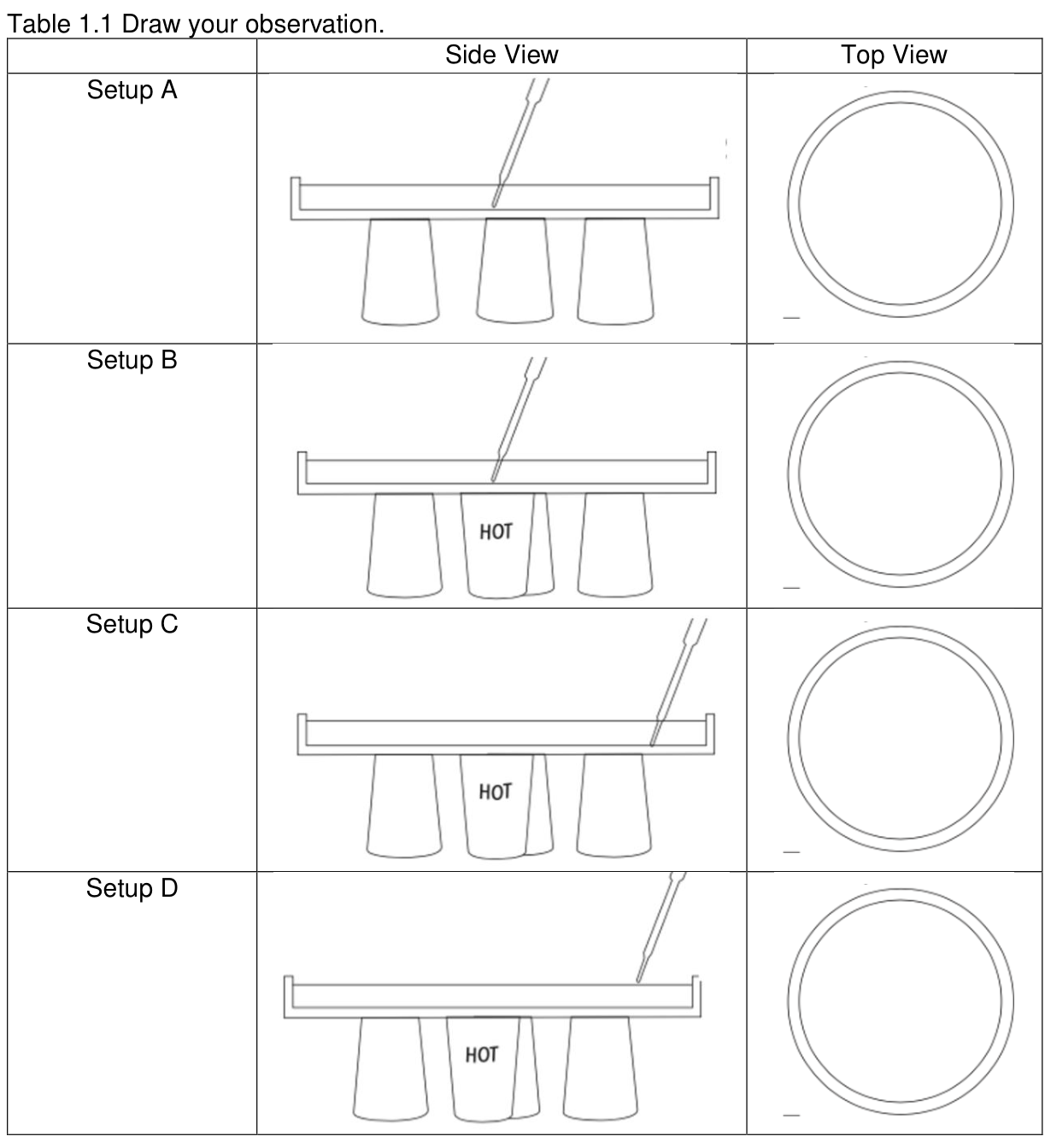
Figure labels: Side View; Top View; Setup A; Setup B; Setup C; Setup D; HOT = hot-water cup. Draw the dye movement you actually observe on each blank view.
Table 1.2 Describe your observation.
| Setup | Observations |
| --- | --- |
| A | ____________________ |
| B | ____________________ |
| C | ____________________ |
| D | ____________________ |
Questions
1\. Refer to Table 1.2, compare your observations from Setup A to the other setups. What effect does the heat source have on Setups B-D?
2\. Describe the location in the pan where: (a) the current flowed toward the heat source and (b) where did it flow away from the heat source.
3\. Describe where in the pan was the food coloring (a) flowing upward and (b) where was it flowing downward?
4\. This experiment models one of the mechanisms geologists think might drive plate tectonics. In this model, what does the water represent? What does the hot water in the cup represent?
5\. In this model, nothing represents plates. To include them, what could you add and where should they be placed?
6\. Assuming that this model accurately represents Earth, explain how plates are moved about on Earth’s surface. Why do land masses or continents move when their underlying plates move?
7\. The currents in the water normally cause the food coloring to move at a rate of 2–3 cm or more per minute. How does this compare to the rate estimated for tectonic plate motion?
2 experiments | 25 points | 150 minutes for the whole paper.
EXPERIMENT 1
The eruption of volcanoes and the formation of mountains are only two of the many wonders caused by plate tectonics. These brittle and rigid plates of massive proportions move independently because of the hot and soft solid rock layer beneath them. But, how exactly do they move, and what drives them?
Materials
- room temperature water
- hot water (about 70°C)
- towels for water spills
- food coloring in small containers
- basin or sink for used water
- plastic pan
- pipette or medicine dropper
- four foam cups
- one cup lid
- two sheets of white paper
Procedures
There are eight (8) videos that you can access through our examination portal. Two video clips for each Set-up: Top View and Side View. Download and view them chronologically (Setup A, Setup B, Setup C, and Setup D). Record your observations on the data tables provided.
Editorial availability notice: The supplied archive contains only three PDFs. This PDF has no hyperlinks, embedded video files or portal address. The eight required videos were not supplied or located in the source inventory. The diagrams below are blank observation templates, not video results. Obtain the original authorized videos before completing video-dependent observations; no substitute observations are provided.
Data Tables
Table 1.1 Draw your observation.
Figure labels: Side View; Top View; Setup A; Setup B; Setup C; Setup D; HOT = hot-water cup. Draw the dye movement you actually observe on each blank view.
Table 1.2 Describe your observation.
| Setup | Observations |
| --- | --- |
| A | ____________________ |
| B | ____________________ |
| C | ____________________ |
| D | ____________________ |
Questions
1\. Refer to Table 1.2, compare your observations from Setup A to the other setups. What effect does the heat source have on Setups B-D?
2\. Describe the location in the pan where: (a) the current flowed toward the heat source and (b) where did it flow away from the heat source.
3\. Describe where in the pan was the food coloring (a) flowing upward and (b) where was it flowing downward?
4\. This experiment models one of the mechanisms geologists think might drive plate tectonics. In this model, what does the water represent? What does the hot water in the cup represent?
5\. In this model, nothing represents plates. To include them, what could you add and where should they be placed?
6\. Assuming that this model accurately represents Earth, explain how plates are moved about on Earth’s surface. Why do land masses or continents move when their underlying plates move?
7\. The currents in the water normally cause the food coloring to move at a rate of 2–3 cm or more per minute. How does this compare to the rate estimated for tectonic plate motion?