Question 30
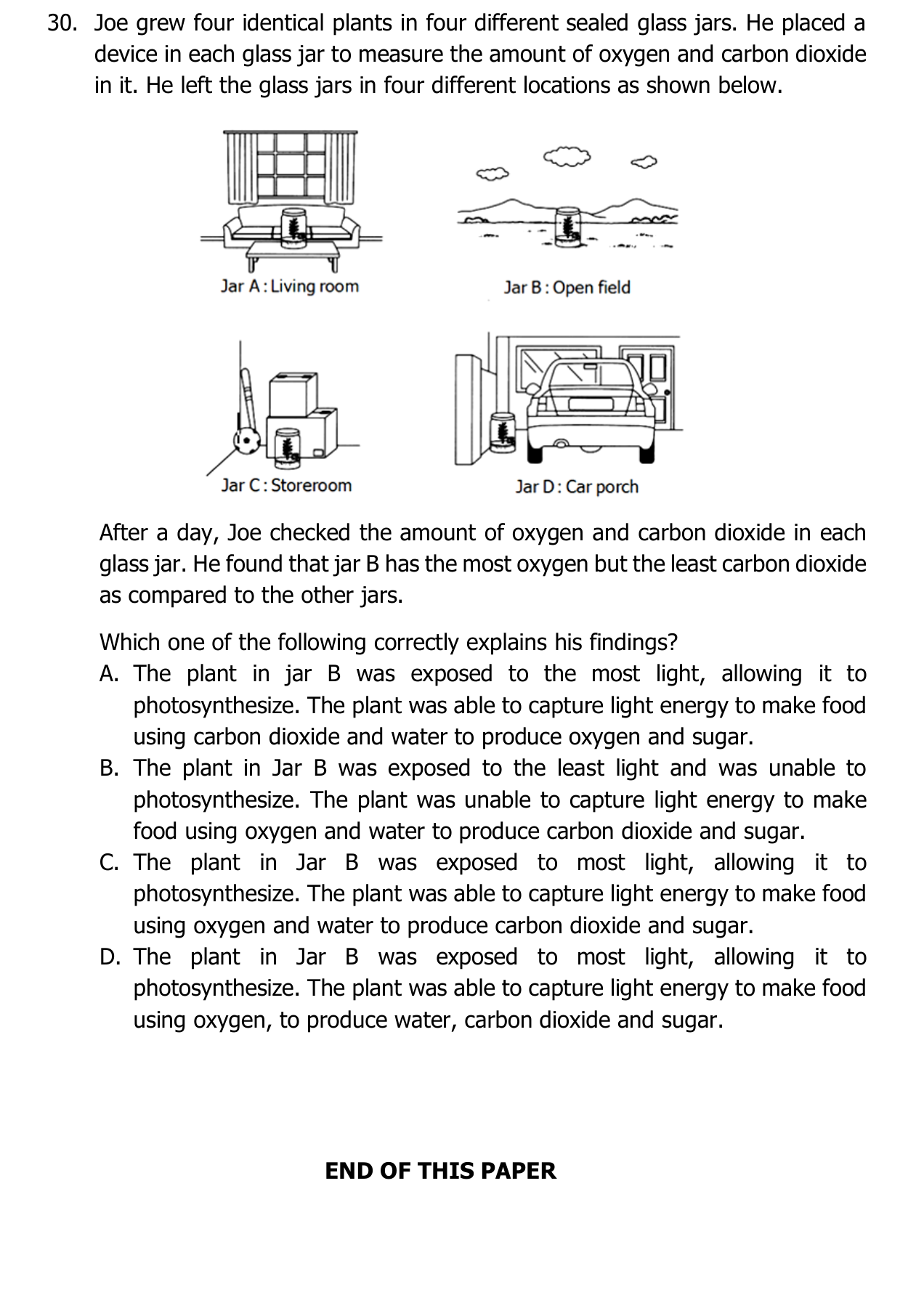
Joe grew four identical plants in four different sealed glass jars. He placed a
device in each glass jar to measure the amount of oxygen and carbon dioxide
in it. He left the glass jars in four different locations as shown below.
After a day, Joe checked the amount of oxygen and carbon dioxide in each
glass jar. He found that jar B has the most oxygen but the least carbon dioxide
as compared to the other jars.
Which one of the following correctly explains his findings?
A. The plant in jar B was exposed to the most light, allowing it to
photosynthesize. The plant was able to capture light energy to make food
using carbon dioxide and water to produce oxygen and sugar.
B. The plant in Jar B was exposed to the least light and was unable to
photosynthesize. The plant was unable to capture light energy to make
food using oxygen and water to produce carbon dioxide and sugar.
C. The plant in Jar B was exposed to most light, allowing it to
photosynthesize. The plant was able to capture light energy to make food
using oxygen and water to produce carbon dioxide and sugar.
D. The plant in Jar B was exposed to most light, allowing it to
photosynthesize. The plant was able to capture light energy to make food
using oxygen, to produce water, carbon dioxide and sugar.
device in each glass jar to measure the amount of oxygen and carbon dioxide
in it. He left the glass jars in four different locations as shown below.
After a day, Joe checked the amount of oxygen and carbon dioxide in each
glass jar. He found that jar B has the most oxygen but the least carbon dioxide
as compared to the other jars.
Which one of the following correctly explains his findings?
A. The plant in jar B was exposed to the most light, allowing it to
photosynthesize. The plant was able to capture light energy to make food
using carbon dioxide and water to produce oxygen and sugar.
B. The plant in Jar B was exposed to the least light and was unable to
photosynthesize. The plant was unable to capture light energy to make
food using oxygen and water to produce carbon dioxide and sugar.
C. The plant in Jar B was exposed to most light, allowing it to
photosynthesize. The plant was able to capture light energy to make food
using oxygen and water to produce carbon dioxide and sugar.
D. The plant in Jar B was exposed to most light, allowing it to
photosynthesize. The plant was able to capture light energy to make food
using oxygen, to produce water, carbon dioxide and sugar.